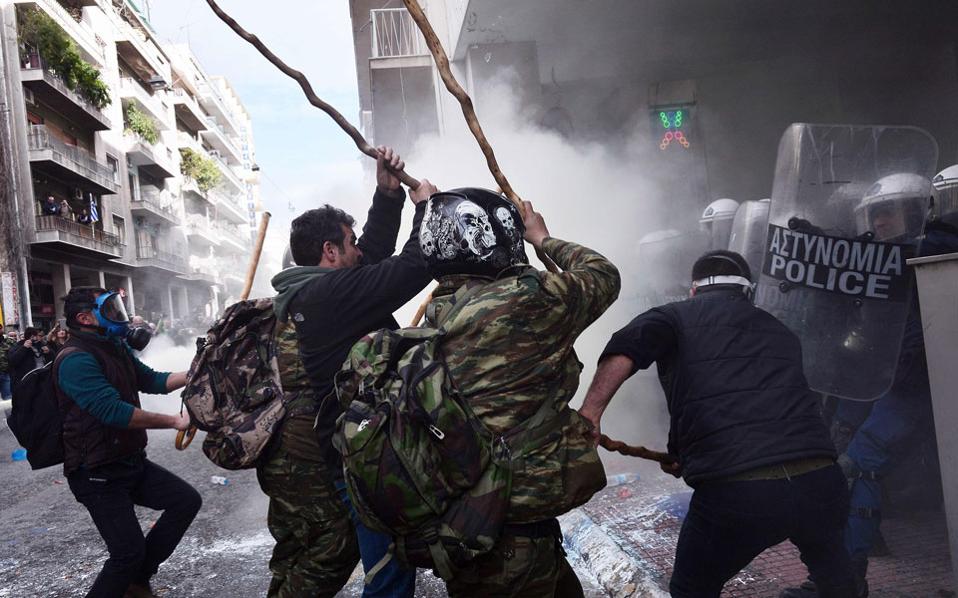
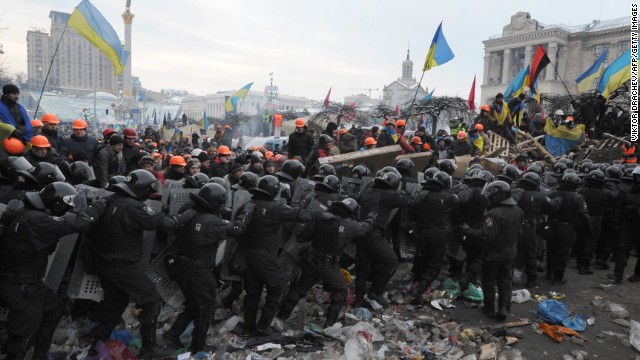
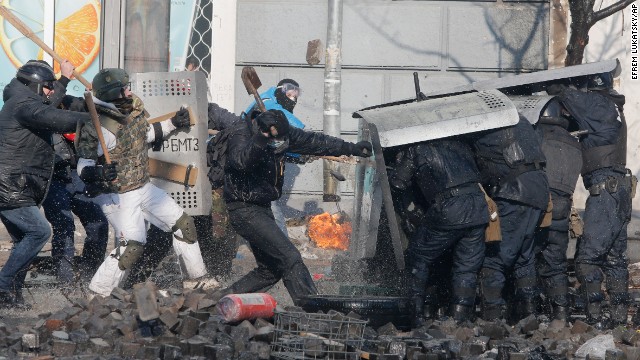
Some reference images:
I've never seen anyone claim these are an exact representation but is there anything to learn here about ancient battles?
Edit: What I'm mostly getting at is the images that are often conjured up of organized Greeks or Romans against "barbarian hordes" and how that doesn't really square with the fact that the Romans or Greeks often found these societies formidable. Or the idea of these clashes instantly dissolving into chaotic individual melee. Or ranks of men smashing into one another at a full sprint.
Can any lessons be gleaned whatever from modern confrontations without massive employment of firearms? Or is it just way too much a case of apples and oranges?
Edit: Thanks to everyone in the thread
Okay, so, a few deleted posts here that had some more or less good information. Hopefully, by providing a few sources, I'll manage to answer your question and not end up with my post deleted.
First off, before we judge whether or not riots can be compared to ancient and medieval warfare, we need to look at what the arguments actually are, undistorted by repetition on the internet.
One of the first examples of where a riot has influenced the opinion of a riot occurs in John Keegan's The Face of Battle, the "Infantry versus Infantry" portion of his account of Agincourt. In this section, Keegan compares the frightened charge of a police horse towards police lines during the Grosvenor Square demonstration in 1968 with the involuntary and uncontrolled flight of the French cavalry away from the English lines during the first stage of the battle^1.
Here, Keegan isn't comparing an entire infantry battle to a riot, but only a specific phase of it. He suggests that the way in which the demonstrators moved aside for the horse and the way in which ripples of force moved through the crowd demonstrate what it must have been like for the French men-at-arms charged by their own horsemen.
The only other source that I've been able to find that uses riots as an example is Philip Sabin's The Face of Roman Battle, although I know I've seen reference to other studies that have used riots in more detail. Sabin, again, doesn't use riots as a way of illuminating all ancient and medieval infantry combat, but only a single aspect of it. Sabin suggests that similarity is the stand off between rioters and police with both sides standing off and trading insults, and only a few individuals going out to do battle before retreating, followed by a final charge that causes one side or the other to give way^2.
As you can see, the two authors I've been able to find who have compared ancient and medieval fighting to riots, haven't actually compared the entire battle to a riot, but to aspects of it.
So, then, to what extent can a riot be compared with an ancient medieval battle?
Well, they can't be entirely compared, as mostly only one side is well armed and armored. For another, the numbers killed are very low and there isn't too great a desire on either side to kill the other (although exceptions exist ).
On the other hand, while there might not be fear of dying, there is certainly the fear of pain or injury. You can see the rioters who charged the police at the Grosvenor riots cringe back and retreat under the flurry of blows given out by the police here, and in this video we see quite heavily armed rioters constantly retreating in the face of a weak advance by South Korean riot police. The example of the Sanrizuka riots, in particular, are instructive, because even though the rioters are well armed, organised and have considerable motivation to break the police lines, they do not continuously press their attack, as those authors who reject the "pulse" theory of warfare suggest they should.
The other riots, though, are more indicative of the mode of warfare suggested by Sabin in The Face of Roman Battle and expanded on in The Mechanics of Battle in the Second Punic War^3. That is to say, long periods of stand off, and the exchange of missiles, followed by a few brief moments of fighting and then mutual withdrawal as the two sides exhausted themselves. Alexander Zhmodikov supports this position and adds that sometime the charge would cause the other side to break and run, noting that Livy records multiple instances of one side breaking and running at the first charge^4 . Infantry breaking at the first charge was noted by Colonel Ardant du Picq as common in the 19th century^5, and also by Keegan in The Face of Battle at Waterloo. Armour, not doubt, would have helped with morale^6, but at the same time morale, fear and discipline would have played roles as well.
TL:DR: Riots provide some insight into how fear can influence the course of a battle and how it is conducted, but the typically non-lethal nature of them does limit their usefulness.
^1 Keegan, John, The Face of Battle, p97, Penguin Books (1978)
^2 Sabin, Philip. “The Face of Roman Battle.” The Journal of Roman Studies, vol. 90, 2000, pp. 1–17. www.jstor.org/stable/300198.
^3 Sabin, Philip. “The Mechanics of Battle in the Second Punic War.” Bulletin of the Institute of Classical Studies. Supplement, no. 67, 1996, pp. 59–79. www.jstor.org/stable/43767903.
^4 Alexander Zhmodikov. “Roman Republican Heavy Infantrymen in Battle (IV-II Centuries B.C.).” Historia: Zeitschrift Für Alte Geschichte, vol. 49, no. 1, 2000, pp. 67–78. www.jstor.org/stable/4436566.
^5 du Piqc, Ardant, "Battle Studies: Ancient and Modern Battle", Part II, Chapter II, http://www.gutenberg.org/files/7294/7294-h/7294-h.htm
^6 Verbruggen, J.F. "The Art of Warfare in the Western Europe During the Middle Ages", p37-44 Boydell Press (1997); Strickland, Matthew, "The Great Warbow", p75, Sutton Publishing ltd (2005)
There are a lot of useful points in u/Hergrim's post, but they still don't mention the actual instances where this argument has cropped up in scholarship on ancient warfare. Specifically, the scholars that have used evidence from riots and riot police tactics to explain ancient battles are these:
A. Schwartz, Reinstating the Hoplite: Arms, Armour and Phalanx Fighting in Archaic and Classical Greece (2009), 162-200, used the testimony of the Copenhagen riot police to illuminate what it is like to fight in tight formation with large shields.
J.E. Lendon, Song of Wrath: The Peloponnesian War Begins (2010), 307-313, used videos of riots in South Korea and Japan in the 1970s and 1980s to show the mechanics of mass pushing in dense crowds.
P.M. Bardunias, 'Storm of spears and press of shields: the mechanics of hoplite battle', Ancient Warfare Special: Marathon (2011), 60-68, used videos of Russian football hooligans to show how battle may change from an exchange of blows to a mass shove, and how dense crowds of warriors respond to one another.
Notably none of these studies suggest that the carefully drilled formations and tactics of modern riot police have any bearing on those of the ancient Greeks. They shouldn't; one of the things that forcefully invalidates Schwartz' conclusions is that they rely on extensive training, which nothing suggests the Greeks received. Instead, they use modern riots as our closest proxy to the mechanics of massed infantry combat, where individual fighting may locally and temporarily dissolve into the collective movement of large groups, without necessarily resulting in people being trampled or crushed, as in a stampede. As such, this evidence is generally used to prove the reality of literal othismos (pushing) in hoplite battles.
There are various reasons why this may not be as compelling an argument as they would like, which are covered in u/Hergrim's post. The sheer bulk of hoplite equipment makes literal shoving rather difficult, and while of course the exponents of the literal model have nifty solutions for this (and Bardunias argues that the hoplite shield was specifically designed for this), such theories are no more than speculation. The lack of direct evidence for the mass shove, or for any descriptions of it in art or tragedy, is worrying - especially since the use of mass explicitly was considered a factor in the pike phalanx of the Hellenistic period.