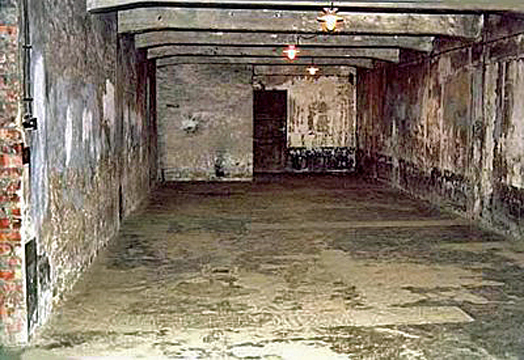
He's not a holocaust denier but believes the gas chamber might be built by the soviets. He supports this by saying how untrustworthy the soviets were in their accounts. He also claims the layout of the gas chamber, specifically how the doors and entries narrowness, are too inconvenient to carry all those bodies through. 2 million were gassed.
Here's a picture of the layout: https://www.scrapbookpages.com/AuschwitzScrapbook/2005Photos/GasChamberLayout.jpg
Here's a picture of the gas chamber: https://furtherglory.files.wordpress.com/2011/12/auchwitz1gaschamber.jpg
From an earlier answer of mine also check out this answer from /u/commiespaceinvader
The best answer to the charge that they were reconstructions is "so what, we know this already." Beneath the indignation of Holocaust denialism and an idiotic agenda being pushed, the general response among historians of the Holocaust to this larger question is something to the effect of "so what?" The death camps have not been kept in situ an it is not as if they have been preserved in amber for future generations. These were built structures that have a relationship to human beings; this did not stop after 1944/45. The camps themselves were largely temporary structures and not meant to last. Auschwitz, which in many respects was an atypical camp and had semi-permanent structures (mainly in Auschwitz-I), has been struggling in recent years with balancing the need to preserve the camp and its relics and still keeping it open to visitors. Furthermore, the camps themselves were not preserved by the Third Reich, which willfully destroyed much of the evidence of judeocide. Denialists love to point out that Auschwitz's gas chambers are a reconstruction -ergo fake- but this is no big state secret. Camp guide materials point this out and historians know this as well.
The more interesting angle to this is the interlinked questions of how and why these sites were preserved. The postwar Polish government, for example, sought to make Auschwitz a memorial of Polish suffering. Part of this instrumentalization involved an embellishment of the numbers of humans killed there, as well as sidelining non-Polish victims and Polish Jews in commemorations. This was of a piece with other commemorative and preservation practices within the Eastern bloc. A high body count proved fascist barbarity and the martyrdom of its victims. Like the Auschwitz gas chamber reconstructions, this is not a secret to historians. Historical accuracy often falls to the wayside with such a politicized environment, but this does not mean reconstructions were cut from new cloth either. The documentation, survivors' and perpetrators' accounts pretty much confirm that structures existed that were used for mass gassing. Additionally, the overall process of finding the right killing method was complicated and evolved after a period of trial and error. Experiments with the Zyklon-B pesticide as a killing agent took place concurrently with the use of carbon monoxide gas. The camps' extermination process was in a constant state of flux.
This poses a question for commemoration and reconstruction, because the issue of which period in the camps' history should be preserved is a thorny one. None of Auschwitz's purpose-built gas chambers ( this site has a good overview ) survived the war, but the Auschwitz State Museum's reconstructed one using surviving components and materials from the demolished chambers. The reconstructed chamber area in Crematoria I reflected an earlier part of the camp's history when that area was used for mass exterminations. Later, it became a storage area as other parts of the camp became more prominent in mass killing operations. Crematoria I serves as a placeholder of physical memory for all of these other sites; people were murdered at Crematoria I, but not all of Auschwitz's victims died there.
Denialists love to bring up the issue that the preservation of Holocaust sites represents something artificial, but much the same could be said of any heritage site. Preserving these areas is a complicated affair balancing very complicated rationales for preservation as well as making sure the public can experience these sites without damaging them. Not surprisingly, historical preservation is not a static process and methods of preservation acceptable for some generations can soon become outdated.
The central issue you seem to be asking pertains, quite clearly, to the "objections" raised by Holocaust deniers. The central point of contention being that the gas chambers at Auschwitz Birkenau appear to be poorly designed if their purpose was for mass extermination.
There is actually superficial merit to this objection, but only if one fails to consider the context of the creation of the camps and the objectives of the regime when the camp was first established. As Deborah Dwork and Robert Jan van Pelt note in the seminal work Auschwitz (1996, 2002), the camp was not designed for extermination but as a concentration camp designed to terrify local Poles. Soon it was developed into a (slave) labour camp designed to support an IG Farben Plant; it was only later that it became repurposed for industrialised slaughter. To give you an idea of the chronology, the first prisoners arrived in May 1940 -- more than a year before Hitler ordered Himmler to introduce the final 'final solution' (extermination) to the 'Jewish question', which was issued in the summer of 1941.
As a result, the development of the infrastructure of the camp(s) was already well underway before outright process of genocide began. Nevertheless, the camp was murderous in the extreme and a crematorium had been installed in the summer of 1940. Such was the demand to dispose of bodies that, by November 1941, the camp authorities were already urgently requesting a third incinerator.
The first gas chambers had arisen out of the T4 programme (the slaughter of the disabled) in 1940 and installed at Brandenburg. Mass shootings of Jews (and others, not least Gypsies) were also a key feature of the Eastern Front. The problem with this was that direct mass slaughter, as in pulling the trigger and slaughtering vast numbers of individuals personally, had a profoundly negative impact on SS personnel which resulted in significant problems with morale not limited to suicide, which required the development of new methods of mass murder. The Nazis also made use of mobile gas vans extensively during the invasion of the Soviet Union in 1941. However, these were not a long term "solution" to the "problem" the Nazis had set them selves.
Similarly, in September 1941 experimental gassings took place at Auschwitz. When increasingly large numbers of Jewish prisoners began to be sent to the camp in 1942 the Nazis converted two farm houses in to gas chambers (the infamous 'little red house' being one). However, the major "step forward" was the conversion of a mortuary into a crematorium and gas chamber.
This facility was Krematorium II (Krema II) and, as noted, was retrofitted. It was not designed with mass extermination on an industrial scale in mind. The gas-chamber was subterranean and the incinerators on the level above. This meant that an elevator had to be installed (and subsequently retrofitted to take a large volume of cadavers) to transport the bodies of the deceased from one level to the next to that their bodies could be destroyed. Sonderkommandos were assigned this grizzly duty.
It is this idiosyncratic layout of Krema II and III (which was built to the same specifications as Krema II) that often is seized upon by Holocaust deniers; if the plan all along was to slaughter millions why not build facilities which reflect that fact? Well, that question ignores the ad hoc industrialisation of the 'final solution' and the fact that later designs were indeed more efficient – the Nazis learned on the job.
I hope this helps.
A couple of good books:
Deborah Dwork and Robert Jan van Pelt, Auschwitz (New York: WW. Norton, 1996, 2002).
Robert Jan van Pelt, The Case for Auschwitz (Bloomington: Indiana University Press, 2002)
Hi! As this question pertains to basic, underlying facts of the Holocaust, I hope you can appreciate that it can be a fraught subject to deal with. While we want people to get the answers they are looking for, we also remain very conscious that threads of this nature can attract the very wrong kind of response. As such, this message is not intended to provide you with all of the answers, but simply to address some of the basic facts, as well as Holocaust Denial, and provide a short list of introductory reading. There is always more than can be said, but we hope this is a good starting point for you.
##What Was the Holocaust?
The Holocaust refers the genocidal deaths of 5-6 million European Jews carried out systematically by Nazi Germany as part of targeted policies of persecution and extermination during World War II. Some historians will also include the deaths of the Roma, Communists, Mentally Disabled, and other groups targeted by Nazi policies, which brings the total number of deaths to ~11 million. Debates about whether or not the Holocaust includes these deaths or not is a matter of definitions, but in no way a reflection on dispute that they occurred.
##But This Guy Says Otherwise!
Unfortunately, there is a small, but at times vocal, minority of persons who fall into the category of Holocaust Denial, attempting to minimize the deaths by orders of magnitude, impugn well proven facts, or even claim that the Holocaust is entirely a fabrication and never happened. Although they often self-style themselves as "Revisionists", they are not correctly described by the title. While revisionism is not inherently a dirty word, actual revision, to quote Michael Shermer, "entails refinement of detailed knowledge about events, rarely complete denial of the events themselves, and certainly not denial of the cumulation of events known as the Holocaust."
It is absolutely true that were you to read a book written in 1950 or so, you would find information which any decent scholar today might reject, and that is the result of good revisionism. But these changes, which even can be quite large, such as the reassessment of deaths at Auschwitz from ~4 million to ~1 million, are done within the bounds of respected, academic study, and reflect decades of work that builds upon the work of previous scholars, and certainly does not willfully disregard documented evidence and recollections. There are still plenty of questions within Holocaust Studies that are debated by scholars, and there may still be more out there for us to discover, and revise, but when it comes to the basic facts, there is simply no valid argument against them.
##So What Are the Basics?
Beginning with their rise to power in the 1930s, the Nazi Party, headed by Adolf Hitler, implemented a series of anti-Jewish policies within Germany, marginalizing Jews within society more and more, stripping them of their wealth, livelihoods, and their dignity. With the invasion of Poland in 1939, the number of Jews under Nazi control reached into the millions, and this number would again increase with the invasion of the Soviet Union in 1941. Shortly after the invasion of Poland, the Germans started to confine the Jewish population into squalid ghettos. After several plans on how to rid Europe of the Jews that all proved unfeasible, by the time of the invasion of the Soviet Union in 1941, ideological (Antisemitism) and pragmatic (Resources) considerations lead to mass-killings becoming the only viable option in the minds of the Nazi leadership. First only practiced in the USSR, it was influential groups such as the SS and the administration of the General Government that pushed to expand the killing operations to all of Europe and sometime at the end of 1941 met with Hitler’s approval.
The early killings were carried out foremost by the Einsatzgruppen, paramilitary groups organized under the aegis of the SS and tasked with carrying out the mass killings of Jews, Communists, and other 'undesirable elements' in the wake of the German military's advance. In what is often termed the 'Holocaust by Bullet', the Einsatzgruppen, with the assistance of the Wehrmacht, the SD, the Security Police, as well as local collaborators, would kill roughly two million persons, over half of them Jews. Most killings were carried out with mass shootings, but other methods such as gas vans - intended to spare the killers the trauma of shooting so many persons day after day - were utilized too.
By early 1942, the "Final Solution" to the so-called "Jewish Question" was essentially finalized at the Wannsee Conference under the direction of Reinhard Heydrich, where the plan to eliminate the Jewish population of Europe using a series of extermination camps set up in occupied Poland was presented and met with approval.
Construction of extermination camps had already begun the previous fall, and mass extermination, mostly as part of 'Operation Reinhard', had began operation by spring of 1942. Roughly 2 million persons, nearly all Jewish men, women, and children, were immediately gassed upon arrival at Bełżec, Sobibór, and Treblinka over the next two years, when these "Reinhard" camps were closed and razed. More victims would meet their fate in additional extermination camps such as Chełmno, but most infamously at Auschwitz-Birkenau, where slightly over 1 million persons, mostly Jews, died. Under the plan set forth at Wannsee, exterminations were hardly limited to the Jews of Poland, but rather Jews from all over Europe were rounded up and sent east by rail like cattle to the slaughter. Although the victims of the Reinhard Camps were originally buried, they would later be exhumed and cremated, and cremation of the victims was normal procedure at later camps such as Auschwitz.
##The Camps
There were two main types of camps run by Nazi Germany, which is sometimes a source of confusion. Concentration Camps were well known means of extrajudicial control implemented by the Nazis shortly after taking power, beginning with the construction of Dachau in 1933. Political opponents of all type, not just Jews, could find themselves imprisoned in these camps during the pre-war years, and while conditions were often brutal and squalid, and numerous deaths did occur from mistreatment, they were not usually a death sentence and the population fluctuated greatly. Although Concentration Camps were later made part of the 'Final Solution', their purpose was not as immediate extermination centers. Some were 'way stations', and others were work camps, where Germany intended to eke out every last bit of productivity from them through what was known as "extermination through labor". Jews and other undesirable elements, if deemed healthy enough to work, could find themselves spared for a time and "allowed" to toil away like slaves until their usefulness was at an end.
Although some Concentration Camps, such as Mauthausen, did include small gas chambers, mass gassing was not the primary purpose of the camp. Many camps, becoming extremely overcrowded, nevertheless resulted in the deaths of tens of thousands of inhabitants due to the outbreak of diseases such as typhus, or starvation, all of which the camp administrations did little to prevent. Bergen-Belsen, which was not a work camp but rather served as something of a way station for prisoners of the camp systems being moved about, is perhaps one of the most infamous of camps on this count, saw some 50,000 deaths caused by the conditions. Often located in the Reich, camps liberated by the Western forces were exclusively Concentration Camps, and many survivor testimonies come from these camps.
The Concentration Camps are contrasted with the Extermination Camps, which were purpose built for mass killing, with large gas chambers and later on, crematoria, but little or no facilities for inmates. Often they were disguised with false facades to lull the new arrivals into a false sense of security, even though rumors were of course rife for the fate that awaited the deportees. Almost all arrivals were killed upon arrival at these camps, and in many cases the number of survivors numbered in the single digits, such as at Bełżec, where only seven Jews, forced to assist in operation of the camp, were alive after the war.
Several camps, however, were 'Hybrids' of both types, the most famous being Auschwitz, which was a vast complex of subcamps. The infamous 'selection' of prisoners, conducted by SS doctors upon arrival, meant life or death, with those deemed unsuited for labor immediately gassed and the more healthy and robust given at least temporary reprieve. The death count at Auschwitz numbered around 1 million, but it is also the source of many survivor testimonies.
##How Do We Know?
Running through the evidence piece by piece would take more space than we have here, but suffice to say, there is a lot of evidence, and not just the (mountains of) survivor testimony. We have testimonies and writings from many who participated, as well German documentation of the programs. This site catalogs some of the evidence we have for mass extermination as it relates to Auschwitz. I'll close this out with a short list of excellent works that should help to introduce you to various aspects of Holocaust study.
##Further Reading