I know he was responsible for the Great Leap Forward and all that... but can someone summarize his achievements and failures? Thank you so much, you're doing God's work here.
Hi, is this a homework question? AskHistorians absolutely allows those, but it's good to know--it helps our users help you in the best way possible.
OK, let's look at this in reverse order from the way you asked it, since it's simpler to attempt to understand the Chinese view of Mao after we establish what all he did for/to China...
As a young intellectual working at Peiking University, Mao took up the cause of Marxism-Leninism and thereafter became one of the founders of the Communist Party of China in 1921, which would style itself closely on the Soviet model. This is all nice and everything, Mao playing war against the Guomindang (KMT) of Jiang Jieshi (Chiang Kaishek), and we get little incidents like the Autumn Harvest Uprising (秋收起義) and subsequent (extremely short-lived) Hunan Soviet... but things actually begin heating up for Mao in 1934 with...
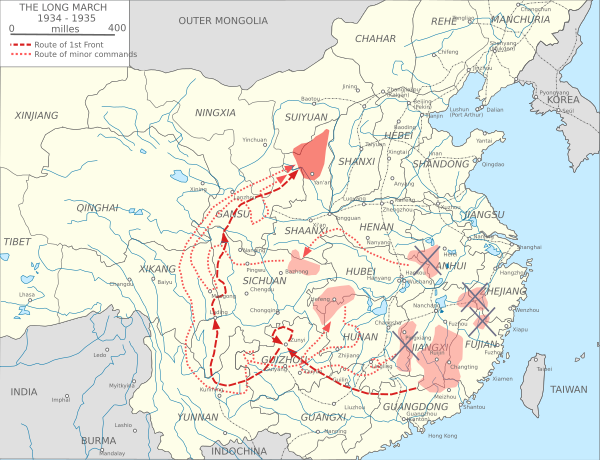
#The Long March
Operating out of the mountainous borderlands between Hunan and Jiangxi, the so-called Chinese Soviet Republic was utterly routed by the technologically and strategically superior KMT forces, and forced to, in essence, run away as far and as fast as they could. The series of - er'hem - long marches north-westward across the country would cover some 9,000 km and end only once the bedraggled remnants of the Communist Party reached Shaanxi in the far north. From then on, the north of China would be the CPC's center of power, while the KMT's capital and strength would remain in the south.
In a vacuum, Mao's story probably would have ended something like that... chased to the ends of the earth and ultimately captured or killed by the Nationalists. But we're going to have to put that on hold because look out!...
#Here Comes Japan
Sino-Japanese relations had been... somewhat tense since Japan had out-modernized Qing China with its own Meiji Restoration and then decided that it really needed an empire like any self-respecting 19th century world power ought to have. Thus, we get the First Sino-Japanese War (1894-1895), which saw the Qing massively defeated and forced to sign the enormously embarrassing Treaty of Shimonoseki, which formally surrendered Korea, Formosa, Liaodong, and the Pescadores to "full independence" (read: Japanese domination), as well as forcing open ports cities to Japanese trade, and making China pay an enormous war indemnity. Good times.
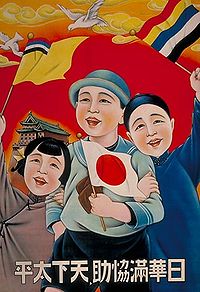
OK, yeah, now Japan's back, it's more militarized and imperial than ever, and the rest of China is looking like a great addition to the Super Fun Happy Time Club Greater East Asian Co-Prosperity Sphere. Long story slightly less long: Japan re-re-invades China (and a whole bunch of other places), and both the KMT and the CPC agree that to put their beef on hold because “no one can punch my brother except me.” Jiang would conduct a – to put it mildly – rather ineffective traditional military defensive in the south, while Mao and the CPC would “pull a George Washington” – that is, they’d go guerrilla, rigorously avoid a direct stand-up battle with a monumentally more powerful force, and wait for an outside power to intervene while winning over the hearts and minds of the populace. 7-ish years and 2 atomic bombs later, Japan went home. Mao had established himself as not just a fearsome defender of Chinese sovereignty, but also a political and military force to reckoned with, as well as the de facto ruler of northern China. OK, so that’s over with so let’s get into…
#Round 2: Little Brother Hits Back
With the end of the war came the faltering of the “frenemy” relationship between the KMT and the CPC. Hostilities re-erupted and –much to everyone’s surprise – the technologically and strategically superior military might of the Nationalists found themselves literally driven into the sea… and then across the sea over to Formosa AKA Taiwan. This included a lovely little five-month siege of the city of Changchun in 1948 that is estimated to have starved to death about 160,000 civilians, or roughly the number of casualties resulting from the atomic bombing of Hiroshima. Surprise, it’s Oct. 1, 1949 and it’s time to proclaim the People’s Republic of China! Now Mao’s a national leader, not just filthy rebel scum.
One year later, Mao would send wish good luck to some 250,000 completely volunteer, definitely not just PLA under orders in a slightly different uniform soldiers into Korea to defend both its own territorial sovereignty as well as aid sister cult of personality, the Democratic Republic of Korea. By the end of the definitely not a war, the world got two Koreas for the price of one… all the best deals come from China.
#Then he got an idea. An awful idea. Mao Zedong had a wonderful awful idea!
In 1958 as part of his latest and greatest Five Year Plan, Mao instituted the Great Leap Forward – an alternative to the Soviet model of growth that Mao was feeling increasingly uncomfortable with. If China was going to be based on a cult of personality, it was going to be his cult, damnit, not Stalin’s! Thus, small farms were merged together in People’s Communes, while huge numbers of the peasantry were ordered to begin work on projects like constructing dams, making steel, and melting down their farming tools into iron ore. Not engineers or metalsmiths, mind you, just illiterate farmers trying out this whole “dam an entire river” thing for the first time… since, after all, the vast majority of people with relevant educations had long ago emigrated or been purged. Contrary to popular opinion, it wasn’t the farmer melting down their tools or the like that would result in what was to follow, but rather total mismanagement and false reports from political subordinates too afraid of pissing Mr. Supreme Leader off to actually tell him that – oh, by the way the peasants are starving to death. The resultant Great Chinese Famine killed somewhere between 18 and 55 million people, and resulted in the first of the only two times in the Mao’s life that the whole Chinese population and economy actually shrank.
#BFFs no more
Sino-Soviet relations had grown increasingly strained as Mao wished to pursue his own ideological vision un-moored from the USSR’s Politburo. That would result in a formal split in their relationship in 1960 under Khrushchev’s chairmanship, and was according to Lorenz Lüthi:
one of the key events of the Cold War, equal in importance to the construction of the Berlin Wall, the Cuban Missile Crisis, the Second Vietnam War, and Sino-American rapprochement. The split helped to determine the framework of the Second Cold War in general, and influenced the course of the Second Vietnam War in particular.
This would fracture the Communist bloc into competing camps, and also pave the way for the thawing of Sino-American relations – i.e. when Nixon went to China in 1971.
#The Revolution Is Eternal
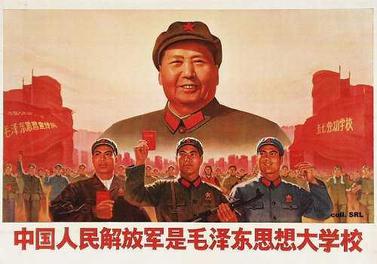
By the 1970s, a sizeable portion of Mao’s flunkies and lackies were more and more of a mind that the old geezer had had his fifteen minutes in the spotlight, and it was time for him to bow out. Mao disagreed rather strongly and so launched the Great Proletariat Cultural Revolution to make sure that his cult socialist ideals would never be subverted by traitorous elements. Quite a few people had very bad days… to the point that even the CPC had to admit in 1981 (once Mao was safely a mummy behind bulletproof glass) that the Cultural Revolution had been “responsible for the most severe setback and the heaviest losses suffered by the Party, the country, and the people since the founding of the People's Republic.” Yeah, that included the GLF… Fewer people were killed, true – perhaps “only” ~2 million – but part of the CultRev was the wholesale destruction/deconstruction of the “Four Olds” - Old Customs, Old Culture, Old Habits, and Old Ideas – which is to say virtually the whole of the nation’s 5k year history, including the Red Guard desecrating and destroying the tombs of ancient Chinese emperors,as well as up to 100 million facing persecution and privation.
#End of the Eternal Revolution
By 1969, the CultRev had ceased to be useful to Mao, and so the unending revolution… was ended. Yeah, bit awkward, that. It wasn’t a total loss, though, since it was during this time that the PRC conducted its first nuclear bomb test and launched its first satellite. So it had that going for it, which is nice.
Anyways, Mao would manage to cling desperately to power, even as his body and mind deteriorated under either ALS or Parkinson’s, along with the “Gang of Four,” led by his fourth and last wife Jiang Qing AKA Lady Mao. He’d succumb in July, 1976 to a series of massive heart attacks.
Final Score: 49-80 million death
**NEW TOP SCORE!
please enter your initials:
MAO_ - 80,000,000
JOE – 60,000,000
HIT – 30,000,000
LEO – 15,000,000
TOJ – 5,000,000
Good Game.
Concluded in Pt. 2...