After reading Zinn's 'People's history...' and whilst watching a programme about Mexican indignation at the Trump wall plan, I was wondering why Mexicans are disadvantaged, and indeed seen as such. The Mexicans are surely descended from the conquistadors, who enriched themselves through exploitation of Mesoamerica and the quashing of native civilisations. What exactly differentiates this from the post-revisionist bogeymen of the British Empire and Anglo Saxon civilisation?
TLDR; Mexico was not set up by settlers replacing the indigenous people, but by conquistadores who replaced the nobility and set up what was effectively a feudal economy and system of government. The Mexican War for Independence did not stem from or result in a popular commitment to classical liberal values, and the 19th century history of Mexico was a century-long struggle between secular liberals and conservative monarchists. The lack of stability caused by frequent wars was exacerbated by the massive loss of land and wealth following the Mexican-American War contrasts with the relative peace and domestic tranquility in the United States. Following the final defeat of the monarchists after the Second Mexican Empire (circa 1867), the commitment to democracy was weak and the economy was still dominated by a land-owning aristocracy. After the Mexican Revolution from 1910-20, land was redistributed and a Mexican “mestizo” identity supplanted the distinction between White Hispanics and Indians, but 1/8th of Mexicans had died in the war. A single party took over the nominal democracy, and Mexico was ruled by an oligarchic government which only managed to modernize slowly and did little to develop a strong middle class. The adoption of NAFTA increased the rate of industrialization, but also hurt Mexican famers who could not compete with government subsidized agriculture from America. Moreover, the profits from new factories were ultimately repatriated to owners in the United States, so Mexico’s Gross National Income did not grow commensurately with the increase in Gross National Product.
Over five centuries, quite a lot differentiates Mexico's many set-backs with America’s many successes. When Mexico began its War for Independence, the colony of New Spain (From modern New Mexico to Costa Rica) was already older than the United State of America is today. The conquistadors arrived in Mexico a century before the founding of Jamestown. They set up an essentially feudal state where white Hispanics filled the position of lords and Indians made up the peasantry. Most Mexicans are descended from the Conquistadors the same way African-Americans are descended from slave owners. Political correctness notwithstanding, the difference between descendants of one group of Mexicans and another is pretty vast insofar as their historical experiences were concerned.
The Spanish were conquerors first and settlers second. Rather than setting up a modern free market economy, they recreated the economic conditions of feudal Spain. With the Aztecs, the Conquistadors discovered a hierarchal society with lords and nobles ruling over a farming peasantry. The natives were familiar with taxes and tribute. The early conquistadors replaced the existing Indian aristocracy and set up a system of encomiendas, in which a Spaniard effectively became the lord of some land and a group of Indian families. These lords were often absent from their estates, preferring to live off the profits in Mexico City.
This history of White Hispanics dominating Natives and Mestizos continued for centuries, not unlike Anglo domination in North America. However, the Roman Catholic Church always recognized interracial marriages and there was never a one drop rule separating the races by law. Spanish aristocrats monopolized arable land, and the basis of free yeoman farmers that underlay Jefforson's vision of America never existed in Mexico. Over the centuries, encomiendas were replaced by debt peonage, which was a form of multigenerational debt slavery that operated through inheritance laws in which you inherited your father's debts with interest. While this was not chattel slavery, it did result in multiple generations being unable to profit from their own labor and being bound to the land by a form of indenture.
One factor that is underemphasized in summaries of world history is the link between the Napoleonic Wars and the Latin American Wars for Independence. Napoleon Bonaparte conquered Spain and deposed King Ferdinand VII circa 1808, appointing his brother Joseph Bonaparte to be King of Spain in 1808. The Spanish colonies did not uniformly accept Joseph Bonaparte, some remaining loyal to Madrid and others remaining loyal to King Ferdinand. Meanwhile, the British enjoyed total naval superiority because other European powers were investing in land armies to fight Napoleon. France could not send reinforcements to Haiti, and Spain could not send them to the Americas. Napoleon sold Louisiana in large part because he had no way to overcome the strategic dominance of the Royal Navy in the Atlantic. Under these circumstances, Mexico began its War for Independence.
Miguel Hidalgo was a Mexican priest who wanted to start a revolution for an Independent Mexico. Many Criollos (natives of Mexico) wanted equal rights to the “Peninsulares,” the royal officials from Spain who held the highest offices. As a rule, government officials had to come from Spain and live in Mexico for only a set number of years. So Hidalgo and the Criollos set about fermenting a popular movement among the peasants which spiraled out of control and turned into a bit of a race war. A lot of white Criollos realized that the peasants resented their wealth and white skin more than the Spaniard’s lisp. Many Criollos switched sides, and in the end the conservative, monarchist forces put down the revolution, reestablishing the basically feudal social structure.
Miguel Hidalgo - the Mexican George Washington - ended up with his head on a spike. Shortly thereafter, a liberal constitution was adopted in Spain, to which the Mexican conservatives did not approve. The war picked back up, and the conservative monarchists gained independence from Spain (not the liberals), creating the Empire of Mexico and appointing Iturbide as their Emperor.
Of note to your question, this result was the opposite cultural result of America’s Revolution, wherein classical liberal ideas such as freedom of religion and sovereignty of the people replaced state religion and the divine right of kings. The final face of Mexican Independence was even more conservative and absolutist than the contemporary Spanish monarchy of the 1820’s. The First Mexican Empire quickly fell apart, however, ushering in an era of uncertain commitment to democracy and federalism.
Central America broke away and balkanized, and Mexico changed its form of government repeatedly. Politics was divided between classical liberals who valued freedom of religion, federalism, and democracy, and ultra conservatives who favored a monarchy and state religion. Compare this to the U.S. after the Revolutionary War, where there was a universal commitment to secular government, democracy, and a government of limited powers.
Then the Mexican-American War happened between 1845-48. Mexico lost a third of its land and a frontier which potentially could have eased the pressure of overpopulation. Its humiliated government could not hold things together to prevent another civil war. After Mexico lost California and Nevada, the world’s largest deposits of gold and silver were discovered there. Great timing for the U.S., bad timing for Mexico.
You are making some assumptions that are leading you to incorrect (or at least inaccurate) conclusions.
Why isn't Mexico seen as a country built on colonisation and oppression like the US or Australia?
You are assuming that the Spanish colonisation worked exactly the same way as the English (later British) colonisation in North America: it didn't. The British colonies in North America were based on re-settlement; European colonists would arrive and displace the native populations (already gravely affected by disease and violent confrontation with the Europeans). The indigenous people would either die or be pushed westwards, and it white-native mixing was not commonplace.
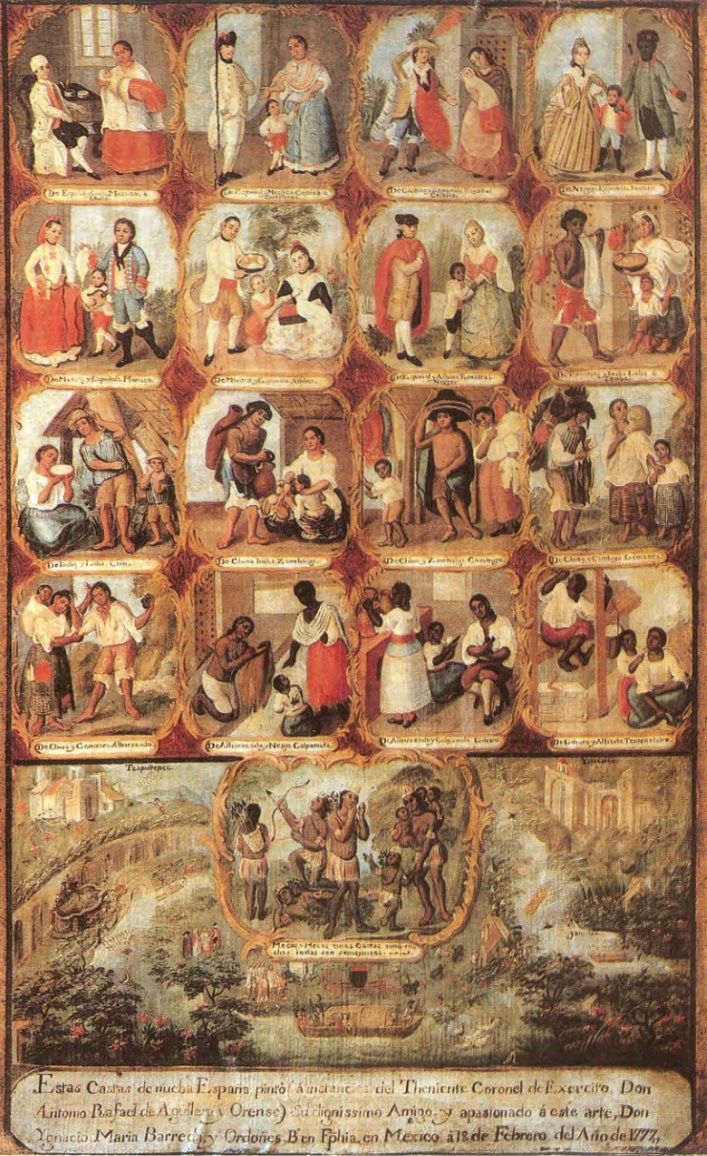
This did not occur in the Spanish colonies, which basically tried to recreate the Spanish feudal society in the Americas. The natives were seen as "conquered" people and subjects of the Spanish crown, and while they are all subject of violence, slavery and torture, it was not uncommon for Spanish people to marry and have recognised families with the natives. So, instead of having a process of replacement (white people replacing the natives), there was a process of mixing, known in Spanish as mestizaje. This mestizaje was so prevalent that the Crown established a complex racial categorisation system, known as casta.
The Mexicans are surely descended from the conquistadors
They aren't, not entirely anyway. Modern Mexicans, just like most Latin Americans, are mestizos, which means that they descend from the mestizaje (mixing) that took place during colonial times and continued after independence. Unlike what happened in the US or Australia, Mexican indigenous people (Nahuatl, and many others) were not completely replaced, but rather they mixed with the European colonists. After the independence of Mexico, the ruling positions were held by criollos, which were white people of direct European ancestry. They held, and in many cases still hold, the economic and political power. This is also the case in most Latin American societies and it is a remnant of the Spanish colonial cast system.
However, most Mexicans, and especially those of middle and low classes, are mestizos. The majorit of those that end up migrating to the United States are mestizo as well.
who enriched themselves through exploitation of Mesoamerica and the quashing of native civilisations.
No, it was Spain who enriched itself with the exploitation of the pre-Hispanic cultures and with the plunder of economic resources. Spain established an extractive system; most of the economic resources were extracted by local people in the colonies (generally indigenous and mestizo people) and then taken to Europe. A good example to illustrate this, is the city of Potosí, in Bolivia. During the Spanish rule, Potosí was one of the main producers of silver in the world, with a population close to that of Paris. However, the silver extracted was not then used or invested in the Bolivian colonial population, but rather it was all taken to Spain (who used it to pay for expensive war campaigns in Europe). Nowadays Potosí is a small city and the poorest in Bolivia, which is the poorest country in South America, despite all the silver that it once had.
So as to
Why isn't Mexico rich?
It is a problem common to most Latin American countries. After independence, the political and economic power was in the hands of the criollos, the descendants of the European settlers and usually a minority within a larger mestizo and indigenous population. The indigenous population in most cases did not see their condition improved with the independence and continued to live in a situation of poverty and exploitation. The mestizos fared somewhat better. Since then it has been a continuous of political instability and corruption, but that has little to do with the colonial times that we have discussed here.