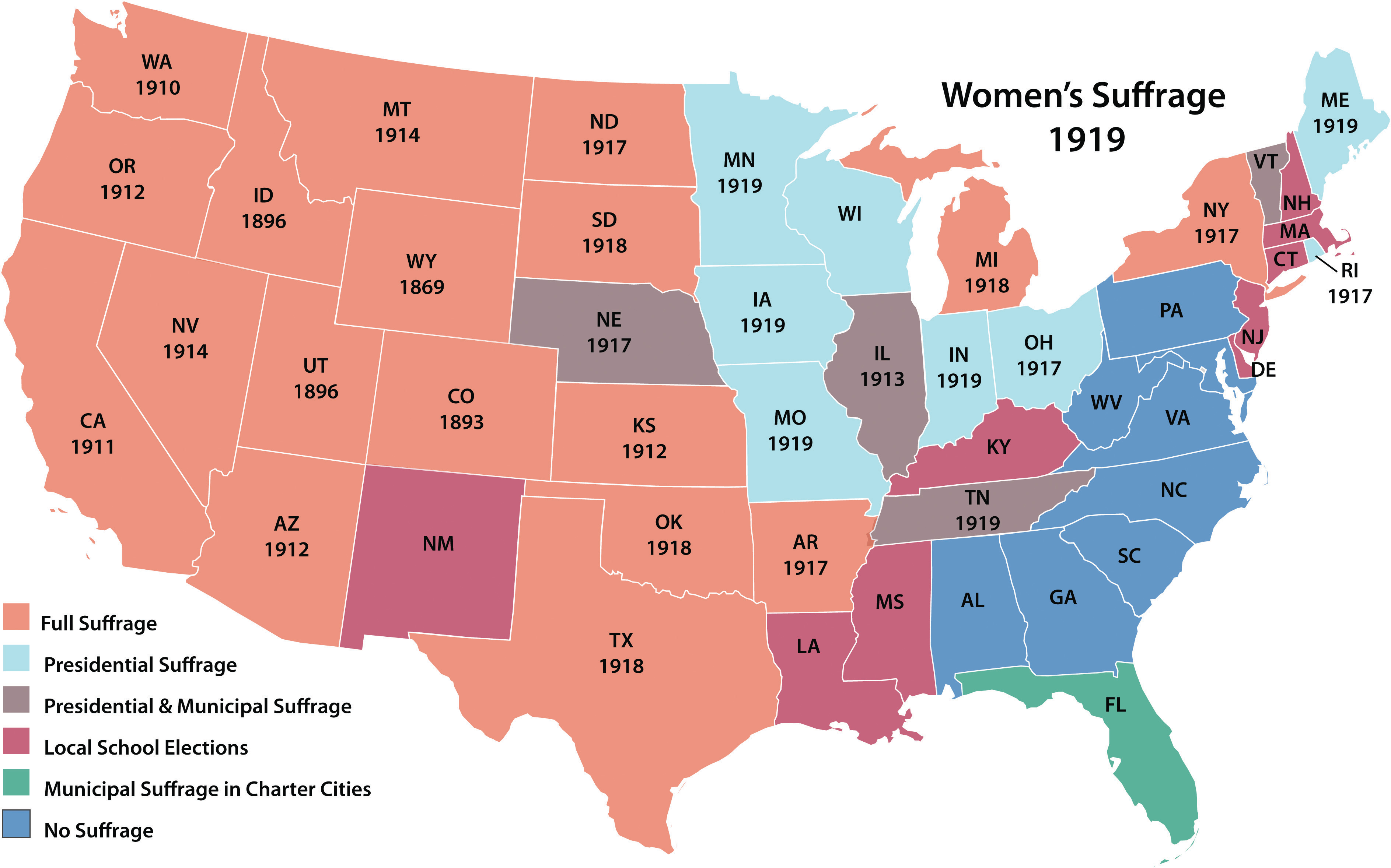
Here's a map showing when women in each state won the right to vote before the 19th amendment was ratified: http://images.flatworldknowledge.com/trowbridge2_1.0/trowbridge2_1.0-fig05_031.jpg Given that the northeast was the cradle of the feminist movement in the U.S. (with the Seneca Falls convention taking place in New York), why did the western states allow women to vote before the eastern ones?
This is a deeply unsettled question in historiography. To a significant extent, that's because it gets at one of the deepest theoretical questions that historians have to confront, even if subconsciously: how far down does the need to consider specific contexts extend--at what level is something a connected pattern rather than coincidence? How much weight do we give local factors versus broader trends?
There are a lot of explanations that focus on individual areas. Proponents of women's suffrage had less of a burden in territories than in states, is one of the most common arguments--except that Western states, too, were mostly ahead of Eastern states. Every investigation on suffrage in the west has to at least name-check the apparent importance of Mormonism in Utah's extension of suffrage. Rebecca Mead demonstrates the importance of alliances between suffragists and other reformers in many Western states (and I'm going to come back to her argument), but her analysis mostly ignores the places where state-level suffrage efforts failed (NM, ND, NE).
Then there are the sweeping narratives that focus on systemic factors. The most popular of these are the variations on the "Mars needs women" theory--essentially, drawing on the real (but rapidly declining over the 1869-1920 period) gender population imbalance, that Western men thought women's suffrage would attract more women to their areas. The biggest problem with this theory on a broad scale is that U.S. state laws on (married) women's property rights were actually more woman-friendly in eastern states. So we clearly aren't talking about the creation of some proto-Herland out west.
That's not to dismiss any of those as factors--but are they sufficient in and of themselves to explain a broader phenomenon? Is that where we stop?
The past 20 or so years have witnessed two important developments in historiography that seem to be getting closer to a comprehensive understanding, even if we're maybe not all the way there yet. (Caveat: unless something has been published since the last time I went at this scholarship.) The picture I'm going to paint is tentative, regional, multifaceted.
The first angle grows out of that paradox over extension of property rights versus extension of suffrage. There is substantial scholarship, coming from multiple angles, that shows economic interests in extending suffrage were stronger in the west; economic interests against suffrage were stronger in the east.
The most popular evidence here--which I'm pretty sure has even been raised as a universal explanation at times--is the powerful alcohol lobby in the east. With such strong ties between temperance movements and women's suffrage, these corporations, and crucially the large immigrant communities out of which their founders often came, had a vested interest in keeping "issue voters" out of the voting pool. This argument is typically extended to general Progressive goals: manufacturing corporations, especially prominent in Eastern and some Midwestern cities, saw women as a collective force who would support laws regulating or banning child labor in particular. The dominance of urban business interests in Eastern political affairs is attractive because it helps explain the better property rights situation as well as the suffrage obstacle in the East.
The biggest problem with a strictly urban explanation is the much less industrialized South, which also lagged far behind the West in the extension of (white) women's suffrage (being, in this era, in full post-Reconstruction swing of revoking black men's franchise). Susan Marshall's study of anti suffrage movements, though, shows how the more rural Southern situation different from the rural Western one. She points out that women anti-suffrage activists in the South came almost exclusively from the uppermost classes. These women actually stood to lose some of their indirect power if suffrage were extended to all (white) women, thanks to the dominance of their husbands and fathers in regional politics. In addition to being more numerous and organized than anti-suffrage women activists elsewhere, they were better funded and generally better educated.
Marshall's study (late 90s) was really important in another respect that is going to sound silly, but hear me out: she paid attention to the particulars of a regional movement. The "puzzle" of women's suffrage being more advanced in the West, to scholars, had long been the idea that suffragists in the East were more organized, active, and skillful. Holly McCammon & Karen Campbell, and separately Mead, have done some of the most important scholarship on blowing open that as a myth.
McCammon and Campbell find that women suffrage activists in the West were, not unlike anti suffrage activists in the South, better at leveraging or more willing to leverage their "specifically female" perspective and traditionally-feminine ways of working. They focused on individual contacts and relationships, working in private, stressing women's "nurturing nature" as a necessary inclusion in politics instead of a threat to it. Mead concentrates instead on women's ties to other Progressive movements, namely farm and labor activism, which were more closely tied into regional economic structures than temperance. They made powerful male allies who saw their franchise as beneficial to their own interests.
I sort of hope there is never a "last word" on this subject--it's complex both historically and historiographically, offering a great chance to think through one's personal theory of doing history.
A related question: what influence did New Zealand have on the suffrage movement worldwide? I understand they were the first country in which women were granted the right to vote, without the caveat that they needed to be property owners.