As far as I understand, the region known as Prussia does not map exactly to the current German state, but the Prussian Federation was a polity that existed over parts of most of modern Germany.
What is the history that lead from the Prussia, as a European power, to modern Germany. I know it's a complex story, so we can skip the complex parts of the rise of the Weimar Republic and Reich, but, as an American, I don't fully understand the historical narrative that relates the two.
In a nutshell, Prussia was the strongest individual German state by the end of the eighteenth century. There were a number of factors behind Prussia's rise. The skillful encouragement of trade, land clearances, and the emergence of the East Elbian Junkers class made it a regional economic power. Prussian state administration was also by the standards of the day quite rational and regular. These factors also allowed Prussia to field a large army that made the Hohenzollerns a great power and expanded Prussia's territories. Although the Prussian army could not operate with complete independence, it was much larger than the armies of other German states like Bavaria or Saxony.
But if Prussia was a great power by 1800, it was certainly the least powerful of this unique club. Frederick the Great's military successes were as much about survival than bold military victories and Napoleon's lopsided victories in 1807 would show that Prussia was vulnerable when bereft of a great power partner. Although Prussia was one of the winners of the Napoleonic Wars and emerged in an enlarged form with territories in Saxony and the Rhineland, it was still a great power of the second rank. Moreover, the other German states that survived the Napoleonic period were also enlarged.
In theory, German affairs in the post-1815 period were to be handled by the German Confederation with Austria and Prussia acting as co-leaders. The Confederation was only a polity in the loosest sense of the word, individual states still had their own monarchs and laws, and the delegates to the Federal Assembly in Frankfurt am Main were appointees. An imperfect modern analogy for the German Confederation in this period was that it was a Central European UN. The two powerful most powerful states (Austria and Prussia) acted as guarantors of the body and exerted a powerful influence, but the activities of the Confederation were non-binding for domestic policies. The Confederation was supposed to act as a means for collective action by the German states, especially in terms of foreign policy, but consensus was increasingly hard to come by. The deterioration of Austro-Prussian relations added a further layer of dysfunction to the Confederation.
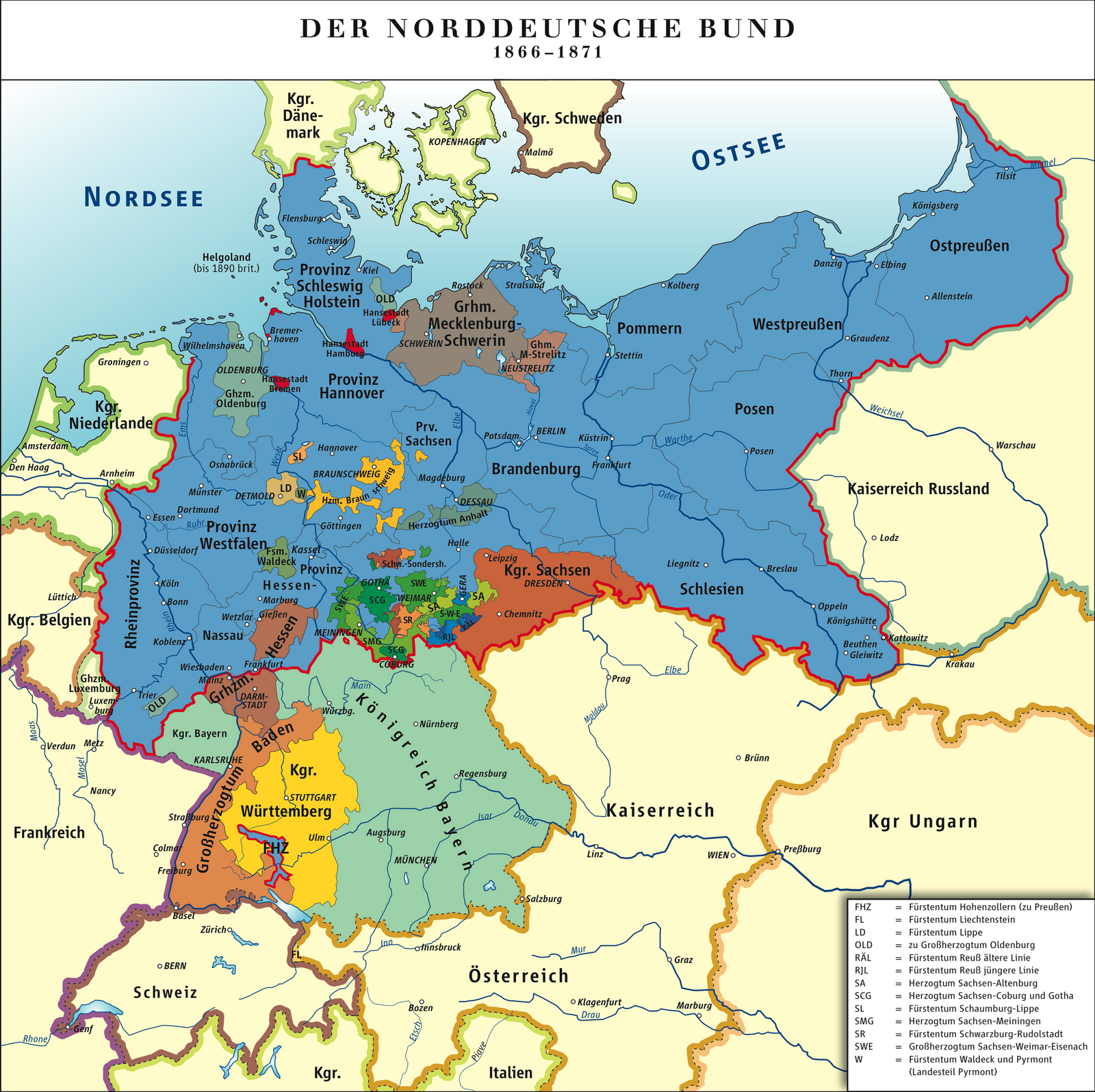
Without getting too much into the weeds of German unification and Austro-Prussian rivalry, Prussia wins that fight. Through a series of wars and adroit politics by Bismarck, Prussia created first the North German Confederation, seen in this map outlined in red, and later with the German Empire. The latter was a voluntary union of all the German states where the Prussian king accepted the title of German Emperor. The Empire was a federal system with the other German Länder ceding executive authority to Prussia but retaining some degree of their own prerogatives in domestic affairs. The sheer size of Prussia in the Empire meant that it exercised greater influence over German affairs. Yet the relationship between Prussia and other German states was seldom very harmonious, with more than a few non-Prussian monarchs resenting Prussian political hegemony and political initiatives like the anti-Catholic Kulturkampf.
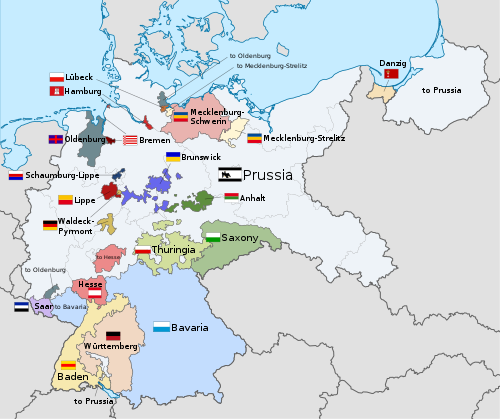
Prussia as an entity survived the collapse of the Hohenzollerns and the creation of the Weimar Republic. Prussia was still the largest state of the Republic, as seen in this map, which made it a very powerful entity within the Republic. Control of the Prussian government became one of the main ways the Nazis managed to create a police state in their seizure of power. The common association of Prussia with the negative traits of Germany such as militarism and nationalism, justified the formal abolition of the Prussian state in 1947, ending the formal existence of this entity.