Today:
You know the drill: this is the thread for all your history-related outpourings that are not necessarily questions. Minor questions that you feel don't need or merit their own threads are welcome too. Discovered a great new book, documentary, article or blog? Has your Ph.D. application been successful? Have you made an archaeological discovery in your back yard? Did you find an anecdote about the Doge of Venice telling a joke to Michel Foucault? Tell us all about it.
As usual, moderation in this thread will be relatively non-existent -- jokes, anecdotes and light-hearted banter are welcome.
Some life advice from 14th century Florentine merchant Paolo da Certaldo:
Be very careful to avoid the following perils, which are great and cause great risk:
- storms at sea
- fire
- flood
- riots
- stampedes of horses
- the tongue of an evil woman
- having to govern peasants
- pirates
- assassins
The NUKEMAP is five years old today. I wrote a little blog post about it: the path to making it, my thoughts on what works well about it, the way forward. I've been ridiculously busy the last few months, so I haven't had a chance to do a lot of things I've been intending to do (and the minute-by-minute chaotic news cycle doesn't help), but some of these tasks will be finished soon and I can get back to the task of doing things like improving the NUKEMAP and building new, NUKEMAP-like projects.
(Also, where did those 5 years go? WTF.)
Ave! I'm Dr Matthew Nicholls from the University of Reading's Department of Classics and I'm the lead educator on a new free online course, A Virtual Tour of Ancient Rome which begins on Monday 13 March.
I developed an award-winning virtual model of Rome and this course combines virtual material with actual footage shot in Rome last Summer.
AMA about the ancient city and virtual technology for learning on Thursday 9 March!
So I’m reading the chapter “The Shaft Tombs of Parcelas 12, 19, and 25 and their Inhabitants: Funerary Considerations of the Recent Archaeological Finds in Colima” by Marcos Trinidad Zavaleta Lucido and Rosa María Flores Ramírez in Shaft Tombs and Figures in West Mexican Society: A Reassessment (2016). On page 67 they are discussing the remains found in a shaft tomb that dates to the Comala phase (0 AD to 400 AD). This is what they say,
“Likewise some of the bones showed the remains of red pigment and of adhered metal, surely from the copper beads that were found in the interior of the tomb.1”
What, what, WHAT?! Copper beads in the tomb?! But metallurgy wasn’t introduced to Mesoamerica until sometime after 600 AD. But they had a note! And the note says,
“Even though the a remains recovered from the interior of the tomb indicate that it was utilized solely in the Comala phase, it is not possible to rule out a later reuse of the tomb during this phase or that the offerings were deposited at the same time, until other tests, such as residual collagen, are carried out.”
So it’s possible the copper beads are from a later period. But then, it looks like they may in fact be from the same period as the tombs. That’s a big find despite the brief description. I think Zavaleta and Flores are waiting on those tests to confirm the dates of the tomb before making the big announcement. I’m sure they are going to get some push back for their findings, but I hope their evidence holds up. I had an inkling that someone was going to find metal in a shaft tomb at some point, I just didn't think it was going to be so soon. I'm going to keep my eyes peeled for their publication on these beads because I think it is going to be huge.
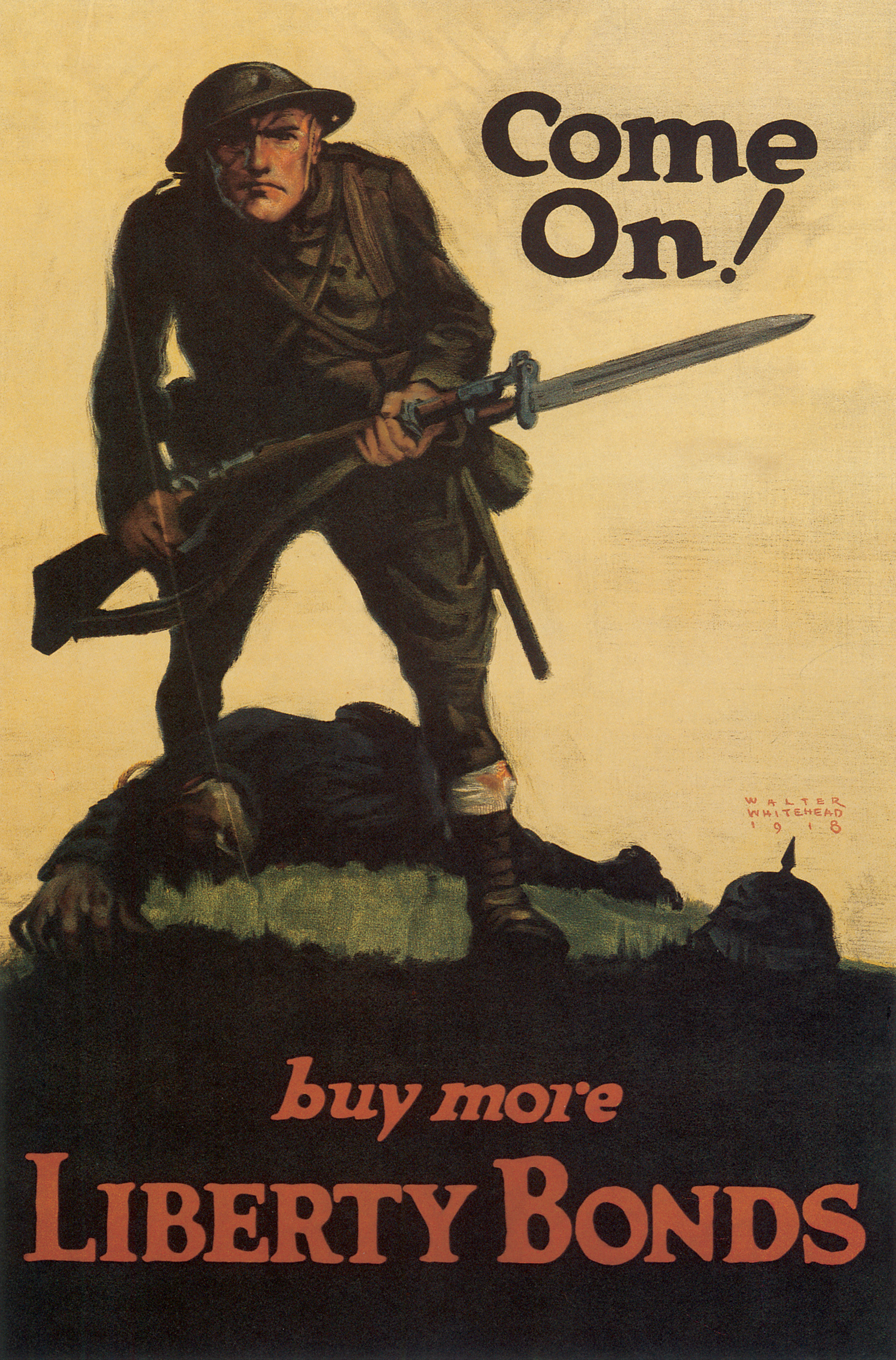
I just finished hanging up the last of the pictures for my museum's World War I exhibition! It consists of four large, full-color propaganda posters (this is one; we also have this one without the "invest", oh, and this one), plus twelve framed photo reproductions. One of the reproductions is of a panoramic photo taken of men who had enlisted, lined up on the street, and the rest are unidentified portraits from glass plate negatives.
Because they're unidentified, I'm putting up number labels and a line in the intro text asking people to let us know if they recognize anyone.
I saw a tweet the other day that read something like this:
"I've been reading a lot of Foucault lately, and here's what I've learned. Science is fake as hell, dude. Sex is absolutely not real. Everything's jail."
Pretty good summary if you ask me.
Concerning Indian cultures—I think you are right in assuming the superiority of the southeastern or "Mobilian" and Iroquois groups to others north of Mexico. I think also that, within the southeastern group, the superiority of the Cherokee is clear. Recent ethnologists have come to regard the Cherokee as a detached kinsman of the Iroquois. As to the Iroquois—you may possibly have read of the very recent theory of Dr. William D. Lighthall that they have an origin different from that of the bulk of aboriginals. It has, of course, long been recognised that some elements alien to the Mongoloid Behring-Strait invaders must have existed in pre-Caucasian America. The vast observed physical differences between different groups in both North and South America suggests as much, as do also the physiognomies represented in Mayan sculpture. Also—the culture and art of Central America suggest Asian influences not likely to have been retained through an Alaskan migration. Aside from any possible accessions through Atlantic migration, it is thought that the aboriginal population received certain elements from the Pacific islands—brought by canoe migrations, and perhaps involving the transfer to the Maya culture of some phases of Indo-Chinese art and lore. Now what Dr. Lighthall has to say is quite specific. He finds in the Iroquois not only the general superiority to the surrounding Algonquins which all have noticed from the earliest times, but a profound and significant culture-cleavage as well. While many of their customs are of course like those of the other Indian tribes with which they have been long in contact, Dr. Lighthall believes that there is a certain nucleus of Iroquoian folkways not reconcilable in any way with a Mongoloid-Indian origin. He points to their custom of sleeping in hammocks and on raised platforms (a tropical tendency), their type of "long house", their mode of reckoning family descent, and other traditional habits, and to the measurements of their skulls as exhumed from burying-grounds. His final conclusion is that the Iroquois are Polynesians—like the Tahitians and Hawaiians—who reached northeastern America by a very devious course including South America. Of course, he recognises that they have picked up an enormous amount of blood and lore from the surrounding tribes of true Indians. Just how the Lighthall theory will be received by conservative ethnologists remains to be seen. At any rate, it opens up a highly interesting set of speculations. Incidentally—I am enclosing a cutting which describes some important Indian finds near the junction of the Mississippi and Ohio rivers. It is clear that at one time there was a great deal more settled life in prehistoric America than is commonly assumed, and it seems to me probably beyond any reasonable doubt that a distinctive North-American civilisation would have developed but for the coming of the white man. How different would the modern world have been if the Indian had occupied America 2000 years earlier than he did!
One of those Lovecraft paragraphs with a good bit to unpack (and important not to quote out of context), which I thought might be fun to do so.
Concerning Indian cultures—I think you are right in assuming the superiority of the southeastern or "Mobilian" and Iroquois groups to others north of Mexico.
"Mobilian" or "Mobilian race" in older sources generally refers to historic Native American groups in the southern United States; I'm not entirely sure why, although I suspect it's one of those occasions where linguistic grouping and racial grouping overlap, and "Mobilian jargon" was a common trade language along the Gulf. Lovecraft is responding to a comment by Howard:
In regard to Indians, I believe — excepting the civilizations of Mexico — that the mental status of the Eastern Indian was somewhat higher than that of the Western, especially those of the great plains. I am speaking, of course, of the Indians found in what is now the United States. The Pueblos of course, had a culture of their own; but their pottery making, blanket weaving and house-building was not sufficient to stave off the invasions of the more barbarous Pimas and Apaches. The Sioux, Cheyennes, Utes, Comanches, Apaches, Pimas, Navajoes, Kiowas, Blackfeet, Arapahoes, Pawnees, Omahas, Konsas, Osages, were not, I think, quite the equals of the Iroquois, Natchez, Delawares, Seminoles, Chickasaws, Choctaws — and I can say with conviction that they were generally inferior to the Cherokees. Considering the so called inferiority of any race, I realize the term is relative and varies with the varying viewpoint. I do not, for instance, consider myself particular superior to a Chinaman, but I’d hate like hell to be changed into one, and I’d knife him if he tried to marry, say a sister of mine. The Indian might have developed a permanent civilization, if left alone long enough, but I must admit I have certain doubts on the subject.
Both Howard and Lovecraft considered Mesoamerican civilizations like those of the Maya and Aztecs "more advanced" because of their construction in stone and large, fixed settlements at the time of European contact/conquest.
As to the Iroquois—you may possibly have read of the very recent theory of Dr. William D. Lighthall that they have an origin different from that of the bulk of aboriginals.
Dr. William Douw Lighthall was a Canadian philosopher, lawyer, and politician with an interest in Canadian history; I'm about 90% sure that what Lovecraft probably read is Lighthall's essay "The Remoter Origins of the Iroquoian Stock" (1931), but I haven't been able to track down a copy of that.
It has, of course, long been recognised that some elements alien to the Mongoloid Behring-Strait invaders must have existed in pre-Caucasian America.
"Mongoloid" in this context refers to the early racial categorization (Mongoloid, Caucasoid, Negroid, etc.), which various racialists worked with; Lovecraft was generally a believer in the theory that the ancestors of Native Americans had travelled over the Behring Strait land bridge from Asia, but he also bought into the idea of a possible "Mound Builder" race that was a precursor to Native Americans; this kind of idea was endemic in pulp fiction and found expression in H. P. Lovecraft's "The Mound," Manly Wade Wellman's Shonokin stories, and some of Robert E. Howard's weird western fiction.
The vast observed physical differences between different groups in both North and South America suggests as much, as do also the physiognomies represented in Mayan sculpture.
I suspect this is a reference to Leo Wiener et al.'s ideas that Olmecs or other Mesoamerican peoples had an African origin.
Aside from any possible accessions through Atlantic migration, it is thought that the aboriginal population received certain elements from the Pacific islands—brought by canoe migrations, and perhaps involving the transfer to the Maya culture of some phases of Indo-Chinese art and lore.
Fourteen years before Kon-Tiki, but the idea of a transpacific oceanic contact between Oceana and the Americas was definitely in some vogue.
[...] and to the measurements of their skulls as exhumed from burying-grounds.
Cephalic index studies, an effort by a lot of folks to provide solid data to justify some of their racialist theories and assertions, and it had some considerable scientific vogue for a bit. Lovecraft borrowed on this idea in his story "Facts Concerning the Late Arthur Jermyn and His Family" and was fond of cephalic index terms like "dolichocephalic," "mesocephalic," and "brachycephalic"; Robert E. Howard picked up this tendency from his letters with Lovecraft and included it in a few stories as well. Still crops up occasionally in fringe/pseudo-science/history theories.
Of course, he recognises that they have picked up an enormous amount of blood and lore from the surrounding tribes of true Indians.
Lovecraft lived in that weird period after heredity and genes were fairly widely recognized and accepted but before the mechanism of transmission (DNA) was isolated and began to be understood, so in his letters he tends to talk about "genetics" in terms of percentage of "blood" and populations in terms of "stock" - like you were breeding dogs, cats, cows, or horses. Which is, to be fair, all that most folks had to go on as far as a reference, but it really underlines some of the thinking that led to eugenics and whatnot.
Incidentally—I am enclosing a cutting which describes some important Indian finds near the junction of the Mississippi and Ohio rivers.
The cutting probably refers to an article on the Wickliffe Mounds (often mischaracterized as an ancient buried city), which were excavated in 1932 by Fain W. King, who made exaggerated claims about it and operated it as something of a tourist attraction.
Do any of the mods use H-Net? Is it actually useful? When I was getting my BA in History one of my professors highly recommended I join, which I did, but I just look at the emails and never really interact.
I'm a history undergrad looking to get into pop history writing, and am working on two books.
I realize pop history is just that--popular history, without original research being done. That being said, would you all suggest I footnote my sources, or just have a bibliography at the back? I've seen writers do it both ways.
More progress with my dissertation. I asked for an extension last week and got it, and I've made good use of the extra time--I'm almost done--but as I'm about to hand in my draft, it occurred to me that I might want to let my profs know about the organizational changes and stuff I've been making before I hand it in. So I sent off an email with a summary of the new draft and I'm waiting for their response, if they like it I'll show them the draft, but if not I'll get back to it with the changes they suggest.
My museum just oppened an exhibit on afrodescendants in Mexico. Its one part of our heritage that we are rarely aware of so im very exited to see what our visitors think!
I'm reading about Mughal invasion of India and it seems like there have been tons of Holocaust of Hindi by the Mughal invaders? How true is this? Also was Gandhi responsible for creating Pakistan and prosecution of Hindus in Pakistan and East Pakistan (Bangladesh)?
Not valid of an entire topic, but I do have a question of sorts.
While I know they existed from simple Google searches, we always see them getting their eyes rolled at or killed by a king while performing. That's right, court jesters.
Which leads to my question. During the general period of the medieval ages, were there any famous/celebrity noble entertainers/court jesters? What kind of performances were specialties or even majorly requested by the audience?
I've had a rather rough day and am jittery from caffeine, so if this doesn't make sense then I'm a pink hippo. Anybody want to play a mind game? Say you can have a date with one historical person from your area of study (or interest) and you can take them for few hours into any point in the future up until today. Who do you choose and how do you impress them? Besides being a sexy time traveller.