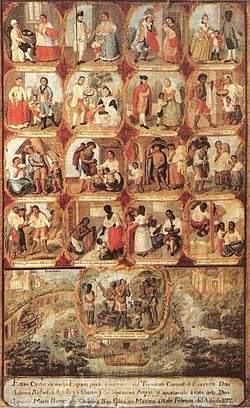
So, you might be asking yourself why a demographer is answering a question about fashion after contact. Your question asked about the influence of different standards of beauty, and different beauty standards are absolutely linked with a more comprehensive perspective on Native American demography after contact. How, you ask? By the insidious influence of identity erasure.
The casta system used throughout Spanish America created racial categories in a hierarchical model where purity of blood melded with class, religion, and actual genealogy to bestow greater social benefit and mobility on those with preferred caste. Folk concepts of race, specifically those associated with phenotype like skin color and hair color were worked into the understanding of the castes, and placed Amerindians on the lower rungs of the colonial world. The rejection of indigenous phenotype, erasure of indigenous identity, and the rules of admixture where descendants of mixed race marriages were assigned to the “higher” caste all contributed to declining Native American census numbers. Demographers are just beginning to incorporate this influence into their models of Native American demography after contact.
Briefly, in the emerging colonial world the highest status in the caste system was reserved for the Spanish colonists who traced their ancestry to the Christians who fought in the Reconquista, and whose blood was untainted by commoners, Jews, or Muslims. All Indians were Indian, regardless of pre-Columbian social status or previous identity. Since Indians were untainted by African/Moor ancestry they could be “transformed” into “Europeans after three successive generations of consecutive marriages with Spaniards” (Gutierrez). Children of a Mestizo who married an Indian could be demoted down this caste hierarchy, but the process of demotion could be reversed by successive generations marrying back into the high Spanish-descent caste.
Gutierrez argues the famous caste paintings were less a celebration of diversity than an attempt to capture and label the self-evident “natural order” of the Spanish caste system and imperial dominion, and serve, in a way, as a “lamentation of the unintended consequences of imperial expansion.” Check out some of the paintings for insight into the convolution of a system trying to categorize the complex post-contact world.
Since pure blood Spanish males always outnumbered the available Spanish females in the Americas, families concerned with the future of their lineage sought out light-skinned members from other castes, or those with the correct phenotypic features to mimic Spanish perceptions of purity and beauty. Conquistador accounts repeatedly describe women as “beautiful for an Indian”, and written accounts testify to the abduction of fairer-skin indigenous women who fit appropriate Spanish beauty standards.
This marriage pattern simultaneously subtracted indigenous females from the pool of available partners for indigenous males (decreasing fertility in the pure indigenous category), while forever assigning their lineage to another, “higher” caste (decreasing the “on paper” number of Indians). Indigenous families, desiring higher status for their children, likewise drew from this emerging Mestizo caste, and their offspring were again removed from the pure indigenous lineage and into the “higher” caste.
Demographically speaking, any Indian marrying outside the group would be counted as a permanent loss, since technically that individual, together with his/her children, would add to the number of mixed-heritage people. And so, even when the Indian group grew in absolute terms, it still lost its percentage of demographic dominance, a pattern that has continued until the present day… (this) represents the demography of erasure, meaning that even though phenotypically Mexico continues to be strongly indigenous, beginning in the early colonial era an indigenous identity was often not beneficial, so people would use interracial unions to transform the identity of their children or sometimes even themselves by adopting the identity of their partner. (Gutierrez, p.135)
Granted, you were probably more interested in clothing and fashion, but the Spanish notions of beauty and purity of blood have tremendous consequences for our understanding of the demography of indigenous populations in the Empire. By focusing on specific phenotypic traits, folk notions of race reinforced the superiority of Spanish lineages, while also erasing indigenous identity and contributing to the declining percentage of indigenous populations in the years following contact. This brief example shows how the decline in indigenous population size, often used as evidence of the tremendous impact of infectious disease spread, is a far more complex story.
Hope this wasn’t too far afield of your interests, but I simply love the intersection of culture, biology, and demography!
For more info check out Gutierrez “Identity Erasure and Demographic Impacts of the Spanish Caste System on the Indigenous Populations of Mexico” in Beyond Germs: Native Depopulation in North America, Cameron, Kelton, and Swedlund, eds. Also, check out the genetic structure of modern Mexico to see how mestizo genomes track closely with their nearby indigenous neighbors and be amazed at the tremendous genetic diversity of modern Mexico.
Way back towards the dawn of time when dinosaurs roamed the earth, /u/colevintage and /u/grantimatter gave me fantastic answers to a question on whether/how women's fashion adapted to different climates in the Western Hemisphere that talk about Native women's--and men's!--clothes as well.