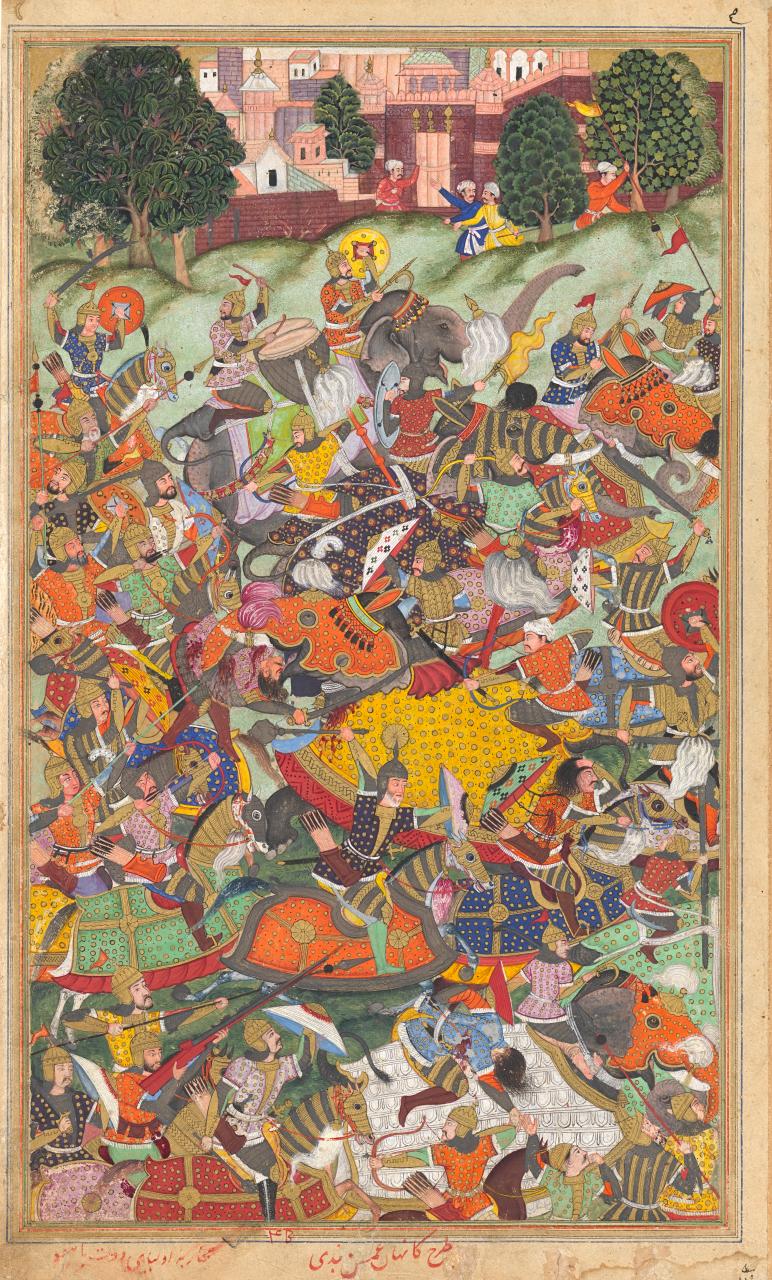
We see them all the time in depictions of ancient warfare (Hannibal, the Selucids, etc.) but never see them in depictions of medieval combat. Why is this?
never see them in depictions of medieval combat
That's really because you're looking in the wrong places. Here's a 12th-century depiction of war elephants by the Khmer empire (Cambodia). Or consider this Mughal painting of the Second Battle of Panipat, in 1556. War elephants were part of warfare in India and mainland Southeast Asia as late as the 18th century.
But you're also kinda right. There was once a time when war elephants fought and died throughout the known world. By medieval times this was no longer the case. The biggest reason why is environmental. The thing about elephants is that they cannot be profitably bred. Elephants aren't fully grown until around twenty. Worse, they stay pregnant for an absurdly long time (almost two years). And the worst thing is, the average female elephant gives birth to only four babies despite having a lifespan of sixty years.
So if you want war elephants, you have two choices. You can try breeding your elephants and deal with a small number of animals that are useless for decades. Or you can capture as many wild elephants as feasible and immediately start preparing them for war. It's obvious which one is better.^1
Now look at this map of elephant distribution in China. As human populations expanded, elephant populations shrank... until that one day when the elephant was no more. Since war elephants were captured and not bred, there were no more Chinese war elephants as well. Likewise, the elephant subspecies used by Hannibal also went extinct during Roman rule.
To answer your OP, this is the most important reason why elephants largely disappeared in medieval Western and Chinese warfare.
There were only two places where elephants, and by extension war elephants, continued to thrive:^2 India and parts of Southeast Asia. So why did the elephant become obsolete there?
Elephants are very, very big. How the hell do you actually fight them, especially if you don't have artillery or your own elephants? This question preoccupied countless generations of kings and generals, who devised the major challenge to the elephant: the archer, especially if he's riding a horse.
Now, bows and arrows cannot kill an elephant by themselves. If you couldn't guess, they're pretty hard to kill outright. But you can incapacitate an elephant by making it panic and hopefully attack its own side. This is where horse archery comes into play. To quote Marco Polo about the Battle of Ngasaunggyan, where Mongol cavalry encountered Burmese elephantry:
[The Mongols] plied their bows stoutly, shooting so many shafts at the advancing elephants that in a short space they had wounded or slain the greater part of them as well as of the men they carried [...] when the elephants felt the smart of those arrows that pelted them like rain, they turned tail and fled, and nothing on earth would have induced them to turn and face the Tartars. So off they sped with such a noise and uproar [...] And then too they plunged into the wood and rushed this way and that, dashing their castles against the trees, bursting their harness and smashing and destroying everything that was on them.
Despite this Mongol success, horse archery never really caught on in Southeast Asia. Things were very different in India. Beginning in the 11th century, Turkic Muslim cavalry from Central Asia swooped down into India and began fighting local kingdoms. Indian kings seem to often have been confident that their elephants would bring them victory. But the Turkic conquerors found that elephants were slow, perfect for set battles but cumbersome against mobile cavalry. They could be outmaneuvered by the much faster horses and put to flight by concentrated volleys of arrows.
While elephants did sometimes win battles, a more instructive case might be the Second Battle of Tarain in 1192. The Indians charged the Turkic army with a corps of "steel-clad, ferocious elephants." The Turkic cavalry was ordered to maintain the distance of a horse's course between themselves and the elephants while shooting at the drivers of the elephants. The tactic was successful. The elephants panicked and fled when their drivers were killed, allowing the Turks to shatter the "infidel host."
In Indian and Southeast Asian warfare, elephants often served as a platform for the commander to see how the battle was going. People on top of elephants were unfortunately also very visible and easy to target. This meant that a skilled archer could kill the commander and possibly make the entire enemy army disintegrate.
So in India there seems to have been a decline in elephant usage even before the arrival of firearms. Arab sources claim that Hindu kingdoms in the 9th and 10th centuries possessed as many as tens of thousands of war elephants. By contrast, the Delhi sultans - despite having been the most powerful rulers in India since the 6th century - do not appear to have ever possessed more than 3,000 elephants. The lumbering behemoth of Indian warfare just wasn't as useful anymore.
For reasons historians still aren't sure of, elephants made a comeback in Indian warfare in the 16th century. But this was accompanied by a tactical change. Elephants were still sometimes placed in the front lines, as they had been at Tarain. But one European also reported:
Elephants thus equipped are not placed in the front line, as they would shut out the enemy from the view of the soldiers, and would, when wounded, break the ranks of the soldiers, and throw the army into disorder. They are kept in the rear of the force; and should the enemy penetrate so far, this formidable troupe is brought suddenly into action, to bar his further progress.
Sp elephants still had a role in cavalry-oriented warfare. What finally killed them off was the firearm.
We shouldn't exaggerate the impact of early, primitive firearms. 16th-century matchlocks in Southeast Asia couldn't even penetrate the skin of the elephant from a distance. But guns, once they were sufficiently developed, provided the same advantages against elephants that archers did.
There were a few key advantages. Elephants are terrified by the sound of firearms being fired. Cannons and rockets were naturally highly effective against the elephant, sometimes scaring them into charging into their own side. While they could be trained to tolerate firearms being fired from their backs, Vietnamese and Lao attempts to train elephants to tolerate enemy cannons were not very successful. Artillery, of course, can kill elephants outright. The 18th-century adoption of flintlock guns, which fire faster and more accurately, made it much easier to shatter a phalanx of elephants.
As firearms became commonplace in both South and Southeast Asia, there was no room left for elephants in battles. Indeed, the later Mughals kept only 1,000 elephants, the vast majority of which were beasts of burden and not war elephants. So one historian notes that in India:
It was [...] in the seventeenth century, following the increasing use of gunpowder weapons, that elephants became fully obsolete.
In Southeast Asia, where warfare tended to be more conservative, the vanishing of the elephant came somewhat later. But just as in India:
It seems likely that although Southeast Asians resisted abandoning the elephant in warfare in the earlier stages of the emergence of firearm technology, that newer technology made the continued use of the elephant as a war-mount unwise. Elephants thus rapidly disappeared from the front lines of battle by the late eighteenth century in most areas of Southeast Asia.
Of course, elephants remained powerful symbols of royal authority. It wasn't for nothing that the king of Burma was titled the King of the White Elephant. Because of their exceptional strength they were also crucial as beasts of burden, especially in hilly areas where they were much more versatile than camels or buffalo. This remained the case as late as World War I.
But by the 19th century, the elephant - the beast that had once crushed entire armies and taken down great castles - seldom, if ever, fought in battles.
^1 OTOH, some rulers actually tried breeding elephants. The Mughal emperor Akbar was among them, but I'm not sure if this was for pragmatic reasons. Akbar seems to have really liked elephants in general, and for good reason - see /r/babyelephantgifs.
^2 And Africa, but African elephants were rarely tamed. They can be tamed, but apparently they're nastier than Asian ones. It's also worth noting that elephant populations shrank even in India, and by Mughal times Indians were having to import a lot of their elephants from Southeast Asia.
You may check you an answer by /u/elephantofdoom in here
The short answer is that elephants were rare, hard to train, vulnerable to firearm. Despite of that, they were used as beast of burden even until 20th century. In places where native elephants are more redundant like India and South East Asia, war elephants are still used in battle through out the medieva age. For example, in 18th century Vietnam had no seperate calvary unit but maintain a whole standing division of war elephants.