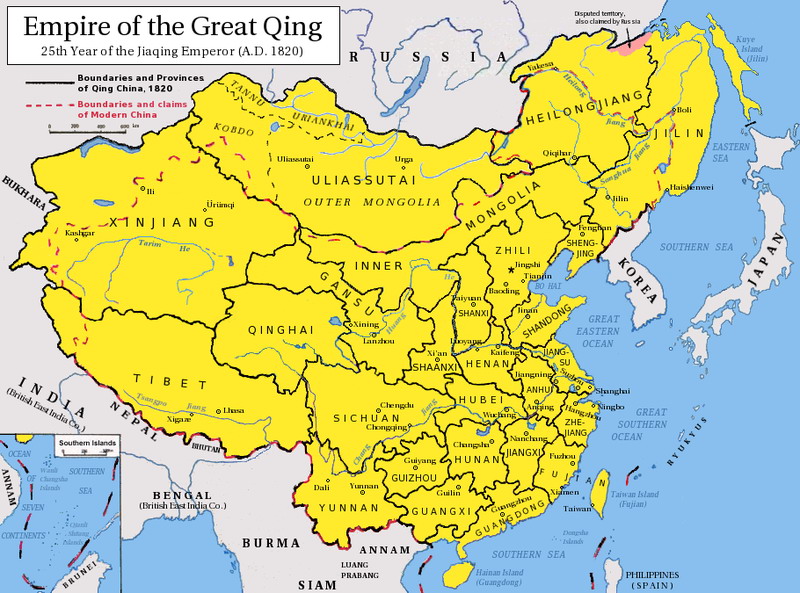
I have a colleague in the UC system right now who is going berserk over the fact that His Holiness is invited as a commencement speaker at UCSD.
I fully understand why people in the West love and adore him. I also understand on a basic level why the Chinese hate him. But I'm not understanding the details of how Chinese have been inculcated to find him a traitor and terrorist (she's equating him to Bin Laden.)
So, to get to the bottom of this, we’ve got to go back… waaaay back… like all the way back to the Tang Dynasty in the mid-7th century far back… to get a wide enough viewpoint to really explain this.
Round about the year 604, Songtsän Gampo becomes the 33rd titular king/emperor of Tibet, called the tsenpo, but the first to unite the nomadic plateau-tribes into the Tibetan Empire (Bod Chen Po) centered around his sometimes-capital Lhasa. With surprising quickness (in 7th century terms, any way) in less than a century it becomes one of the Tang Chinese Empire’s chief threats, and is constantly harassing them from the west while other steppe peoples/angry border generals do a number on China’s northern border. By the last decade of the 8th century, its territory looks like this, and it along with the Uyghur Khanate has managed to cut off central China from its far western holdings and seal up the Silk Road once again. You can imagine that the Emperors of China were not amused.
Well, that situation stabilized for the rest of the Tang Dynasty, and much of the subsequent Song Dynasty of the 10-13th centuries, thanks to marriage alliances and the Tibetans succumbing to their own series of devastating civil wars… and that’s nice and all, but let’s flash forward.
Knock knock. It’s 1240 and the Mongols are at the door. And one of the (many, many) grandsons of Genghis Khan, Prince Godan, come a-calling and asks for a meeting with the Tibetan leader and Buddhist lama Sakya Pandita, giving the pretty standard-issue Mongol greeting of “bow down to us or we’ll kill everything you’ve ever loved” (and they’d showed that they really meant it by sacking a monastery and executing some 500 Buddhist monks). So Sakya thinks this whole “bowing” thing sounds like the better end of the stick and accepts. Tibet begins its life as a vassal state to the mighty Mongol Khanate, which some 30 years later fractures into sub-states like the Golden Horde, the Ilkhanate, and for our purposes the Chinese Yuan Dynasty under another of Genghis’ grandsons, Kublai Khan (AKA Emperor Shizu of Yuan, 元世祖帝) .
So, now Tibet’s officially a part of a Chinese Dynasty, albeit a conquest one. That middling little detail wouldn’t stop subsequent dynasties, like the Ming, and then the Qing from saying “no take-backs” to Tibet. At times submission was sent, and at other times the Tibetan response was somewhat less-than-satisfactory, ranging all the way from internal civil war to outright de facto independence. But at least in the eyes of the Chinese imperial governments, once in the empire, always in the empire.
So now we’re at the year 1391 (alt. 1543, when the title was actually first given), and it’s time for the Bodhisattva of Compassion to take corporeal form in the person of Gendun Drup, the first Dalai Lama. Incidentally, that title is a bit of a linguistic muddle – but hey it’s central Asia, so that’s to be expected. The “Dalai” comes from the Mongolic for “ocean/oceanic” – which often in such instances itself refers to the idea of “all the oceans/everything”, which “Lama” stems from the Tibetan word for “guru”, blama. So, “Universal Teacher”, if you will. From the mid-17th century until the mid-20th century this incarnation of the Bodhisattva will become the political and spiritual ruler of Tibet… and since it is an immortal entity merely sheathed in flesh, every time the old Dalai Lama “dies” Avalokiteśvara simply reincarnates into a body of its choosing to begin anew. That part will be problematic later.
In the early 17th century, the on-again-off-again relationship between China (now under the rule of the Aisin Gioro Jurchen/Manchus of the Great Qing Dynasty) and Tibet (now led by the 6th incarnation of the Dalai Lama), is solidified in the form of first a tribute payment by Tibet to the Manchus – the first recognition of Qing suzerainty over Tibet vs. their old pledge of servitude to the Mongols. Then in 1718, the Qing Army was dispatched to Tibet to – er’hem, - assist with the expulsion of an invading force of the Dzungar Khanate. This encountered some turbulence in the form of an extremely embarrassing defeat at the Battle of Salween River in 1718, but the Qing Kangxi Emperor simply re-raised a new force and stomped the Dzungar threat out in 1720. So now Tibet officially has acknowledged its vassaldom to the Qing Empire.
OK, fast forward to 1911 and the Qing Empire is dead, overthrown from within by the republican forces of the Xinhai Revolution. And there was much queue cutting and rejoicing. But wait, now that the Chinese are back in control of China… what’s to happen to all those periphery areas and territories, like Tibet – who had pledged allegiance to the imperial order that the republican upstarts had just overthrown? So the Republic of China simply decided to maintain the exact same borders as the Qing, nevermind the question mark over whether those non-Chinese regions would extend their pledge of vassaldom to this new regime, rather than having it die with the old one. Suffice it to say, there is more than a little griping about this state of affairs. But at least for a while it doesn’t really matter all that much because the RoC is far too busy beating down regional warlords, and the fighting the Communist Party, and then fighting the Japanese, and then fighting the Communist Party again all the way until they find themselves booted off the mainland entirely in 1949 and forced across the sea to Taiwan. Meanwhile, Tibet has been functioning completely autonomously, and considers itself legally free of its pledge to the late Great Qing – once more a de facto independent and free nation from 1912-1951.
So now it’s Oct. 1st, 1949, and Mao proclaims the People’s Republic of China… and now there’s no more infighting and civil wars to worry about (just forced labor, mass starvations, and Five Year Plans). The PRC takes the Qing/RoC’s borders and just runs with it, saying in effect, “uh, yeah, these are all ours, too.” Tibet says "wait, but we pledged ourselves to the Qing Empire, which is no more" and then the PLA officers laughed and laughed at this silly joke as their Type 50 tanks rolled in...
The following year the PLA pushes its way into Tibet to reassert Chinese control and faces only sporadic resistance. The fourteenth (and current) Dalai Lama and the Tibetan government accepts the Seventeen Point Proposal in 1951 and is “peacefully reintegrated” into China. And for a few years, things seem hunky-dory from Beijing’s perspective. The Dalai Lama is named as the Vice Chairman of the Standing Committee of the People’s National Congress. In 1955, Mao Zedong and Zhou Enlai both visit Lhasa and celebrate the Tibetan New Year with an nice photo op with the Dalai Lama and the Panchen Lama (the 2nd in command).
But over in Lhasa, the Dalai Lama was growing more and more concerned over the ebbing away of his political and spiritual authority. In 1956, while on a trip to India to celebrate the Buddha’s birthday, he secretly asks India’s President Nehru for political asylum, which was rebuffed on the grounds that India had just signed a treaty with China promising mutual non-intervention in each other’s internal affairs. But that same year the CIA steps in on the heels of an outbreak of rebellion in the Kham region, and begins arming and training the rebels to effectively mount a guerrilla campaign against the CPC/PLA.
By 1959, the Tibetan guerrillas had been pushed back into the Tibetan heartlands by the PLA, and the Dalai Lama – on the hook for this whole thing – fled the country with assistance from the CIA. This time he was admitted to India where he set up the Tibetan Government in Exile.
So long story short here: the Chinese hate the 14th Dalai Lama because they view him as a traitor to the state, an insurrectionary, an oathbreaker, and a political firebrand who went around getting the UN to adopt 3 anti-Chinese, pro-Tibetan resolutions all before the PRC was granted representation in the body as of 1971.
But wait! There’s more!
Owing to the Dalai Lama’s ability to never truly die if he doesn’t want to, there is lingering tension/fears on both sides about what will happen when the 14th eventually kicks the bucket. His initial chosen successor was taken into Chinese custody almost immediately after he was named in 1995, and has not been seen since. The Chinese government then issued laws about reincarnation, stating that anyone planning to reincarnate must first receive government approval to do so, otherwise it’s an “illegal or invalid” reincarnation. Yeah, it goes off into cuckoo-land. Meanwhile, with the 11th Panchen Lama MIA, Beijing went ahead and named its own Panchen Lama – who is the “designated reincarnation” of the Dalai Lama – in 1996. #14 retaliated by... saying some things that I'll not get into.
Hi, I'm actually a historian of modern China so hopefully I'll be able to shed light on this for you.
First of all, perhaps the issue most central (at least from a historical perspective) is the narrative of the so-called Century of Humiliation ( 百年国耻). Now of course the defeats suffered by the Qing Empire did not directly concern Tibet but it's important to understand how this historical moment, the 19th century, is discussed in the modern context. As the name implies, in this narrative the Qing Empire, and by extension "China," was the victim of the evil influence and intervention of imperialism. Of course it is debatable to what extent the Qing Empire was actually a Chinese empire. Yes, it's capital was Beijing and the majority of its administrators were Chinese speakers (Manchu/Jurchen, Han Chinese, or sometimes Mongolian). The China historians who make up the New Qing History School largely argue that the Qing was a multi-ethnic land empire much like the Ottomans or even Russia. But the importance of keeping each successive state that ruled China serves both the narrative of continuous historical greatness of China as well as lends moral legitimacy to China's contemporary imperial ambitions. This is of course very ironic given the fact that since 1911 much of Chinese political thought has been highly critical of the dynastic period of Chinese history with it generally being labelled as "feudal," but that is a different discussion and relates more to discussions of Maoist thought.
This is where the two primary revolutionary parties of the post the Xinghai Revolution China (1911) come in, the Chinese Communist Party (CCP) and the Nationalist Party (KMT or Guomindang). They both sought to portray themselves as the liberators of China from the yoke of imperialism. For the communists especially, this also meant an opposition to all things "feudal" in the Marxist sense although the KMT also used similar political logic. But also in their attempt to liberate China from imperialism and recover from the humiliation of defeat, they also sought to restore the traditional hegemony of previous Chinese states. This is of courses ironic given the rejection of much of Chinese history as backward and feudal but this logic served the political needs of both regimes when they were in power. Tibet was a key part of this logic. Tibet was conquered by the Manchus (Qing Empire) in 1720 but slipped from Chinese rule after the Xinghai rule and effectively became an independent state due to the weakness of the central government under the KMT. Thus, the "recovery" of Tibet became central to both the KMT and CCP's desire to recover from the humiliation of the 19th century.
In a broader sense, the current hatred of the Dalai Lama by Chinese citizens can largely be attributed to propaganda. I'm not trying to say that some of the arguments made by Chinese nationalists are incorrect or purely sourced from indoctrination, but it's undeniable that this plays a central role. Given the importance of the recovery of Tibet to the CCP, its conquest after 1949 had to be justified within the logic of Marxism and Maoism. Particularly, the communists argued that the Tibetan theocratic government engaged in mass slavery, feudalism, and superstition, all of these terms became words used to describe anti-revolutionary thought or rhetoric after 1949 and the CCP engaged in a scorched earth policy to eliminate these "oppressive" evils with religion being one the greatest targets. Thus within this narrative it is easy to see why the CCP opposed the influence of the Dalai Lama and the religious institutions of Tibet, their authority represented a direct challenge to the narrative of economic and political liberation of Maoism and the utopia that this ideology would bring to China.
In the modern sense, I can only give you anecdotal evidence but these answers seem to largely fit in with the narratives I have already mentioned. One common argument is that the Tibetans were oppressed under the Dalai Lama. Another one is that the imperialist powers supported and promoted the narrative and cause of the Dalai Lama in order to humiliate and belittle China. Another answer is that Tibetan people are better treated than Chinese people, receive more benefits, and are very happy under the rule of the CCP. Thus the Dalai Lama is simply an evil agitator. However, the most common answer I've seen and heard essentially is: denying the legitimacy of China's rule over Tibet is racist towards to Chinese people. This is a similar argument to the arguments opposing Taiwanese independence. In essence, opposing Chinese political goals are a direct insult to the Chinese people. This argument really illustrates how the narrative of the national humiliation and the narrative of victimization still plays a central role in how Chinese people perceive their history and how they view the role of their government in rectifying the historical failures of the very government they vilified some 30 years ago. It is very troubling to me in part because Tibet suffered and continues suffer under the rule of the Chinese government. One only has to look at the colonization of Han Chinese in contemporary Tibet as well as economic marginalization that the government encouraged making Tibetans the poorest of China's poor. This does not even include the ongoing political repression and imprisonment of dissidents. I hope this answer was helpful.
For more information on the Century of Humiliation and responses to the victim narrative of the CCP and KMT, I suggest reading Robert Bickers's book: The Scramble for China: Foreign Devils in the Qing Empire. Also, Dru Gladney's seminal paper on minority representation in contemporary China, Representing Nationality in China: Refiguring Majority/Minority Identities, is an excellent piece that touches on this topic.
I would suggest trying to have a series of calm discussions with your colleague if you're truly interested. Like any colonized* country there's usually a culture of talking-down-to when looking at Chinese history, so Chinese people are often very defensive.
*before anybody comes in here and tries to tell me that China wasn't colonized, it was the goal of New Imperialism, and Russia, France, Britain, Japan, and Germany had huge successes and an unequal relationship with China
I'll try to answer your question (and I hope to God this doesn't count as soap-boxing) but I'd encourage you to talk to your colleague about why she thinks this way and to genuinely listen.
u/cthulhushrugged wrote a concise summary of Sino-Tibetan relations, but I don't think Chinese really think about their country that much this way any more. I think the word you'll hear (which is the common accusation the government throws around) is "Splittist." They believe the Dalai Lama wants to split the country, specifically Tibet from China, despite the fact that that has never been his goal, and he's reiterated his commitment to a "Middle Way" approach for Chinese suzerainty over Tibet, with Tibetans in charge of their own affairs.
There's more political reasons (i.e. territorial integrity) than historcial reasons (i.e. the Dalai Lama's connections to the CIA) for the Chinese to hate the Dalai Lama. Keep in mind that the rhetoric China has used for the Dalai Lama is the same as that used for Taiwan: both represent an alternative to Beijing rule, which is a threat to the integrity of the Chinese state.
Chinese, though quick to forget about how they acquired Tibet, are quick to point out that Tibet "had a caste/slave system" which I wrote about extensively here, and here.
Hello everyone,
In this thread, there have already been a large number of incorrect, speculative, or otherwise disallowed comments, including many that blew straight past our "current events rule" to discuss events post-1997. As such, they were removed by the mod-team. Please, before you attempt to answer the question, keep in mind our rules concerning in-depth and comprehensive responses. Answers that do not meet the standards we ask for will be removed.
This thread is trending high in the subreddit, but those upvotes represent interest in the question itself, and it can often take time for a good answer to be written. We know that it can be frustrating to come in here from your front page and see only [removed] and this post, but we ask for your patience and understanding. If you are looking for some interesting content in the mean time, we hope you will check out our Twitter, the Sunday Digest, or the Monthly "Best Of" feature. It is very rare that a decent answer doesn't result in due time, so please do come check into the thread in a few hours. A Private Message to the Remind Me bot is a good way to remember.
Additionally, it is unfair to the OP to further derail this thread with off topic conversation, so if anyone has further questions or concerns, I would ask that they be directed to modmail, or a META thread. Thank you!