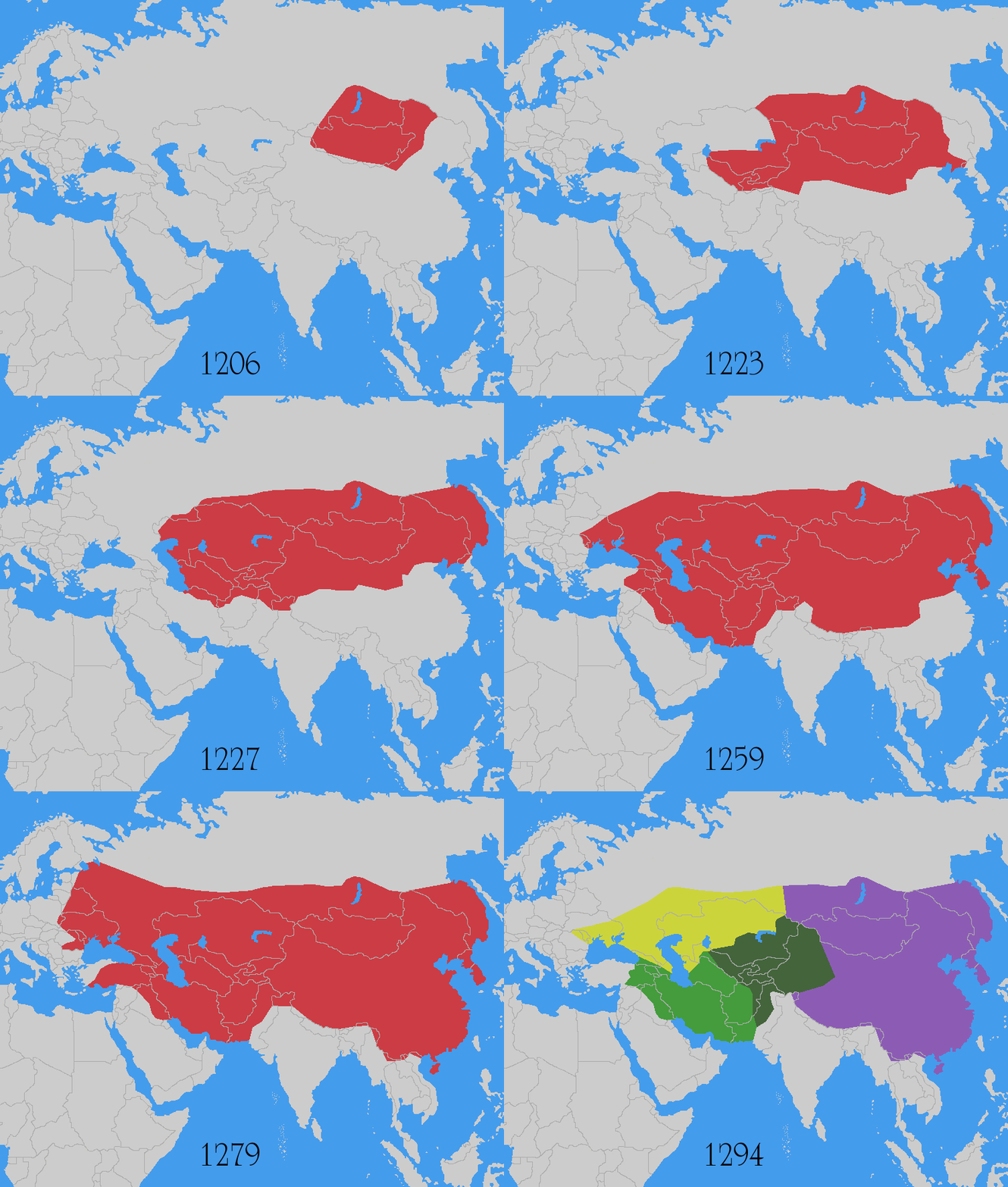
This GIF recently made it onto /r/all and it got me wondering about the huge empires of the past (Roman, Mongolian, British, etc.) and how they were administered, maintained and run in a time before phones, planes and other rapid means of transport and communication.
Basically, how do you maintain an empire and keep it from fragmenting if getting a message to the governors and bureaucrats in the far reaches takes weeks or months?
So to speak to the empires you've mentioned (Roman, Mongol etc) I'm going to first step back to a different early empire that I've done a bit more research on. Then we'll tie it back together.
Disclaimer: Hobbyist researcher, information may not be 100% - happy to be corrected!
The Persian Empire
The first of the 'Persian Empires' was the Achaemenid Empire under Cyrus the Great. It was one of the earliest real 'empires' and one of the largest in history covering 5.5 million KM^2 (that's about 3.7% of the earth's total land mass).
For that time period, in particular, it was an empire the size of which we had never previously seen. The Macedonian Empire came close to its size nearly 200 years later, but it would be 400 years before we saw an empire beat the scale of the Achaemenid Empire (the Xiongnu Empire around 176 BC).
There are considered to be a few main reasons that the Achaemenid Empire was so successful:
1) Strong Local Autonomy:
One interesting aspect of the empire of 'Cyrus the Great' was the power he bestowed in local rulers. Cyrus referred to himself as the 'Shahanshah' or 'King of Kings' which placed him as a ruler more of confederated states (Pasargadae, Babylon, Susa and Ecbatana).
Each of these states had a 'satrap' who was a governor and vassal king, their job was regional administration. Other government members locally would report into that satrap, including the regional military general, and administration record keepers. This is different than other models we've seen where the pecking order reports directly into the central authority. This meant that regions were able to be quite autonomous.
It may seem counter to logic that autonomous regions lead to a strong empire, but it allows them to quickly deal with local issues without communication becoming an issue.
2) Cultural Acceptance:
One of the other fascinating parts of the Achaemenid Empire was its acceptance of other cultures and religions. Where many other empires (like the Roman empire) tried to assimilate cultures, the Achaemenid empire encouraged regions it conquered to continue their practices. The Persians would even adopt some of them.
In Herodotus' "The Histories" the Greek historian writes about the Persian practices (I.135):
"But the Persians more than all men welcome foreign customs. They wear the Median dress, thinking it more beautiful than their own, and the Egyptian cuirass in war. Their luxurious practices are of all kinds, and all borrowed"
Beyond taking on those practices, Cyrus was very accepting of religions. In his occupation of Babylon, he freed the Jewish people who were taken prisoner under Nebuchadnezzar and had them return to Jerusalem to rebuild their temple.
When we look at why early societies didn't fracture under a loose rule, it may be because in order to fracture people would have to have a reason to rise up. If you were under a tolerant rule, there likely wasn't a reason too.
3) The Roads and Royal Post (Main Point)
In the end, the main reason that empires were able to manage vast distances without modern communication is simply because they still had mass communication.
The Persian empire is known for the Royal Road a well maintained ancient highway that connected the main provinces of the Achaemenid Empire. Wikipedia Picture of the Royal Road
The journey from Susa to Sardis (1677 miles/2699 km) took 90 days by foot but could be completed by mounted couriers in just 7 days. [Kia, Mehrdad (2016). The Persian Empire: A Historical Encyclopedia -- p. 127]
While that still may seem like a long time given current communication methods, it was unbelievably fast for the ancient world. You could send a request back to the capital from the furthest point of the empire and receive word back in two weeks. For most issues, this timeline was entirely acceptable as the strong local authority was usually able to manage problems during that time frame.
To give context to how novel this was at the time, another quote from Herodotus: History VIII. 98:
"There is nothing in the world which travels faster than these Persian couriers ... it is said that men and horses are stationed along the road, equal in number to the number of days the journey takes - a man and a horse for each day. Nothing stops these couriers from covering their allotted stage in the quickest possible time - neither snow, rain, heat, nor darkness."
The Royal Road and its transport became a very defining point for the Achaemenid empire and even seeped into their culture. In the book "A History of The World in 100 Objects" by British Museum Director Neil MacGregor, he covers the 'Oxus Chariot Model' which is a golden model of a chariot carrying what is believed to be an important dignitary from an Achaemenid state. (Possibly even one of the satrap but that is mostly speculation).
Seeing this intricate piece set in gold, and the size of the dignitary vs the size of his driver we get to peek into this time period and understand that traveling by such a chariot was a symbol of status and power. It was a great divider not only with-in the empire but also likely in how the empire viewed itself compared to others outside.
Returning to Our Main Question:
So for the Achaemenid state quick travel by roads seems to have been the primary method of maintaining their great empire. But, your question was focused on some empires that came a bit later!
So what about the Romans?
Well, once again the answer seems to be roads.
Roads were integral to the Roman Empire, so much so that they had three different road designations depending on they type of road, its purpose and who had created.
Roman Roads stretch far across their empire and while I won't do them justice, from what I understand, the roads they built were far ahead of their time and very defining in terms of modern infrastructure. You can read more about them on Wikipedia though: Roman Roads
It is worth noting that part of the Persian Royal Road near Gordium seems to have been re-purposed by the Romans. (The Campaign of 1955 at Gordion: Preliminary Report" American Journal of Archaeology 60.3 (July 1956):249-266))
And the Mongols?
Of the empires we're discussing this is the one I know the least about, but, a few points stick out to me.
1) Once again roads!
The Mongols built 'Yams' every 20KM along their trade routes. These stations acted as protection on the trade route but also as a post-office where couriers would send messages from station to station. This seems very similar to the Achaemenid Royal Road, and as the Mongol trade route was along the famous 'Silk Road' I believe it was a fairly modern and maintained 'road'.
2) Horses
Horses were notably key to the Mongol empire. The Mongolian horse is a short stocky and sturdy horse known for its endurance, strength, and stamina. While I believe they don't compare in speed to other horses, it seems they make up for that in their ability to travel great distances with a heavy load. This once again seems to contribute well to an empire that is efficiently able to move messages and supplies across a vast distance.
3) Relocation of People
Unlike the Persians, the Mongols had a different method of dealing with people they conquered. They would divide people up based on their skill sets and relocate them into other cities. Others who had no skills were basically given the option to prove loyalty and join the Mongol army or to be a human shield in front of the Mongol army.
Uprisings require a great deal of able-bodied individuals with the same ideology in the same location to stage a resistance. If you split up the people, and weed out the disloyal it is really hard for anyone to fight back.
"State" is probably the more interesting term to be explored in your question. If you're thinking of "state" in the modern perspective of systematized institutional coercive force, then... that wouldn't really apply.
Much of these empires were dependent upon a certain political acquiescence (although it can be argued the same occurs even now) that debatably doesn't exist beyond the social. This is by the way, how the early empire kept its system going. They left the local leadership in place, and gave them social benefits in prestige for those who worked within the Roman political system.
Consider Alexander's conquests. After defeating so many barbarian leaders, he promptly put many of them back in charge of the local administration. To your average local leader, did anything change on the ground? Which is all the more interestingly illustrated in that anecdote by Arrian, where Alexander comes across some poor wise men in India, who say to him that he has control of nothing more than they do, namely the ground beneath their two feet.
I would not really look at the example of the Mongols as successfully maintaining a large empire as it broke up barely 50 years after the death of it's founder, and Mongol rule in places such as China were overthrown under a 100 years after that. Compare this to the Achaemenids, which lasted 220 years as a centralized and coherent entity.