What's the record of Portugal, or independent Brazil, with regard to treaties with American Indian tribal authorities?
What about Spain, and the subsequent independent Spanish-speaking states of the Americas?
What about Canada and the British Caribbean islands like Jamaica?
Oh boy, this is a question so prominent in Canada it is still debated in court to this day! [Here] (http://news.nationalpost.com/news/canada/as-the-caledonian-occupation-comes-to-a-close-in-court-its-issues-linger) is a famous treaty case settled in 2011.
But the historical origin of treaties in Canada is multi-faceted. The earliest document on the issue is the [Royal Proclamation of 1763] (http://www.thecanadianencyclopedia.ca/en/article/royal-proclamation-of-1763/) which ceded territories owned by France to Britain at the end of the Seven Years War. Notably, the proclamation ceded land to the indigenous peoples of the region ("Indian lands.")
Later, when the War of 1812 broke out and the indigenous groups of those lands sided with Britain/Canada, this land-claim alliance was formally acknowledged by the British crown with something called Bread and Cheese Day. Until 1901, every year on Victoria Day, the Crown representative would arrive at Six Nations in Southern Ontario and present community members with bread, cheese, blankets, and other gifts, as a show of appreciation for remaining loyal to Britain and not the US. From 1901 to 1924, the tradition lapsed but was restarted by the Grand Council. (Maracle, Brian. Back on the Rez: Finding the Way Home. Penguin, 1997, p. 212.) It persists to this day on certain Six Nations reserves like Kanawake (which is very near Montreal.) However, the day is celebrated as something of a mixed blessing, given the uneasy relationship between indigenous peoples and the Canadian government throughout the 20th century.
After the Royal Proclamation and the War of 1812, there weren't many treaty developments until 1871. Essentially-- and you'll have to excuse this simplification-- the fur trade's moves westward should have theoretically enriched both the settlers (mostly French) as well as the indigenous peoples of the region, and the new mixed culture, the Metis. The Hudson Bay Company was encroaching on the lands of the Metis without permission, and a leader, Louis Riel, lead a military resistance against them. [Here] (http://www.thecanadianencyclopedia.ca/en/article/louis-riel/) you can read a rough summary of the life of Louis Riel, who managed to both bring Manitoba into Confederation and be hanged for treason against Canada. He was honoured with a [short video] (https://www.historicacanada.ca/content/heritage-minutes/louis-riel) which is an excellent summary.
Riel's revolution concluded with the signing of a Treaty: the first of many to come in Western Canada. [Here] (https://upload.wikimedia.org/wikipedia/commons/thumb/5/5d/Numbered-Treaties-Map.svg/2000px-Numbered-Treaties-Map.svg.png) is a map of the Numbered Treaties. (Numbers are by order of composition.) The boundaries of the treaties are known as "treaty lands," whereas areas outside of treaties are often called "ancestral lands."
The Treaties were written to guarantee the indigenous residents of the lands certain benefits from the state: the Medicine Chest is a commonly cited one. As a result, First Nations people who are "status Indians" receive healthcare from the federal government, while non-status people receive healthcare from the provincial government. Again, to demonstrate that treaties actually are still a big deal, here is a present-day [government site] (http://www.hc-sc.gc.ca/fniah-spnia/nihb-ssna/benefit-prestation/index-eng.php) about those benefits.
Now, in theory, this relationship should have been a workable one: numbered treaties guaranteeing indigenous peoples certain rights and certain protections under the Canadian government. Except, even as the treaties were being signed, Canada's federal government was enforcing another law-- again, still in place-- [the Indian Act.] (http://laws-lois.justice.gc.ca/eng/acts/I-5/)
Among other things, the Indian Act determined and determines precisely who was an "Indian," using calculations like blood-quantum. Notably, half-indigenous and half-European people (like Riel) were not included. It forced "Indians" onto reserve lands. If they wanted to leave the small, isolated reserves, they were forced to ask permission of the Indian Agent, white bureaucrats. This was called the [pass system] (http://esask.uregina.ca/entry/indian_policy_and_the_early_reserve_period.html) and was used in some reserve communities as late as WWII. This was seen to be one of the greatest violations of the spirit of the numbered treaties; the indigenous peoples had claim to the land in accordance with the federal government, but were effectively held prisoner by the Indian Act.
And then we arrive at Canada's national shame: the Residential School system. Families who lived on reserve had their children stolen away from them at the age of 5; if they did not comply, they were sentenced to jail time or otherwise punished. The children were not allowed to leave the schools (sometimes only allowed to visit their families once a year, sometimes never); they were not allowed to speak their own languages; they were forced to convert, usually to Catholicism but occasionally Anglicanism in the Far North. The objective of this project was explicitly stated: "to kill the Indian in the child."
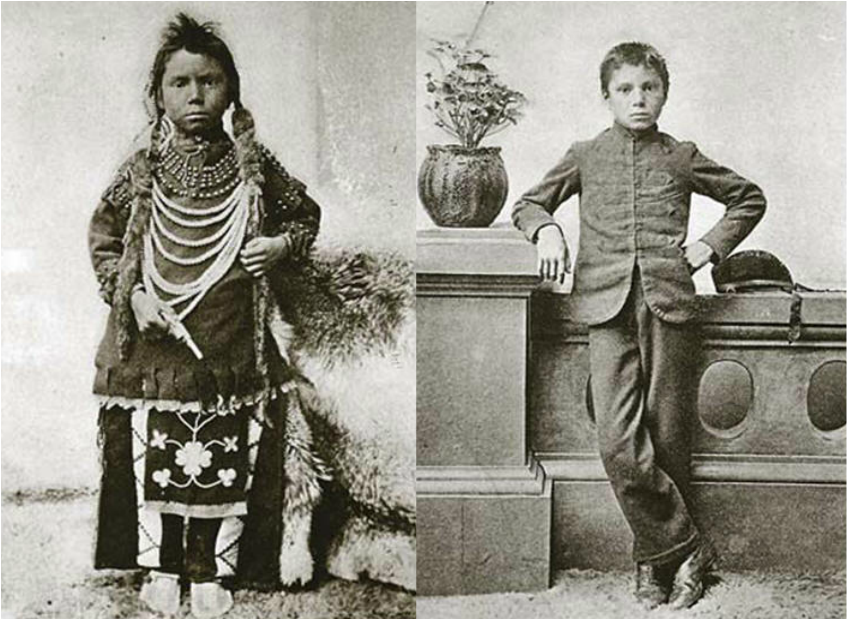
[Here] (http://www.trc.ca/websites/trcinstitution/index.php?p=12) is the complete list of residential schools operated in Canada. The last shut down in 1996, though residential schools as described above were commonest in the late 19th century through to about 1960. [Here] (http://firstnationsresidentialschools.weebly.com/uploads/1/6/4/4/16440524/1359398603.png) is a very famous photograph from ~1880 now used to teach about residential schooling in Canada. It's such a big story that I couldn't possibly do it justice in a Reddit post, but suffice it to say-- it's contentious. The relationship between the treaties and the Indian Act is ongoing in controversy.
Nowadays, the numbered treaty system and its associated rights and responsibilities has become a frequent topic in the courts, as different First Nations make the case that the federal government has violated the treaties. In the last 25 years, the treaties effectively have been acted on like legal agreements-- something largely absent for much of their history.