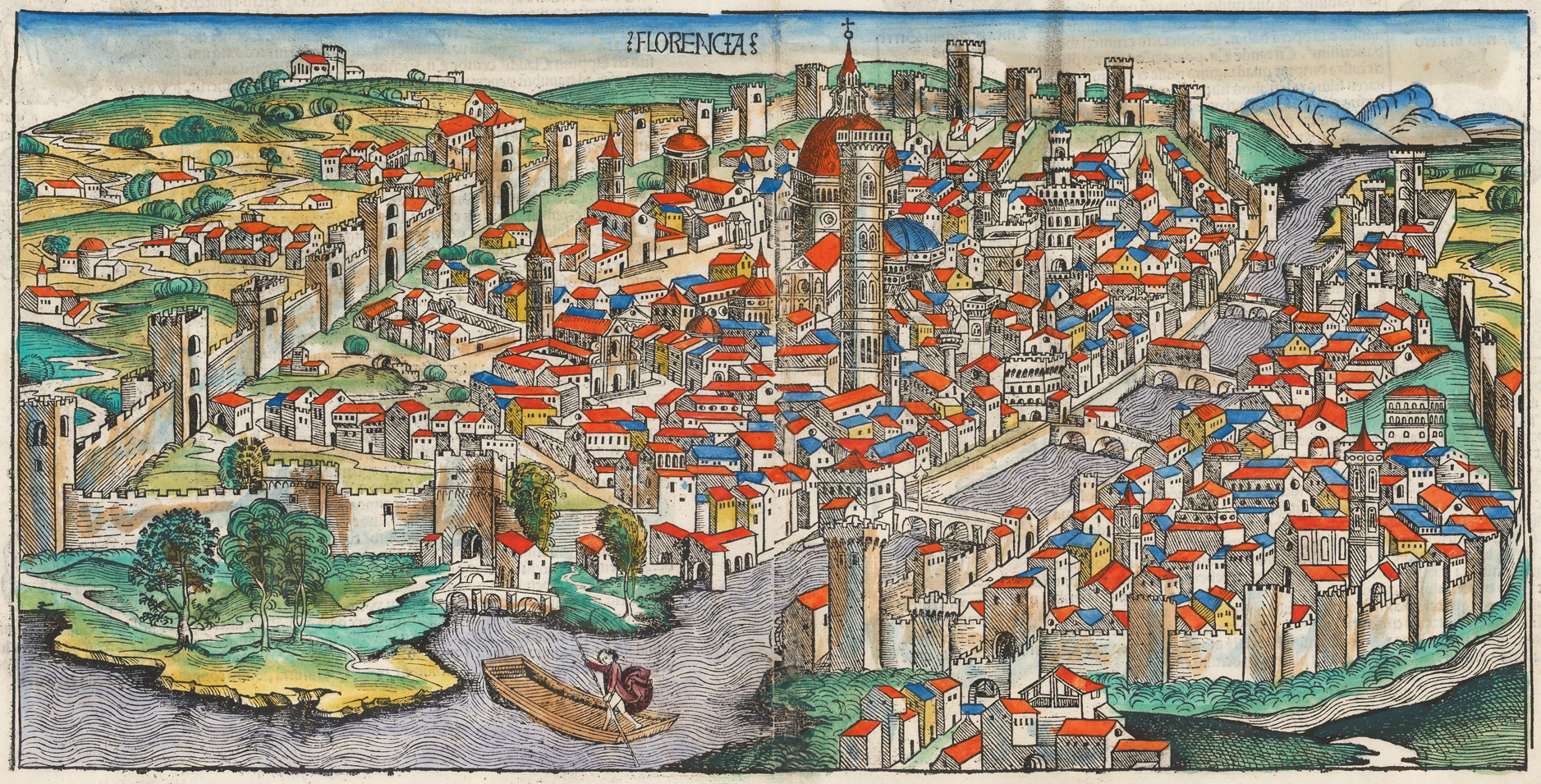
I understand the qualifier that the Medieval Era represents a large swathe of time, but I implore all of your various expertise to chime in with your more specific knowledge on this.
When I think of a medieval town I am imagining in essence a group of buildings that were erected to support a market. Unevenly distributed around the town for miles were farms, and the farmers would go into town in order to barter for goods not immediately available to them and to sell their produce, participate in festivals, hear news, and if they were lucky, relax at some point.
Is this model correct?
And if that is correct what was the typical make up of who resided more full time in the town? I assume the clergy and the skilled laborers (carpenters, smiths) and any semblance of local authority (the mayor/baron/lord), but would anyone else live in the houses there? What would daily life be like?
Again I know the general nature of the Middle Ages, but for each flairs give me your expertise both in the British Isles and Continental Europe from the 1000s to 1500s, because I would adore a good overview from as many areas as possible to help me paint a better picture.
If you want to look at city life in the middle ages, look no further than northern Italy. It was the most urbanized area in Europe in the high middle ages, which is why the renaissance blossomed there.
Take Florence for example. Here's a picture from 1493, on the eve of the renaissance: https://upload.wikimedia.org/wikipedia/commons/b/ba/Nuremberg_chronicles_-_FLORENCIA.png
I think you have to think a bit bigger when it comes to cities like Florence. Because that's exactly what it was, a city. There were at least a hundred thousand people living there. There's no way a population center like that sustains just based on trade with local farmers. The economy was based on far reaching trade and banking.
I'll list off some of the people who lived in Florence during this time. First of all, the guilds. They were the heart of Florentine society. There were literally dozens of guilds, making everything from nails to luxury clothing. Textiles specifically were big in Florence. There were spinners, weavers, dyers, dye makers, you name it. What we would think of as a supply chain today. Every profession organized under a rigid structure, from apprentices to masters. And the guilds had representation in the government, although it waned as Florence transformed from a kind of democracy into a kind of autocracy (more on that later).
There were a lot of unskilled laborers too, who hauled the carts and did basic construction work. I seem to remember them being formed into guilds too at one point, although I could be wrong on this. These people lived in the city with everyone else, which meant there were rich and poor neighborhoods.
There were also many aristocratic families living in the city. Many of these families had land and estates outside the city. Their power was often rooted in old, feudal, rural society, but they moved to the city because it was the center of life in the surrounding region. Trade, at least in this area of Europe, could compete directly with owning land in terms of lucrativeness.
In fact, as time went on, the most powerful merchant and noble families became increasingly indistinguishable. A lot of merchant families got their starts as minor nobles. Since they already had wealth it was easy to invest in business. And the Medici family, which eventually seized power and abolished democracy, made all its money through banking.
The leading families of Florence feuded constantly. Neighborhoods had walls around them. Mansions were fortified. Killings were common, both for familial honor and politics. The government even sponsored brutal blood sports like mock battles with clubs to let the city blow off steam.
One of the biggest divisions in society was between merchants and nobles. Though they dressed similarly and had similar wealth, the nobles never forgot that the merchants were of common blood. Another sticking point was whether to support the papacy or the Holy Roman Empire in their nominal claims to suzerainty over the area. These were somewhat intertwined. The merchants tended to support the papacy, the nobles, the empire.
Although the city was a kind of democracy during this time, it was marked by coups and purges. One side would gain power, either legitimately or illegitimately, execute the leaders of the other faction, and force the rest to flee. Both Dante and Machiavelli were driven into exile in this way. In fact, some people argue that when the Medici family seized power, it was actually a good thing for Florence, quelling centuries of unrest.
As far as the government goes, this was not a simple castle town. It was ruled as a limited democracy, with the leading families and guild members participating. Officials were elected. There were a lot of committees and representative bodies. The leaders, at least until the Medicis took power, served on a very temporary basis. Towards the renaissance the Medicis became the overwhelming force in the city's politics. Long before they became the dukes, they were the dukes in all but name.
The clergy were of course present. I have to say I don't know a lot about them, but I do know the Medicis had a strong connection to the papacy. They essentially bankrolled several popes. And the papacy was a highly political institution at this time, with a lot of land of its own.
To summarize, Florence was an economic powerhouse during its time. The coins it minted became the gold standard throughout Europe. Its bankers financed not only businessmen, but kings and popes. Its textiles were similarly ubiquitous. It and the other Italian city states like Venice were the richest places in Europe per capita. Despite their small size, they exerted quite a bit of influence. The bigger ones controlled multiple smaller cities and their hinterlands. Venice even had a maritime empire.
Of course, most other cities in Europe weren't analogous to these. Maybe the ones of the Hanseatic League. They seem to have been quite a unique phenomenon during the period. It's worth reading about them if you're interested.