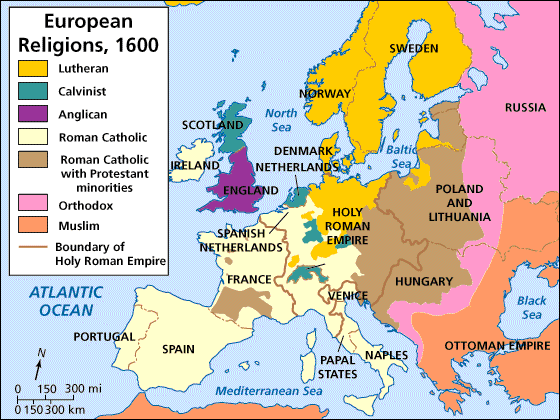
In this picture, the British Isles are shown to have 3 major religions. Why is Scotland Calvinist, and whereas Ireland remains Catholic and Britain is Anglican? I know that this map is just a rough approximation, but help would stil be appreciated! http://4.bp.blogspot.com/_zBTrwnUSmNc/TBqLUikJi5I/AAAAAAAAHms/Fy9hdW4UC74/s1600/European+religions+map.GIF
Firstly, Scotland is in Britain. On the map, England is marked as Anglican (and Wales isn't marked at all, but then, from a legal standpoint Henry VIII had made Wales part of "The Realm of England")
Secondly... why shouldn't they be different? They were different countries, with different histories. Scotland and England(/Wales) were ancient foes, having fought many wars (within living memory) and the Queen of England in 1600 (Elizabeth I) had actually imprisoned and eventually executed the Scottish King's own mother (and former Queen of Scotland).
More to the point, they'd had quite a different transition from Catholicism to Protestantism. Scotland was slowly influenced by various continental protestants, and the number of Protestants grew. A fiery preacher called John Knox popularised the Calvinist form of Protestantism. Several Protestant Lairds (lords), who called themselves the "Lords of the Congregation" became quite powerful, and got the Scottish parliament to adopt Protestantism. When a weak Queen Mary returned from France (her husband, the King of France, having died), Protestant Lords forced various concessions from her and eventually made her abdicate in favour of her young son, who was then raised as a Protestant. (A note: while that map describes Scotland as Calvinist, the Church is actually called the Presbyterian Church, not the Calvinist Church. But their theology is broadly Calvinist.)
The English Church became Protestant in quite a different way. Henry VIII was fed up with Papal control for various reasons (most famously because he wanted a divorce and the Pope wouldn't grant it to him), and "reformers" (ie people interested in Protestant ideas) gained influence with him by suggesting he declare himself head of the English Church, not the Pope. This was eventually done, allowing Henry to get his divorce, as well as dissolve the monasteries and get their money. So, unlike Protestantism in Scotland, which was essentially just the normal spread of Protestantism in its Calvinist form, Anglicanism was a top-down reform of the English Church to take it out of the Pope's control. Exactly how similar the Church of England should be to Catholicism, Calvinism or Lutheranism is something that was very contraversial in England, and was a strong influence in 17th century politics. In fact, even today there are "Anglo-Catholic" churches (aka "High" Churches) and "evangelical" churches, Calvinists and Arminians, conservative Christians and liberal Christians, all within the Church of England. It's probably one of the most theologically diverse Church denominations, to the extent that it's sometimes not even classified as a Protestant church at all.
But wait, one might ask, what of Ireland? In 1600, England and Scotland were two entirely seperate realms (this would change 3 years later), but Elizabeth I of England was also Elizabeth I of Ireland. But that's not something that the Irish approved of; the Irish chiefs had only accepted Henry VIII as King of Ireland because he invaded* and forced them to. In fact, in response to English attempts to reform the Irish Church to be more Protestant, settle English protestants in the Pale (an area under English law in eastern Ireland; it's the origin of the phrase that something is "beyond the Pale"), and general anger at paying taxes to a foreign ruler, there was a large rebellion in northern Ireland called the 9-Year War. This led with the Irish chieftains of that region losing, and their land being settled by Protestants (the origin of today's Protestant/Catholic rivalry in Northern Ireland). To the Irish, Protestantism wasn't a new radicalism discussed by the educated middle-classes, opposed to the corrupt establishment Church, as it seemed to many Englishmen and Scots; to the Irish, Protestantism was the corrupt church of their evil English oppressors. Thus, Catholicism became a mark of true Irish patriots fighting against the heretical English oppressor. And thus, while Protestantism was common amongst the Anglo-Irish nobility, it made little inroads amongst regular Irish people.
*The Kings of England had styled themselves "Lords of Ireland" for centuries, since the Norman invasion of Ireland had forced the Irish Kings to acknowledge English overlordship, but in the century prior to Henry VIII's invasion they'd had little real, practical power over Ireland.