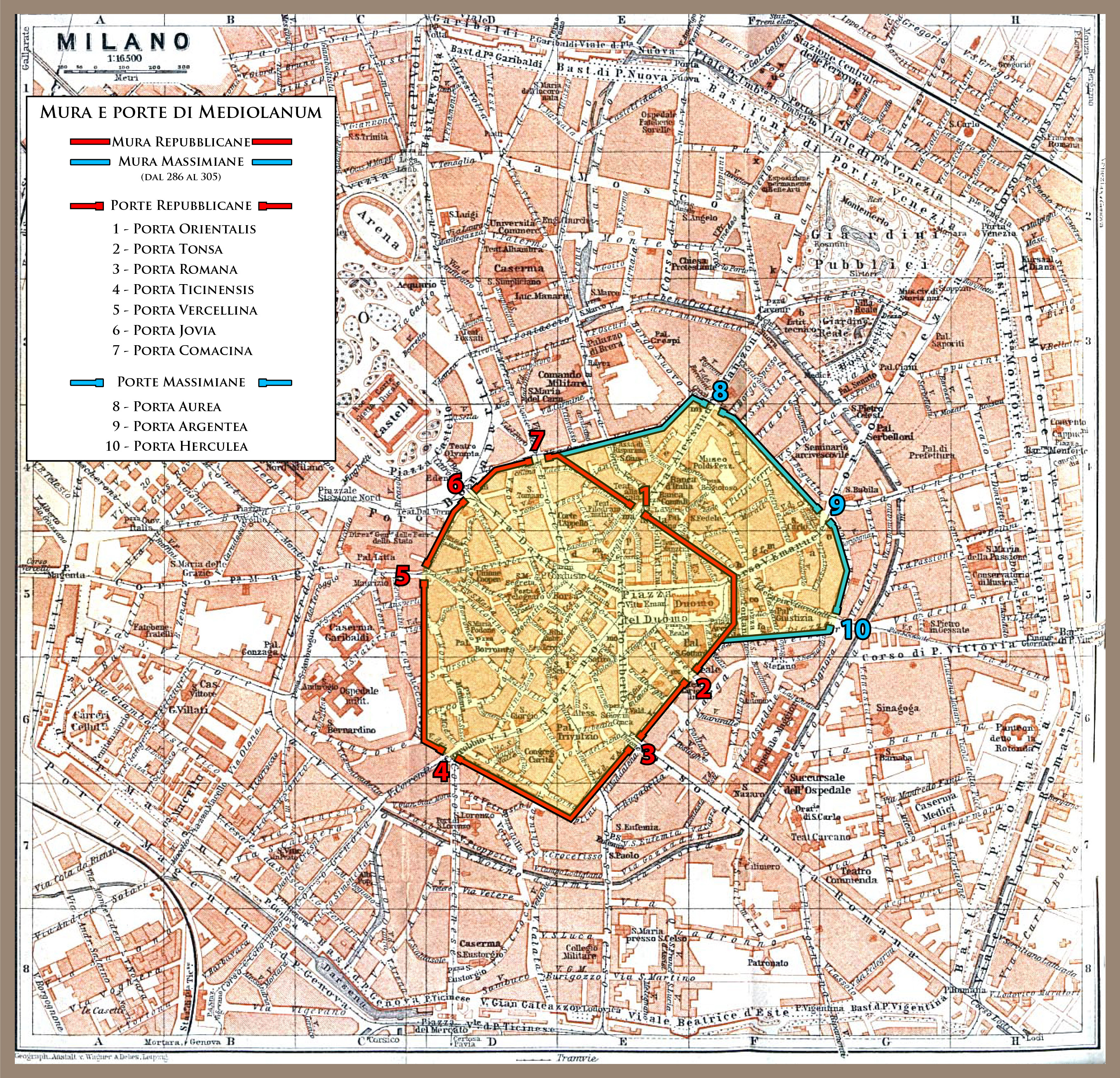
In one of the more important cities for my era of study, Milan, this actually happened in the year 286. The ancient city, called Mediolanum, had outgrown its walls. Consequentially, Emperor Maximilian commissioned an expansion. You can see the expansion of the walls here, marked by a blue line.
It was common for there to be small communities outside a large city's walls; expansions like those in Mediolanum were undertaken when these communities became too large to effectively evacuate in times of crisis. However, most ancient city walls would allow for large open spaces within the limits of the walls, giving the city space to grow. An exaggerated example is Syracuse, in Sicily, where the walls constructed by the ruler Dionysius in the 5th century BCE defended a massive area even larger than the modern city limits. The walls of Rome also allowed for large green spaces between the limit of urbanization and the actual wall.
This practice would continue until the middle ages, for example look at this representation of the Italian city of Siena.
By and large, when Roman cities expanded beyond their walls there was no real attempt to make additions or rebuildings. From a practical defensive standpoint, you don't really want a bunch of additions because that makes defense more difficult. It is a basic surface-to-volume ratio situation, as the ideal is the shortest possible wall circuit encompassing the largest possible area. Adding a bunch of additions greatly increases the "surface area" without greatly increasing the "volume" and so are impractical--in fact Chinese siege manuals--to use a comparison--generally recommend setting fire to suburban development to cut down on defensive complexity.
But there is a hidden assumption here, were walls for defense? It is a bit of a counter intuitive question, but if you look at individual cases, say the spate of wall building in second/third century British cities, it doesn't really make sense. There were no foreign invasions threatening London or Cirencester, so why bother building walls (also why build them so neatly, but that is a different issue)? It is probably because having a city wall was an important status symbol, and so rather than seeing Roman walls as practical defensive structures, we should often see them as decorative.
Im having a bit of difficulty finding the particular papers related to this, but JS Wacher's The Towns of Roman Britain discusses the wall building.