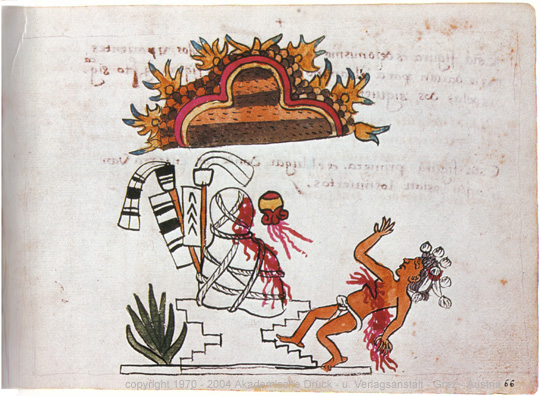
By this I mean the wrapping of the dead in cloth and rope so that the deceased is in almost-fetal position with just the head "upright." I've read about the Paracas culture, but didn't Incas also do this? I'm almost sure I've seen similar mummies attributed even to the Aztecs.
My questions:
How widespread was this tradition (if you can speak of tradition)?
What is the oldest grave found in this burial style?
What you're thinking of is most often called "mummy bundles" or, more simply, "flexed" burials.
In the Aztec context, these did exist, but were most often transient. The Aztec practice was to cremate, rather than bury, the body. Mummy bundles were an efficient way of preparing the body for what was to come next: cremation. Which is not say there was not some amount of symbolism to the flexed position. Compare, for example, this image of a royal mummy bundle from the Codex Magliabecchi with the depiction of the ruler Ahuizotl in the Codex Mendoza as he sits upon the reed mat which was one of the key indicators of rulership Late Postclassic Central Mesoamerica. Whereas the modern American/European eye might see such a position as odd or even awkward, the flexed mummy bundle evoked a more majestic position in Mesoamerican depictions.
Of course, while the Aztecs most commonly burned their dead, this was not a universal practice throughout Mesoamerica, nor even among the Aztecs. There are mummy bundles that have been unearthed in such unequivocal contexts as Tlatelolco (Iguaz 1993). Such "sacred bundles" however, appear to have been more significant in Western Mexico, particularly in the Oaxaca region. Duncan et al. (2008) suggest that flexed burials, like with the images above, may be seen as "seated" burials, indicative of a position of power, but that the general pattern was of adults to have extended burials. Blomster (2011), while not necessarily disagreeing, lays out how there was considerable variation in internment just within the Valley of Oaxaca over time, with both extended and flexed burials co-existing at the same time, and with other practices like secondary burials, ossuaries, and home interments also have periods of popularity.
So while flexed burials are found throughout Mesoamerica, their significance and prevalence depends on local context, rather than some broad pan-regional diffusionism. Wrapping the body up into a compact position can both represent a return to a symbolic fetal state (as suggested by Matos Moctezuma) as much as it can represent a seated ruler as much as it can represent simply a practical way to handle the dead weight of a body (and as someone who has had to handle corpses, a compact bundle would often be appreciated) on its trip either to internment, cremation, or extended veneration. The basic fact is that the extended, prone burials so familiar in Western cultures do not -- as many cultural practices do not -- exist for a particular concrete purpose, but are the result of a confluence of influences both practical and symbolic. So to are flexed burials. There is no reason not to bury someone in a flexed position, and so we see the practice cropping up throughout Mesoamerican (and beyond), but with varying prevalence and differing aspects of symbolism depending on the culture and the time period.