Part I
The outbreak of the Second World War in 1939 and the German invasion of 1940 caught the French right and far-right somewhat flat-footed. Political groups like Action Française and its their ideologues like Charles Maurras had been locked out political power of the Third Republic by virtue of the Popular Front. The various elements of the French right tended to bring up foreign affairs in the persistent political squabbles of the 1930s as a stalking horse to discredit the ruling coalition of left-wing parties and attack the degeneracy of the Republic. There little in the way of a coherent definition of France’s geopolitical role in Europe among rightist ideologues other than the vague assertion that France had lost her way. Outside of a few outliers like Pierre Drieu La Rochelle, there were not many voices in French rightist circles calling for either a fascist revolution or that France should hitch her star to an ascending Germany. The invasion of Poland reluctantly forced groups like Action Française to strike a pose for national solidarity and they did not actively hinder the war effort even if privately many rightists blamed their domestic enemies on the left for a war they did not want. But if the outbreak of the war posed a dilemma for the French right, the problems of both defeat and occupation were even more tendentious. Collaboration with the German occupation regime offered the tantalizing prospect of settling scores and restructuring French society away from decadence, but these plans foundered on the realities of the occupation.
Right before his death in 1952, Maurras summed up his thoughts on the calamity of defeat:
The barbarous occupation of 1940 would not have taken place without the Jews of 1939, without their filthy way, the war they undertook and they declared; our occupiers were introduced by them, it was the Jews who launched us into catastrophe.
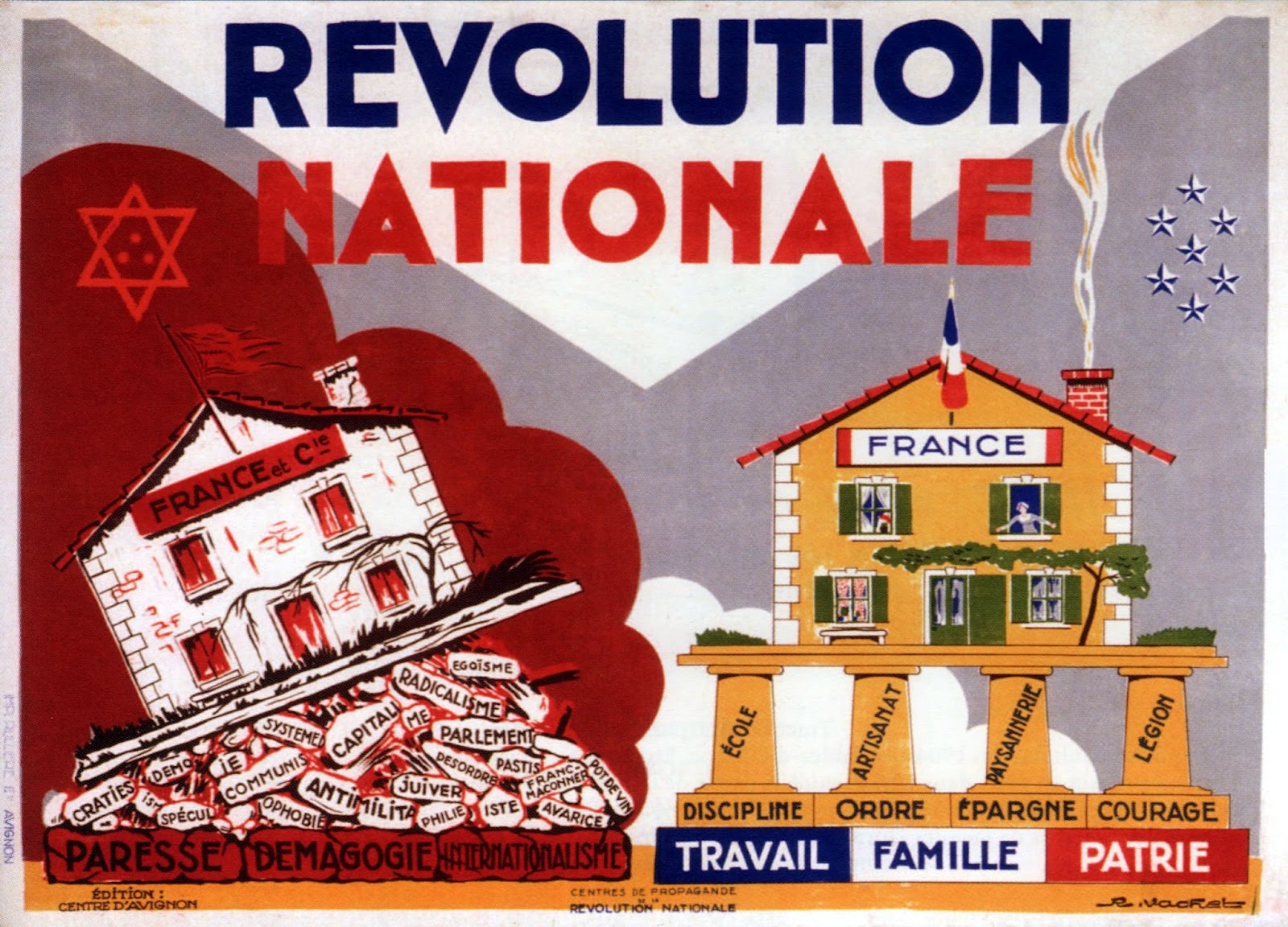
In addition to Maurras’s appalling antisemitism is a sense that was common among many right-wing circles in the aftermath of defeat: the war was not our fault and our political enemies are to blame for defeat. In this calculation, defeat was not something to be welcomed, save as it allegedly exposed the traitors and sources of French anemia. In this sense, the suddenness of Fall Gelb and the totality of German victory were a boon for French right-wing politics in that it proved what they had been arguing for decades about the Third Republic. The ascendency of Marshal Petain also came with notions of French spiritual and political renewal along conservative lines. The schema for Petain’s Revolution Nationale was apparent in this famous Vichy propaganda poster which contrasts the poor foundations of the Republic with the ordered conservative principles of the new France Vichy was to serve as a gateway. The Vichy regime itself was not to be a new state, but rather serve as a mechanism for political rejuvenation Revolution Nationale.
Yet national rejuvenation was much easier said than accomplished. Petain had a noted reluctance to investigate his fellow officers and there was constant foot-dragging to bring the Republic’s military and political leaders to trial. When the Riom trial finally took place in 1942 after much German pressure, the defense soon proved the trial to be a farce and the trial was suspended after a month.
This is not to say the French right did engage in recriminations; the postwar antisemitism of Maurras’s statement on French defeat illustrates one segment of French society the right could scapegoat. Vichy’s control of the civil service like the police meant that there was little love for the plight of the Jews under German occupation. Raphaël Alibert, Vichy’s first Minister of Justice and an acolyte of Maurras, drafted a provisions of French law that defined Jewish identity racially and denied Jews leadership positions in the French government and military. Other aspects of these antisemetic provisions included limiting Jewish participation in French arts and culture, which built on older rightist discourses on the predominance of Jews in the cultural degeneracy of the Republic. Alibert signed these laws in October 1940, and although many at the time suspected that it was at the behest of the German government, postwar research by Claude Singer and Richard H. Weisberg has shown these antisemitic measures were done without German prodding. Vichy’s Foreign Minister Paul Baudouin would justify these measures to the US State Department claiming the assimilationist polices had patently failed and measures were necessary to quarantine Jews from the wider French body politic since Jews “did not accept the French spiritual inheritance.” There were other purges of suspected communists and a general increase in anti-Bolshevik rhetoric and discourse in the Vichy press, often associating communism with a Jewish conspiracy.
One way in which the German occupation impacted French politics was that it allowed the French right to give into its worst impulses and provided little in the way of a check against the rejuvenated antisemitism of Vichy ideologues. But aside from attacking groups that were rather powerless to begin with, the German occupation offered the French right very little in the way of tangible gains. Maurras may have been a staunch antisemite and a typical Action Française figure in his hostility to republicanism, but he was also a French patriot (and in the minds of many Action Française members, antirepublicanism and antisemitism were vital elements of French patriotism). Baudouin frequently called upon the German ambassador and his counterparts in the German foreign ministry to come up with a final peace treaty that would normalize Franco-German relations, but to no avail. One of the fundamental problems of the Franco-German relationship in this period was that Hitler was either unwilling or unable to grant France few concessions which made collaboration very much a one-way street.
The dead-end nature of collaboration was evident in the lack of interest in German circles over the fate of France’s far-flung colonial empire. The Empire was one of the signature signs of French strength and Vichy’s leaders placed great stock in the colonies as a source of power and prestige. Admiral François Darlan, Petain’s main deputy in early 1941, envisioned the world as divided into three power blocs: European, Bolshevik, and Anglo-American. France’s global colonies, according to Darlan, allowed her to exert Europe’s influence in global affairs. Alliance with Germany would allow for French strength and national renewal to act as Europe’s counterbalance to the other blocs. Darlan believed that the Republic’s alliance with Britain was a mistake, since British victory would turn France into a “second-class Dominion, a continental Ireland.” Drieu likewise argued that France’s colonial position would make Germany’s hegemony more secure and place France as one of the chief lieutenants of a pan-European order. Various entities within the Vichy French colonial service also attempted to articulate a vision in which French colonial space would coexist and supplement the new order promised by the Third Reich. One of the most prominent of these advocates was Edmond Vivier de Streel, an industrialist and former cabinet chief of the Colonial Ministry. Vivier de Streel envisioned France as the colonial power within a German-dominated Europe; it would be the standard-bearer of European civilization and act as a source for colonial products for Europe. As de Streel put it in an October 1940 interview, if France intensified its colonial efforts:
our country can orchestrate a material turnaround under the aegis of a noble ideal that will vivify the flame of patriotism; it can also, with the help of other European states, ensure others their supply in raw materials, and a parallel increase in exports which will liberate them from their own geographical servitude.
In de Streel’s formulation, the colonies aided both national rejuvenation after 1940, but also cemented France’s position within the new order of a German-led Europe.
The problem was that Germany had very little interest or ability to protect France’s colonial possessions, and pursued policies that undercut the viability of Vichy’s hold over the French empire. The Japanese initial moves in Indochina caused considerable alarm in the Colonial Ministry especially after a sharp border clash with Japanese forces at Lang Son in September 1940. Vichy acceptance of the Japanese occupation of the colony, even with the French colonial administration existing in some capacity, was a major blow to the prestige of the empire and its ministers since it was clear that they were taking the orders of a non-white power. Baudouin was apoplectic about an Asian power occupying a European colony. His appeals to Berlin to rein in Japan on the basis of racial solidarity fell on deaf ears as strengthening Japan was geostrategically beneficial to Germany. German strategic thought had formed a consensus by 1941 that Japanese expansion into these SE Asia was in Germany's larger interests. Japan's occupation of resource-rich Indochina meant that neither Britain nor the US could take advantage of the colony for their war industries. Similarly, planning at OKW envisioned that a strengthened Japan would tie down significant Anglo-American forces, giving Germany ample time to conclude its invasion of the Soviet Union and win the Battle of the Atlantic.
Related question: was there resistance by far-right groups to the liberation of France?
A good portion of far-right French thinkers rallied against the Germans for attacking France. Remember that the bulk of French nationalism for the past 50 years had been organized around anti-German sentiment. I remember that Maurras had been hostile to the Germans invading but proclaimed that it was a "divine surprise" that Petain had been put in charge of the defeated state. The hope for many far-right groups was that the defeat cold be taken in stride and used to their advantage. And even among the Vichy government there were disagreements about exactly how much deference should be given to the Germans with regards to extraditions and so on - nominally Vichy France was the legitimate, and therefore independent, French government.
On the Gaullist front you had a solid mix of far-rightists still hostile to Germans, social-democrats, conservative republicans, monarchists, and communists - all people unwilling to accept the surrender and trying to legitimize their movement as the French government-in-exile, which had trouble propping itself up to the Allies for quite a while. De Gaulle himself was considered by some at the time to be some variant of fascist (even outside the realm of political posturing).
So there were really four reactions by the far-right to the German invasion: 1, hostility because the Germans were attacking (virtually universal). 2, refusal to accept defeat and withdrawal to resistance (where the Communists vastly outnumbered them) or to the Gaullist front (substantial portion of the supports). 3, willingness to rebuild under the Petain government as some sort of unexpected boon from defeat. 4, open pro-German collaboration, even at the expense of the French state.