I was able to pretty quickly find the text of Executive Order 9066, FDR's order that led to the construction of Japanese Internment camps in the US. I know it isn't quite the same as Germany's camps, but I'm researching the broad subject of 'camps' (from all nations) and how they start.
I have found that: (Please correct any inaccuracies at your leisure)
What I have not found is: (This is where I really need your help)
I suppose it's possible that these don't exist, but that doesn't jive with my perception of the Nazi regime. Did they just do things differently? I'm prepared for that kind of answer, too.
Part 1
"The main constant of the KL [meaning the Concentration Camps System] was change", writes Nicholaus Wachsmann in his new seminal study on the Concentration Camps. The main thing to keep in mind here is that the CC system underwent several historical distinct phases and a particular evolution, that – as the word implies – did not follow a pre-determined or set-in-stone central plan but was often the result of local initiatives.
In fact, the very beginning of the Concentration Camps represents such a case: When the Nazis took over power in 1933, they had long since promised to do away with and persecute the political enemies, which they and their supporters regarded as dangerous: Social-Democrats and Communists. However, they had given little thought to how they would do this on the practical side. After the take-over of power and after the Reichstagsbrand-Decree suspended parts of the constitution and civil rights, a wave of centrally-ordered and locally initiated mass arrests went over the land. In 1933 alone, it is estimated that up to 200.000 people, mostly communists and social democrats were arrested by the SA, the SS, and German police.
The basis for this was the legal construct of "Schutzhaft" (protective custody). A construct that meant taking people into police custody to "protect" society from them and thus not requiring any sort of legal process or similar, this had been employed during WWI and shortly after (Rosa Luxemburg having been a person, who was taken into protective custody at one point) but it really was the Reichstagsbrand Decree in which it said that the government was able to "take all necessary measure to restore public order and security" that solidified the concept. Later on, protective custody would become deeply intertwined with the Concentration Camp system, especially after a 1934 decree of Reich Interior Minister Wilhelm Frick (the *Runderlaß des Reichsminister des Inneren Dr. Wilhelm Frick über die Bestimmungen zur Anwendung der Schutzhaft *), which not only made the Gestapo the sole institution to be able to take people into protective custody but also explicitly mentions the Concentration Camps as a place to do this.
But this is going ahead: The crucial development was that in 1933 there were a lot of Nazis wanting to arrest their political enemies and with the Reichstagsbrand decree, they had a tool to do so. What they didn't have was space: Normal prisons, build in the Weimar era and before were frequently criticized by the Nazis and being too lax and nice for the prisoners. Additionally, they often didn't have the capacity to hold all the newly arrested communists etc. Out of this necessity, the earliest Concentration Camps were born: Set up ad hoc in the cellars of known SA bars or established on the fly by local and regional agencies, the earliest camps of 1933 served as sort of Ersatz-prisons and places where political opponents could be brought, beat up and imprisoned.
These early improvised camps tended to last only for a few weeks because soon regional and state agencies became involved in opening up special prisons for political enemies and in the literal sense trying to concentrate them in one or several places. Thuringia and Prussia were the first federal states of Germany to do this (also, where Hermann Göring comes in). In order to facilitate the protective custody of political enemies, police would take several hundreds of political prisoners take them to a marsh and instruct them to build a camp, where they'd be housed potentially indefinitely, as was the case with the Emsland Lager in Prussia. However, these early attempts often failed, simply because after a short while, many of the imprisoned were deemed by the political police, normal police or party agencies as not sufficiently dangerous and let go and thus, many camps closed down.
These early mass arrests were in effect comparable to a show of force, arresting hundreds of thousands of potential political enemies to show that a new Nazi sheriff was in town and resistance was futile. For many of these prisoners, there was never the intention of keeping them locked up forever. In some cases, this differed though and that was mainly due to one person with a vision of a system of extra-legal prisons under his control: Heinrich Himmler.
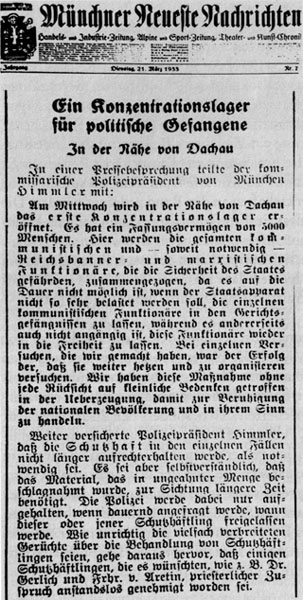
Having become police president in Munich in early March 1933, Himmler arrived there with the idea of establishing an extra-legal prison where all political and other enemies of the Nazi state were to be imprisoned and kept away from society and punished. The result was the Dachau Concentration Camp. While Himmler stated to his subordinates in the camp as well as in several press conferences in March 1933 that Dachau was to become a model camp to concentrate the Reich's enemies, the official document setting it up is less spectacular: After having discussed this with his the boss Röhm and the Bavarain minister of the Interior, the state of Bavaria simply issued orders to set up a prison camp at the Dachau munitions factory near Munich, in much the same way, they would have set up any other prison. While Himmler wrote several times that Hitler approved the idea, there was not a Reich-wide decree from Berlin setting up these camps nor some sort of special hub-ub. Rather, on an administrative level, setting up Dachau worked like setting up any kind of prison had worked since the Weimar Republic: The ministry of the Interior of Bavaria, the ministry of Justice and the Police hashed out the details, issued a decree and thus Dachau was set up. While the decree specified that it was to be a camp – in the sense of prison – for political opponents, it was originally set up like any police detention camp with the SS employed as auxiliary police. It was only on April 2, 1933 that Himmler ordered – via internal police decree – that the SS was to take over completely from the police.
Thus the first real concentration camp as we understand the term – run by SS, distinct from prisons, having its own culture of forced labor, beatings etc. – was born: Not with one central document specifying all this but with a series of steps: From protective custody to the federal states erecting police prison camps, to Himmler placing it under SS-administration via decree.
Subsequently, Concentration Camps and the Concentration Camp system were referenced often in decrees issued by state agencies (the aforementioned Frick decree as well as others) as well as by the news media, which hailed the development as a bold and necessary step (Himmler giving the press conference for the opening of Dachau). Here are some examples: Münchner Neueste Nachrichten reporting the opening of Dachau; a newspaper from Brandenburg reporting about prisoner transfers to Oranienburg; the Sindelfinger Zeitung reporting arrests of communists and their transfer to the Heuberg Concentration Camp in March 1933.
While after establishing Dachau and naming the notorious Theodor Eicke its commander, the Gestapo under Himmler slowly expanded its power over what camps existed in Germany, the establishment of a Reich-wide system of administration of the camps came only in 1934 after the SS had established itself as a sole, independent, and important agency of the Nazi state by getting rid of the SA leadership and specifically Röhm in 1934. In the aftermath of the "Night of the long knives" Eicke was named Inspector of the Concentration Camps and the according agency, the IKL or Inspectorat of the Concentration Camps was founded by Himmler in his capacity as head of the SS and Gestapo. A sub-agency of the Gestapo, the IKL united administrative responsibility and overall-command of the camps in Dachau, the former SA-camp Oranienburg, the Esterwegen Camp, Sachsenburg, and the Berlin Columbia Haus; almost every other camp were dissolved or continued as a regular prison and all the aforementioned camps were organized along the model of how Eicke had organized Dachau; with a specific internal division of labor, a camp Gestapo, a specific set of camp rules etc.
The documents concerning the founding of the IKL and its early administrative output, today found in the German Bundesarchiv under the signatures NS 3, NS 19, and some of them under R 3001 unified administrative responsibility and in many ways unified the camp system. It also gave via taking over several impulses previously pioneered in Lichtenburg and Dachau, the camps the internal structure we are so familiar with; the Kapos, the commanders, the punishments and so forth.