I know philanthropy became a big deal in the Victorian times and using your own funds to create public libraries etc and religions have always collected donations for the poor. Just wondering if there was actual charitable organisations etc? More interested in Roman era
In a sense, yes. Since you mention Rome and the kind of philantropy that permeated Victorian society (of which I have to confess that I posess no knowledge), if one looks at the ancient cities of the Roman Empire (and before of the Hellenistic Era), you will find a certain measure of philantropy as well. I should preface this with the caveat that I won't be talking about charity by Christians in late antiquity, since that is not very representative of the kind of charity that took place during the early Empire, and others here are more qualified than me on that topic. I'll also be talking about private actors, not about the Emperor who was arguably the largest spender on public works and displays of charity.
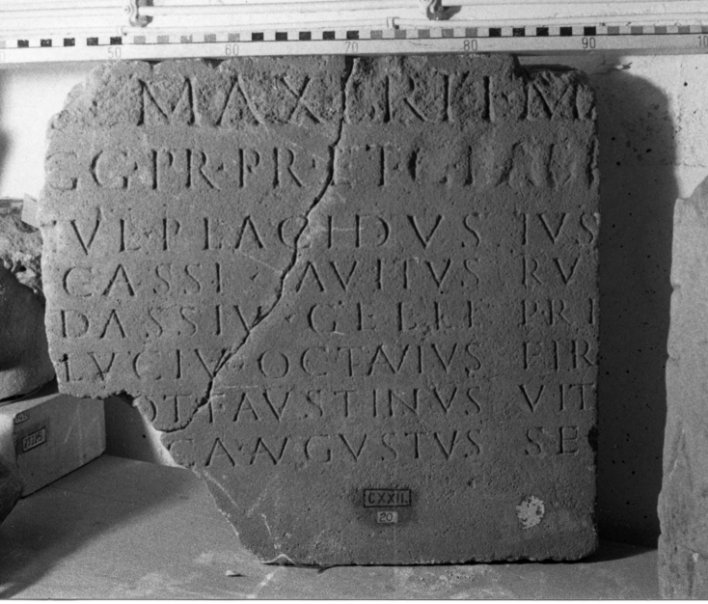
That being said, an ancient type of philantropy, for which modern historians have coined the term 'euergetism', which comes from Ancient Greek and literally means 'doing-good-ism', was a very important element of civic life throughout the Empire. Greek and Roman cities were full of buildings and other works that were the product of the munificence of a wealthy benefactor, or a group of benefactors. This included temples, arches, porticoes, basilicas, churches, statues and altars for the Gods, libraries, baths and sports facilities and so on. In fact, one of the most famous buildings that remains to us from antiquity was the result of this form of euergetism, the Pantheon. To this day you can read the name (the letters are modern copies) of the person who built it (it was restored by Hadrian later and finally became a church and one of the most enduring and imposing symbols of Roman public architecture): Marcus Agrippa, son of Lucius, Consul for the third time, made this.
This is only one, if a very prominent and memorable example. But it also clearly shows something very important in this context: The name of the benefactor is one of the most important and immediately apparent features of the building. Everyone entering the Pantheon through the monumental entrance-hall, the pronaos, would be confronted with it and consequently know just whom he had to be thankful to for this building. And in turn, this is one of our main sources by which we come to know about such acts of charity, since every benefactor would take great care to have his name recorded for all his fellow citizens to see in an inscription placed either on the building or in close proximity, or on a plaque on the part of the bulding he helped to finance. Sometimes they would also explicitly state the amount of money they had spent (which incidentally also tells us something about the cost of buildings in general).
It wasn't necessary to fund a complete building, some just financed a wall, some of the building material, or even just a single column, all of which was recorded epigraphically. So even if this was part of elite activity, since even a simple column would be more than the average citizen would be able to afford, there was a wide span of possible investment, from a modest column to grand baths or libraries. In fact, these small scale acts were probably quite common compared to grand investment. In one of his letters, Pliny the younger, who was governor of Asia minor at the time, reports that some of the citizens of Nicaea had joined together to finance the building of a new theatre, each electing to pay for a part of the structure:
Several private persons have undertaken to build the compartment of this theatre at their own expense, some engaging to erect the portico, others the galleries over the pit [Ep. 10.37,3]
It was quite common for people to group together in a collegium to collect the money needed for a certain building. In Bonn, a group of centurions are listed each by name as the financiers for a monument for the honour of Caracalla, Geta and Iulia Domna in this inscription (AE 1985, 683), while another inscription from Carthage (AE 1964, 124) records the building of a porticus for a temple of Pluto, financed by a large group of people, just to give two examples.
What also becomes clear here is that it weren't just buildings that were immediately beneficial to the public that were erected, like libraries, sports facilities, baths, roads or temples that were build here, but also constructions that were purely of aesthetic value, like statues or arches. These served no immediate purpose, apart from beautification of the cityscape, other than conspicuous consumption. This is one very important aspect, since it shows that many of these instances of euergetism were not what we today would file under charitable actions, but rather examples of the elite spending money to quite literally cement their status in public view and reflect the social hierarchy in a way that was immediately apparent to the public eye. Competition among the elites also played a part here. Sometimes, these donations were also prompted by immediate need, such as when Fabius Maximus rebuilt the Sabinian Baths at Telesia, which had been destroyed by an earthquake (vi terrae motus eversas, AE 1972, 150).
Another field of euergetism were festivals, games and contests, festive processions and feasts, which played an important part in urban culture (in some cities there was some kind of procession or procession winding its way down the streets almost every day) and were often financed by private persons. These processions would also often quite literally reflect the social order, with images of deities or the emperor at the front, followed by the cities magistrates and the council, with the lower social rungs in the back, so while the whole population often would take part, they did so in a context that made their place clear. Gladiatorial games are also included in this category, which were very popular among the people and would often secure public acclaim for the benefactor. Advertisements painted on the walls of the houses of Pompeii tell us of upcoming games, who financed them, and the number of pairs of gladiators involved, like in this example CIL IV, 3884:
D(ecimi) Lucreti / Satri Valentis Flaminis Neronis Caesaris Aug(usti) Filì(i) / perpetui gladiatorum paria XX et D(ecimi) Lucretio Valentis fili(i) / glad(iatorum) paria X pug(nabunt) Pompeis VI V IV III pridie Idus Apr(ilis) venatio legitima et vela erunt // scr(ipsit) Celer // scr(ipsit) Aemilius Celer singulus ad luna(m)
Translated: "20 pairs of Gladiators of Decimus Lucretius Satrius Valens, perpetual priest of Nero Caesar, son of Augustus, and 10 pairs of Gladiators of Decimus, son of Lucretius Valens, will fight at Pompeji on the sixth, fifth, fourth, third and second day (counted backwards from) the Ides of April (8th through 12th April 79). There will be a legitimate hunt and awnings! Celer wrote this. Aemilius Celer wrote this alone by (the light of) the moon." Note how the name of the sponsor is the most prominent feature here.
Donations of goods or money to the citizen body were also a field where people could engage in deliberately showing off their wealth while at the same time helping their fellow citizens. These distributions would most often include olive oil, grain and wine, but also money. However, as Arjan Zuiderhook has very succintly put it, these distrubutions were
gifts to the city or the citizens, not to the poor. Even those forms of euergetism that carried a semblance of philantropy, such as distributions of grain or money, were often targeted at those who least needed them. As inscriptions show, those at the top of the social hierarchy received most. [p. 33]
This also reflects the rather sober reality of the often-cited 'grain dole' in the city of Rome itself, which was not really a welfare programme - on this, see f.e. this post by /u/XenophonTheAthenian. It is simply a further manifestation of the hierarchy in the city, and so while the poor may have profited to some degree, from festivals, feasts and games, the rich profited more, and monetary gifts seem to most often have gone to members of the local councils.
One thing has to be mentioned in this context, since it was a long-held view, and that is that these private expenditures made up for shortcomings in the financial capabilites of the cities, but this is no longer believed to be the case. One of the earlier arguments for euergetism was that the cities simply had little money, but this doesn't seem to be the case. For one thing, cities laid claim to a certain amount of 'workdays' that citizens had to spend each year working for public projects (usually around 5 days a year), which represents a quite big workforce, a direct pecuniary advantage for the city. Cities also often owned public land that they rented out for substantial income, and collected tolls, fines entrance fees for baths and so on. Another thing to consider here is that the attaining of public office often was connected with the obligation to pay for this office, the summae honorariae, which often took the form of financing public buildings. What's also important is that we would expect private acts of munificence to be over-represented in our records, since they were something exceptional that was connected directly with the individuum, while the more mundance public tasks one had to undertake were more commonplace and hardly worth remembering. Private euergetism was probably not necessary for a city to survive, even if that is impossible to prove, but there are cities from which no examples of such private dedications survive.