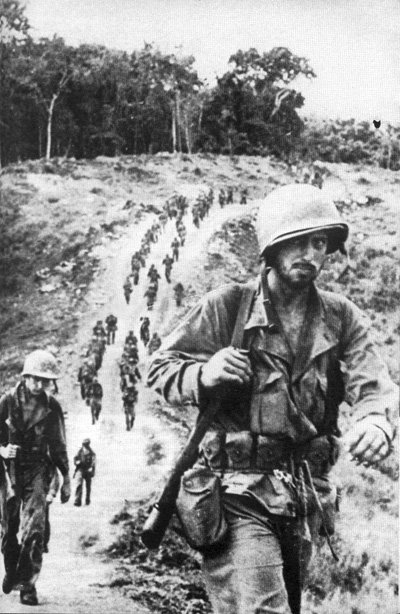
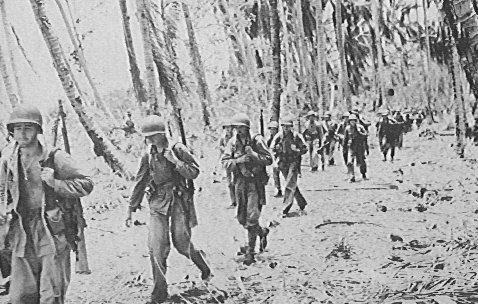
Honestly its a bit hammed up to make the show more interesting, but it is at least in the right area as a depiction.
Combat in the Pacific was not pleasant, and often in conditions that simply had little direct comparison in Europe. The Tropics will also do horrible things to the physical condition of even well prepared fighting men.
Irregular supply, continuous close contact to the enemy, sustained forward operating before relief units arrived, and a truly dedicated foe could strain any unit. All in weather that makes proper nutrition, medical care, and hydration even more essential. And we should note conflate appearance necessarily with ill-discipline at all. Situations like those faced in much of the Pacific had a way of stripping away all that was not of immediate concern or need to the fighting man. So if it was too heavy and unused there is a good chance it is getting discarded and the climate of the region does a lot to dictate what you can do without when or "lost" and if you are on water rations, drinking is far more important than shaving to look at another example.
Lets just look at a few instances, the first being Guadalcanal. The success of the IJN in dominating the immediate seas around the island after the landings, and the shoestring nature of the campaign meant that for more than a month supply was tenuous at best, and the Japanese determined to drive the Marines out. The First Marine Division then would be in near constant combat for 4 months from early August until being fully withdrawn in early December, on an island with next to no internal infrastructure beyond the coast.
This meant that there often was little ability to provide clean uniforms, or even wash those they had beyond a dip in the surf or a river, and the men could indeed look little better than ruffians. While the heat was no friend and stripping of uniform parts during work was no rare sight.
While later at Tarawa for instance circumstances again meant that the experience was one of a continual meatgrinder until one side or the other was dead. The result was 4500 dead Japanese, with 1k dead Marines and another 2k as other casualties. The small speck of an island was surrounded by a coral reef that prevented landing craft from getting close or approach from larger ships, while purpose built LVT's were few in number and only able to deposit their loads on the beach under Japanese guns. That meant for the next 3 days tasks as basic as getting more fresh water, or ammo to shore, let alone more men, or taking wounded off were risky at best. By the end the blasted burned out island resembled what it had done to the men on it. And it would be another 6 months before the 2nd Marine Division saw combat.
We should also note that Band of Brothers shows a lot more of the men in garrison, training, and in general postings away from the front. The whole not saluting officers thing is actually very basic fiedlcraft that virtually every modern force uses, along with the removal of rank insignia or making them less obvious. Its generally considered a poor choice to point out your leaders for enemy snipers or others looking to ruin your day.