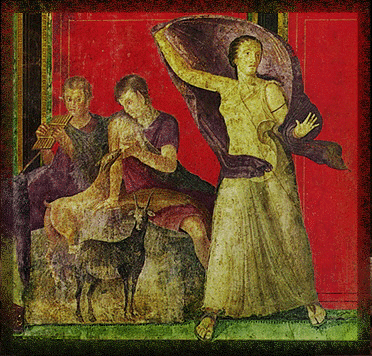
The hard and fast answer to this question is yes, but you may have to forgive me because in order to appropriately support that answer, I will need to go a bit more in-depth than just talking about shoes. The TL;DR response is best explained by the Romans themselves: e gustibus non est disputandum— there is no accounting for taste. I can give you a general idea of how things might’ve been, but we all know that person who insists on wearing Birkenstock sandals with every outfit they put on, so it’s more insightful in the long run to discuss the reasons why a Roman person picked a particular pair of shoes, rather than give a list of specific examples.
For the slave class, footwear was pretty homogenous in that they tended not to wear footwear at all. That said, if a slave was afforded shoes, there were a lot of factors aside from sex that dictated what they might be given: working conditions, seasons, personalities of masters/mistresses and favouritism within the household combined mean that it's probably easier to say what a slave wouldn't wear. To clarify, a long-serving ornatrix may have worn more luxurious footwear than a male kitchen slave was afforded in the same household. This was not necessarily due to her sex, but rather because her work involved long hours in direct contact with her mistress, which in turn might result in a sisterly bond between the two women if the mistress was genial. A similar phenomenon could also easily occur when comparing, for example, the master's secretarial slave with a housekeeping maid.
Moving up from slaves in the social ladder we have the plebs. Economically, plebs ranged from practically destitute to extremely rich, so again, there are quite a few external factors to consider when discussing the differences in footwear between sexes. In a poor family, women and men would likely wear the same footwear typically provided to slaves. These were called carbatinae, and were essentially a dressed-down moccasin: a flat piece of leather wrapped around the foot, with little strips cut to tie together and hold it all in place. Size aside, the style would not have differed substantially between men and women.
If a plebeian family was better-off, however, things begin to diverge. Generally speaking, footwear that covered the upper part of the foot was for outdoor use, whereas sandals, or soleae were for indoor use. A “middle-class” pleb typically possessed a slave or two, which in turn would change the expectations of the household mistress: errands involving leaving the house could be deferred upon the slave(s), meaning that the mistress inevitably spent more time wearing thong-like sandals. Since the sandals would be her primary footwear, she might elect to purchase more ornate or more comfortable sets, according to her personal priorities and tastes.
By contrast, her husband would likely own fewer pairs of sandals, as more of his day would be spent outside the house. His footwear of choice might be a fancier set of carbatinae, or— if he preferred a toga to a tunic—a set of calcei. At first glance, calcei look fairly similar to carbatinae, but for Romans the unmistakable difference was the hobnail sole of the former: slaves were forbidden to wear calcei, just as they were forbidden to wear a toga. There was a great deal of variety in styles of calcei, ranging from quite simplistic to rather ornate. If his wife were to leave the home, she likely wore a specific subset of this type of shoe, called calcei muliebris. Like her sandals at home, her calcei were likely made of a softer, thinner leather, and might have been dyed to a vibrant colour. Suffice to say that although the design of the family’s footwear was similar, if you were to line every shoe in a household up, it would have been quite easy to tell whose shoes were whose if the mistress was fashion-conscious.
A specific subset of the plebs— and their direct hierarchal superiors, the equites— worth briefly mentioning are soldiers and their families. Serving soldiers wore caligae, which were quite distinct from women’s shoes. They were also fashioned without hobnails for women, although this is less common archaeologically.
Finally, footwear in the highest echelons of society— the richest of the patricians—differed substantially between sexes, if the wearer so inclined. The overall trend appears to have been that the richest men tended toward calcei, whereas the richest women favoured fairly ornate sandals. This is ostensibly due to the overall seclusion of patrician women in combination with their preference toward travel by sedan chair, which was the ultimate protection against refuse found on the street. Surely some Patrician women did wear calcei as well, but the fact that wearing sandals outside the home was generally considered effeminate indicates that sandals were a strictly indoor item for men.