Given how common belief in/stories about dragons were across many different cultures in Eurasia I was wondering if there was anything similar among the pre-European inhabitants of the Americas. If so what were some of the traditions and what were their unique features? Are there distinct shared archetypes - like Western vs Eastern dragons in Eurasia?
In addition to the Piasa mentioned by /u/SpookySabe, the Underwater Panther of the Great Lakes area can be considered to be dragon-like. It has a feline base, but with horns, a serpentine tail, sharp scales and spines, and other apparently crocodilian features. It's probably the closest you'll get to a European dragon shape-wish, but is still mostly catlike.
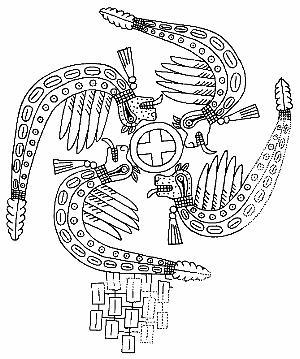
Further down south in Mesoamerica, the image of a feathered serpent takes the form of a popular wisdom god in many cultures, the most notable being Quetzalcoatl and Kukulcan. I suppose you can compare their shapes with that of Asian dragons, though their resemblance is mostly superficial and the details of their design are quite different, and their role in mythology are extraordinarily different.
Feathered serpents also make their appearance in the American Southwest, in the form of Kolowisi for the Zuni and Avanyu for the Tewa, both mostly water spirits. Depictions of winged rattlesnakes also make their appearance in Mississippian iconography.
Yes there is but they are more sort of bird like creatures than reptilian. These include the Piasa from Native Americans on the Mississipi. The Thunder-bird of the North Western tribebs. The Quetzalcoatl of the Aztecs.
The Piasa was a creature said to have existed long before the Europeans came some tribes say they lived during the last ice age. Piasa in the local languages means 'the bird that eats men'. It was said to have been when Quatonga a local chief and some of his men lured it out of its cave and killed it with poison arrows. I however don't know where this fits in chronologically with the next stories.
During an expedition along the Mississippi to find the Pacific Ocean being led by Father Jacques Marquette, a French missionary, and Louis Jolliet, a fur-trader and cartographer, the local Indians gave them lots of warnings about a creature that will kill and eat all who come near it. After travelling down the river they eventually came to some cliffs and this is the extract Marquette wrote.
'While skirting some rocks, which by their height and length inspired awe, we saw upon one of them two painted monsters which at first made us afraid, and upon which the boldest savages dare not long rest their eyes. They are as large as a calf; they have horns on their heads like those of a deer, a horrible look, red eyes, a beard like a tiger’s, a face somewhat like a man’s, a body covered with scales, and so long a tail that it winds all around the body, passing above the head and going back between the legs, ending in a fish’s tail.'
Professor John Russel later visited the alleged cave after hearing stories of it and wrote this account.
“Near the close of March of the present year, I was induced to visit the bluffs below the mouth of the Illinois and above that of the Piasa [Creek]. My curiosity was principally directed to the examination of a cave connected with the above traditions, as one of those to which the bird had carried its human victims Preceded by an intelligent guide who carried a spade, I set out on my excursion. The cave was extremely difficult of access, and at one point of our progress, I stood at an elevation of more than one hundred and fifty feet on the face of the bluff, with barely room to sustain one foot. The unbroken mass towered above me, while below was the river. After a long and perilous clambering, we reached the cave which was about fifty feet above the surface of the river. By the aid of a long pole placed on a projecting rock and the upper end touching the mouth of the cave, we succeeded in entering it.
“The roof of the cavern was vaulted, the top of which was hardly less than twenty-five feet in height. The shape of the cave was irregular, but so far as I could judge, the bottom would average twenty by thirty feet. The floor of this cave throughout its whole extent was a mass of human bones. Skulls and other bones were mingled together in the utmost confusion. To what depth they extended I was unable to decide, but we dug to the depth of three or four feet in every quarter of the cavern and still found only bones. The remains of thousands must have been deposited here: How, and by whom, and for what purpose, it is impossible to conjecture.”