What kind of God(s) would Hannibal pray to? Was it a pantheon of gods, just like in Greece and Rome?
Carthage was polytheistic and worshiped a pantheon like Rome and Greece. Also like Rome and Greece they were pretty syncretic. They were perfectly happy to adopt and adapt other people's gods when they wanted to.
The primary god of Carthage was Baal-Hammon (lord of altars of incense). Baal is a confusing name because it translates to "lord," so there's real argument as to whether Baal-Hammon is the same Baal (El) of Sidon (the Baal of the Bible). It also seems like a quarter of Phoenician gods carry Baal as part of their names (like Baal Iddir, Baal Marqod, Baal Oz, Baal Qarnem, Baal Sapon, and Baal Shamin), which further confuses the issue. As locals may call any of them simply Baal, making it hard to know which Baal anyone was talking about. So it can be hard to decode if Baal-Hammon really should be associated with El, it's not even certain if the Carthaginians themselves knew or even cared. The Romans sometimes equated Baal-Hammon to their Saturn.
In Carthage Baal-Hammon received human boy babies among his sacrifices. The Romans loved to slam the Carthaginians for participating in human sacrifices. So for a long time this was believed to be simply a Roman slur against their greatest enemies. But archeologists have since found a site of urns with charred animal bones mixed with urns containing charred remains of human infants, largely corroborating the Roman accounts. So it's now generally accepted that the Carthaginians did sacrifice their children. This is probably the most salacious fact of Carthaginian religion to modern readers.
Aside from Baal-Hammon the next most important god may have been Melqart. He was a deity of strength sometimes identified as a Heracles equivalent. He was also connected to the sea, seafaring, and trade. Hisorically he was also important as the patron of the Barca family. When Hannibal swore to destroy Rome, Melqart was the god he swore to.
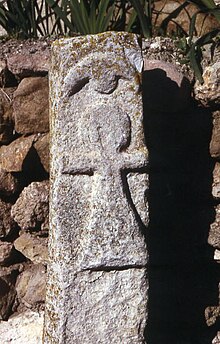
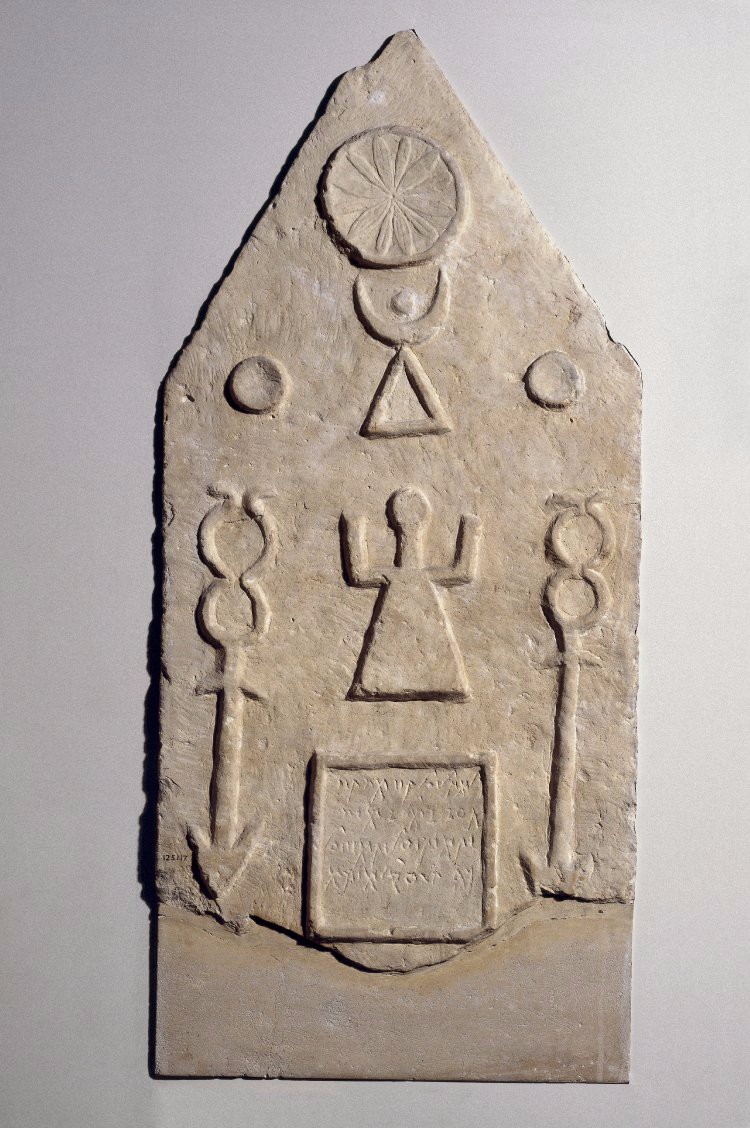
Tanit filled out the triad of important deities. She was Baal-Hammon's consort, and her symbol is all over everything in Carthage. She was the mother goddess, source of all life, etc. On a street level she may have been the most important deity to the common Carthaginian.
There are several dozen other named deities: Eshmun (a god of beauty, love, and healing sometimes associated with Adonis or Æsclepius), Reshef (associated with fire and lightening), Hawot (the dead), Kothar (arts, crafts, and engineering), Rasap (war), another Reshef (who was also a god of war... or maybe simply an alternative name for Rasap... or maybe a blending of Reshef and Rasap), and so forth. They also worshiped plenty of import deities. The Egyptian goddess Isis for example had a large temple in Carthage and was apparently popular.
All in all it appears to be a rich and varied religious tradition... and we unfortunately don't know that much about it. Far too few primary sources have survived.
(sorry for formatting errors: this is my very first reddit post, but I know something about this so I wanted to share it!)
Yes, it was! According to their mythology, the city was founded by the Phoenician princess Elissa (whom you might know as Dido from the Aeneid). In reality, it probably was some traders from the Phoenician city Tyrus who founded a colony: the name Carthage is derived from Kart'hadasht, which means 'new city'. They took their customs with them to the new city, among which their gods. They were very conscious of their origins: for centuries afterwards, the Carthaginians made an annual journey to Tyrus to honour the gods over there (also for trade). Their most important gods were:
Some other gods, in no particular order, were: Astarte and Ashera (mother/fertility goddesses), El (Ashera's husband), Adonis (bread), Yam (sea), Reshef (lightning) Eschmoun (healing), Ba'al Shamin ('Lord of the heavens'), Ba'al Magonim ('Lord of shields'), Ba'al Haddad (war). I don't know that much about them, sorry :(
In the earliest centuries (9th ct-5th ct BC), the gods were not depicted as figures: more often, they were identified as river stones or something like that. Only from the fifth century onwards (mostly towards the end of the century), iconic depictions of gods have been found, like the stylised form of Tanit I mentioned above. In the fourth century, the gods start to resemble the Greek/Roman pantheons: some new gods are introduced (such as the cultus of Demeter and Persephone in 396 BC) or Phoenician gods are assimilated with Greek or Egyptian gods. An example of this is Melqart: he is often depicted wearing a lion's skin and is identified with the Greek Herakles/Roman Hercules.
Two bonus fun facts about Hannibal, since you mentioned him:
Source: catalogue of museum exhibition about Carthage.