I'm curious at how the historians on this sub deal with this subject. I know there is a word for viewing historical events through a contemporary lens and making false judgments, but I can't remember what it's called.
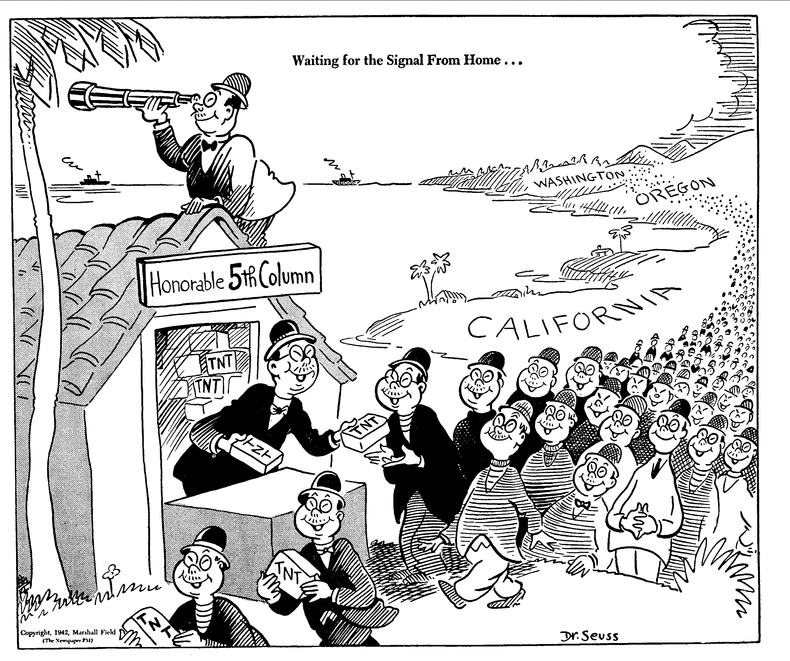
My interest stemmed from a conversation with someone who was absolutely fixated on the racist cartoons that Dr. Seuss had made around the 50's, and was arguing that it functionally disqualifies him as someone that we can trot out and celebrate in any way.
I have heard people do similar things with former presidents (Jefferson had slaves!) and I wanted to know how to properly respond to this line of reasoning.
It strikes me as understandable but misguided, however I don't have the proper terms and base to refute it competently.
What do all you of say when someone wants to discount a historical figure just because they had views or actions that were historically commonplace or banal but would be heinous today?
I know there is a word for viewing historical events through a contemporary lens and making false judgments, but I can't remember what it's called.
The word you're looking for is presentism.
As for how to respond to the sorts of things you're mentioning, whereby incredibly virulent racism infects a historical figure who we might otherwise find to be virtuous, I personally find it incredibly difficult. I think there is a tack that actually uses a person's presentism to your advantage in the discussion, I think. Basically, you isolate the racism, acknowledge that it may even be totally disqualifying, but then ask the person to consider whether we can find anything good in the figure. It's a similar impulse to the one that allows a person to love Annie Hall but find Woody Allen personally reprehensible. Put another way, human beings can rarely be placed into binary or Manichean categories of "wholly good" and "wholly evil." By doing so, we deny ourselves the opportunity to think critically, to understand context, and to otherwise get the richest and most nuanced portrait that we can. On balance, we might find Jefferson less objectionable than, say, John Calhoun, and choose to nudge our estimations of him upwards, even if we are able to condemn large sections of his worldview (and acknowledge the pain that worldview caused to the very real people whom he enslaved, and whom his worldview allowed to be enslaved by others).
I'm not sure I've made a great case - basically, we've got to appeal to a sense of context and nuance, while acknowledging that it is both satisfying and perhaps even morally sound to condemn Jefferson for his racism.
Another angle, one that doesn't really work for Jefferson (and might or might not for Seuss; I don't know much about him), is to ask the person to consider the person's evolution throughout their lifetime. Did their views on race change? Did they ever admit their earlier mistakes? In this case, it becomes a powerful message of both forgiveness and human capacity for change.
I don't think this is reasoning that should be argued against or refuted--your interlocutor there is raising very legitimate concerns that should be considered rather than dismissed. To take the two examples you ave, it is certainly true that Thomas Jefferson was not the only slave owner, but even if we took the (incorrect) view that slave owning was normal and totally accepted during his time, does that fundamentally change anything? Does it make the pain inflicted on his slaves any less or less real? When you take the choice to judge somebody "by the standards of the time" you are almost invariably taking a privileged viewpoint, choosing to excuse injustice rather than confront it. When we brush aside Dr Suess' wartime comics about Japanese-Americans as an just an example of past racism, we are normalizing the victimization of those people. It is easy for us to say that, well times were different then and such views were of the times, but by doing so we are in a sense creating an "of the times", because in 1942 there were white, Oxford educated cartoonists writing about how people of a certain race were a fifth column, and there were people of that race being ripped from their homes to be corralled in a camp in Death Valley. I argue the former is not more representative of the views of 1942 than the latter.
I study ancient history, and so I come into very close contact with men (almost exclusively) like Cicero and Tacitus, who were very clever men who could write very well about things liberty and courage and morality but who all thought it entirely reasonable that somebody born of a particular mother could live their life entirely controlled by somebody born of another mother, for no other reason but the mother they were born of. It is possible to say that these were the normal views of the times, but that would be cold comfort to the slave. I think it is more productive, when considering this seeming paradox, to wonder what in our own society is just as grotesque when fairly considered.
As for the general question, Cat in the Hat is pretty great regardless of whether or not the author advocated ethnic cleansing.
In addition to the responses by /u/Tiako and /u/pipkin42 I think the thing here is that there are several dynamics at place:
First there is the line that needs to be drawn between a historical assessment of a person and them being celebrated in a contemporary context. What I mean – and this is very much colored by my own sub area of history – is that as historians when it comes to assessing Dr. Seuss and Jefferson and other historical figures, we sure do take into account their historical context. What I mean is that e.g. with Seuss, we can and should take a close look at the general discourse concering the Japanese and Japanese Americans at the time and draw a connection between what that discourse was and Seuss' cartoons, in the sense of how they were influenced by it and in turn further influenced the discourse themselves. We can also look for similar influences in his other work and so forth.
When I study the Nazis, in order to understand their actions and the reasons behind them, I am very much forced to explore their stereotypes and ideological ideas in-depth and examine why they took hold, how they took hold, how widely they were held, and how they came about.
But does the fact that we can understand Nazi ideology in a historical context of European anti-Semitism and post-WWI Germany does not mean that we should not find their actions morally and politically reprehensible today.
Because the question, what and whom we as a contemporary society chose to celebrate, hold up as an example and revere while linked to a historical assessment within the context of their time is not solely dependent on this assessment but also linked with what images and traditions we want to project of our society and hold up as worthy.
The reason why we as a society want to and should celebrate Sojourn Turner or Rosa Parks is not solely related to their courageous actions against a system of injustice in their time but also because we as a society or as individuals want these actions to stand as examples to live up and aspire to in the sense of also standing up courageously to injustice. So, when it comes to the question of which figures to celebrate and revere, it is not just about their time but also about ours.
While undeniable that important things historically happened under Jackson's presidency, the question if we as a society want to celebrate him as an exemplary president, who's legacy people should live up to, is not answered yet (and the answer is no, if you ask me).
The Stalinist Soviet Union played an undeniable important role historically in liberating Europe from the dangers of Nazism and Fascism – but that doesn't mean we should celebrate it as a shining example of virtue to aspire to.