What kind of clothing would be acceptable to wear as a man/woman in interwar Germany? For instance, would it be acceptable for a woman to wear trousers, or have short hair? Would it be acceptable for a man to have long hair, or wear a more "blousey" garment?
The difficulty in answering this question lies that what these norms are and what kind of clothing is con-notated as male and female is always more fluid than one would assume and was often up to an unspecified practice, mainly of those seeking to impose judicial or other consequences upon the cross-dressers and trans-people, Hirschfeld described and issued these passes to.
Neither Weimar nor the German Empire had a specific law against cross-dressing. Rather persons who wore clothing not commonly associated with the sex they were assigned were often arrested by police for "disturbing the public peace" since it was the official police line to sanction what they found revolting. Oftentimes where these lines were rather blurred both in terms of what the police considered a violation and what kind of clothing the cross-dressers themselves associated as of the other sex.
In his book on the subject Die Transvestiten: eine Untersuchung über den erotischen Verkleidungstrieb : mit umfangreichem casuistischen und historischen Material (The Transvestites: An Inquiry on the erotic urge to disguise with plenty of casuistic and historic material), Hirschfeld provides a lot of study cases of the people he came in contact with and issued transvestite passes too.
In many of these cases, the men (and it is almost always men in Hirschfeld case studies, probably because of the greater difficulty to cross-dress M2F than the reverse), many of them speak of a desire to look end emulate what they saw in Fashion Magazines of the time. Hirschfeld cites a case of a man saying:
I turned all my attention to fashion magazines and stood daily in front of the display windows of ladies' clothing stores.
Another describes his specific desire for dresses and corsets while a third is fixated upon wearing earrings. Almost all of them speak of visiting Hotelballs and other "fancy" occasion to not only marvel at the dresses they behold there but also learn how to emulate the women wearing them in their movements. Similarly, many resort to buying and on occasion wearing corsets.
What can be gathered from these case studies is that for the cross-dressers themselves, the version of femininity and womenhood they aim to embrace and emulate is very closely aligned with what can be seen as "classic" femininity, and which in turn is not exactly what the current fashion trend for women of the new class of women of Weimar was.
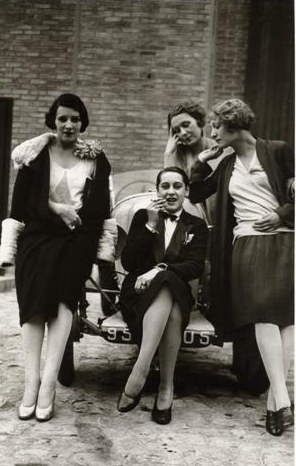
In Berlin at least, among the higher society of women who profited from many of the emancipatory measures democracy and the right to vote brought with it, one of the foremost fashion icons was Marlene Dietrich, who in the first half of the 1920s was famous for a fashion style embracing trousers and suits, emulating male fashion, and what can best be referred to as gender bending styles.
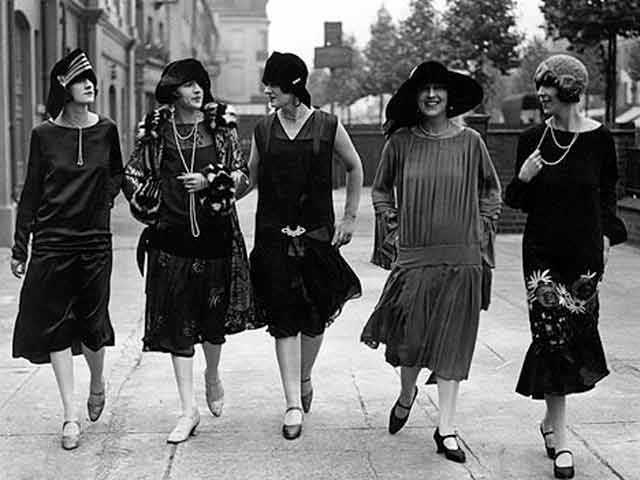
A lot of the more embraced and avant-garde fashion magazines would have embrace a style like this with short hair, elements of traditionally male clothing and a so-called roaring look.
The fashion sense of the people Hirschfeld called transvestites and who in our modern understanding would be either cross-dresser or trans-persons did apparently look at these fashion magazines but following Hirschfeld's in-depth study embraced a different version of femininity than what was fashion at the time. Most had been socialized in the German empire and their version of what they wanted to look like as women was influenced much stronger by the pre-war Imperial fashion as many of the passages in Hirschfeld's study reveal.
"I used to imagine myself as one of the ladies I had seen as a child at fancies balls or at least as one of their maids", one describes while another mentions his first experience of his desire being his mother's beige gown in this style from the early fin-de-siecle. Another one describes his dream outfit stemming from a play in which he played a maid of the 17th century while a fourth has gone to wear a corset (notably absent from what was fashion forward at the time) under his clothes.
So, while in general the "new woman" of Weimar was especially in Berlin able to gender bend and use elements of cross dressing in what was considered fashion forward at the time, the so-called "transvestites" Hirschfeld interviewed and issued passes to embraced an altogether for the time more conservative vision of what they wanted to look like when wearing women's clothing. More oriented towards a classic fashion of the Kaiserreich, they bought big and long wigs, flowy dresses and long gowns and wore corsets rather than embrace the pantsuit and bobby haircut that was popular for women at the time (and made it easier for women to cross dress).
In the interview they talked about a current of homosexuality present within the SA. I've heard conflicting reports about this, with some reports saying that this belief had its roots in Soviet propaganda. Is there a historical consensus on whether or not this is true?
Could someone please explain why the police would hand out passes to prevent the same organization from arresting someone?