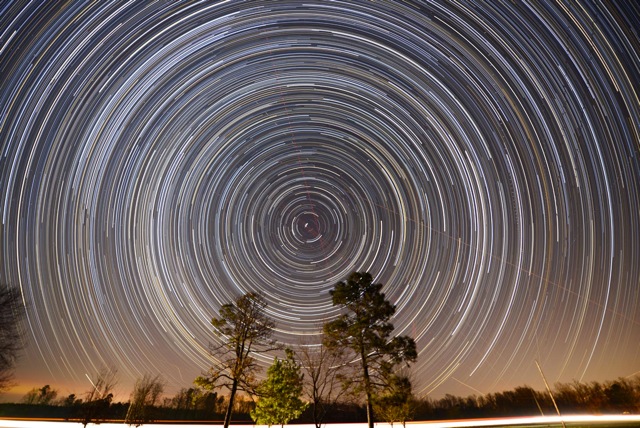
So as far as I was taught in school, astronomy is a very old field of study and that astronomers have distinguished between planets and stars for a long time. How were they able to do so if Galileo is the first known person to have used telescopes to observe the sky? How did older astronomers know the planets were not stars?
The simple answer to this is that planets move about the sky differently than stars do. Stars follow a predictable path (within seasonal variations) -- as the earth revolves overnight, you can see stars that rise and set in succession, and their relationship to one another doesn't vary over the course of a human lifespan. (Over celestial time scales, constellations will change rather quickly, but in the course of four score and ten years you won't notice the drift in stars.) There are of course non-setting stars -- e.g. Polaris will not set in the Northern Hemisphere -- but they again move about the sky predictably. If you google "star trails" you can see plenty of fun long-exposure photography of how that works.
Planets, on the other hand, rise and set at different times and in different places and follow quite a different pattern than stars do. The word for "planets" in Greek, πλανήτης, means roughly "wanderers" (caveat lector my Greek is very sketchy; I'm sourcing this from reading I've done about celestial navigation in the English/British fleet). Ancient astronomers were able to see with the naked eye the planets of Mercury, Venus, Mars, Jupiter, and Saturn (and so can you given decent sky viewing conditions). The classic model of the universe in ancient times was the Earth at the center, with stars, planets, and the Moon and Sun rotating around it in different levels of aether. (There was a heliocentric model proposed in the third century BC, but it didn't catch on.)