I don't remember where or when I heard this, and I can't find much of anything online which might hint at the validity of this statement, but I was once told that Poland was actually pleased with Germany invading them.
This was coupled with that they had cheered as German forces paraded down the main streets.
Normally I don't take an interest in WWI and WWII, as others do to the point that I feel any addition would be severely unnecessary, but I have to rectify this for truth's sake as well as better equip myself for my midterm on Monday.
Thanks in advance.
It was almost certainly the First World War, not the Second, and the situation was quite complicated.
When the Central Powers invaded East Central Europe in 1915, "Poland" as a state entity had not existed for over a century. The partitions of Poland had divided up the Kingdom of Poland between Austria, Prussia, and Russia in the latter third of the eighteenth century (minus a Napoleonic interlude where the Duchy of Warsaw served as a rump Poland). Each of the Partition powers toyed with using Polish nationalism for their gain, but by the 1840s had settled for a mixture of repression and cooption to govern their piece of Poland. Of the three Partition powers, the Russian Empire was the most repressive. After the 1830s and 1863 revolts, the Romanov state apparatus became almost pathologically anti-Polish. State bureaucrats often ascribed problems in the Western Borderlands to covert Polonizer agents and also enacted a series of civil and legal restrictions to their Polish subjects. Educated Poles, for example, could not serve in the local government by law, and often served in the Empire's more distant provinces like Central Asia.
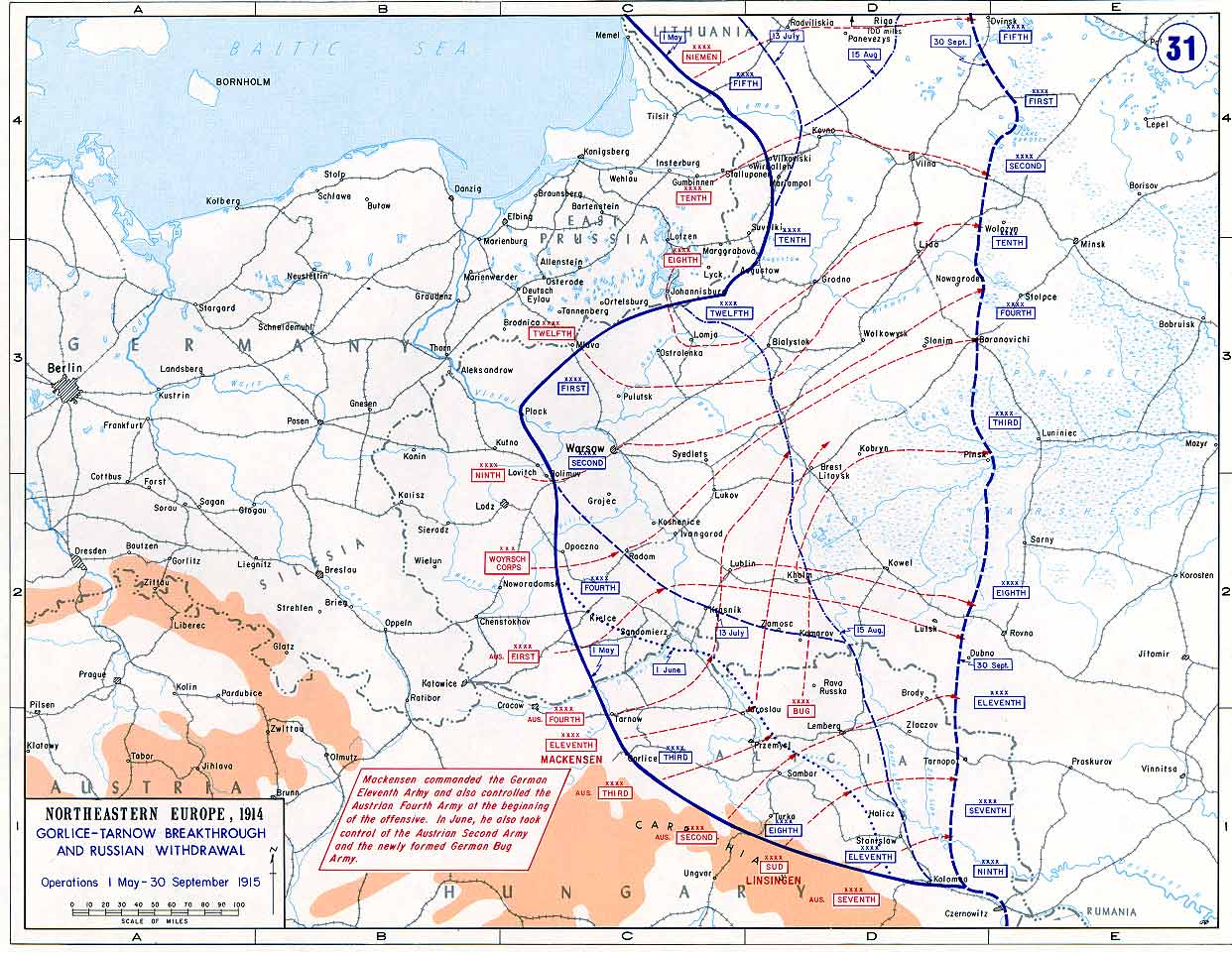
This anti-Polish mentality was sharpened by the outbreak of the war. Forced requisitions and other aspects of modern war strained Russo-Polish relations, but the defeat of Tannenberg/Gorlice-Tornow and the wider reversals forced the Russian army to conduct a scorched earth retreat across Poland, as seen in this map. The brutality of this retreat, as well as the removal of "suspect" populations who might have aided the Central Powers (more often, Jews), added a further level of misery to this retreat.
The Central Powers' occupation of Poland thus stoked the immediate hopes that the war, at least for this region of Europe, was over. Germany though was far from a Polonophilac country; the state's treatment of the Polish minority in Prussian Poland and elsewhere was not that far behind the Romanovs in its antipathy to Polish national sentiment. The Germans did set up a number of Polish institutions and intermediaries, as well as a General Government that suggested a new Polish state would be soon in the offing.
There was a hope among a number of Polish activists that if they played their cards correctly they could get one. Both the Germans and the Russians realized that the Polish national issue could be used to their advantage, even if neither power relished the thought of a reborn Polish state. For their part, various Polish nationalists realized that they could use this Allied/Central Powers patronage to their advantage and craft their own Polish state. Although this is greatly simplifying the shifting alliances and politicking, the collapse of Russia in 1917 and Germany in 1918 allowed for these Polish groups to maximize their position and the size of the postwar Poland.
So some Poles likely did cheer German troops in 1915. For most Poles, the victories of the Central Powers meant an immediate end to Russian plundering and a return to a degree of normalcy. For Polish nationalist activists, who were always a minority, Germany's immediate victory meant that they could exploit Germany's on-going war for their own agenda. Stalemate at the front, not victories, suited the purposes of men like Józef Piłsudski and Roman Dmowski who could use the promise of Polish troops as a lever to gain concessions from both sides.