What was the immediate reaction to gunpowder warfare? At what point did people think, "oh this is a big deal and very effective, everybody should have gunpowder weapons..."? At what point did cannons become naval weapons? When did archers become "obsolete"? What kind of psychological impact did seeing things go boom and shooting things at speeds that the human eye could not accurately detect have on soldiers?
It's tricky to tell the history of "gunpowder warfare" without also describing much of the rest of warfare in the 14th-16th centuries. I'll have a go at covering some of the basic ground though. /u/WARritter is the real expert here, and if you're lucky they'll have time to respond. There are lots of relevant threads in the archive if you want to explore more specific questions. I'd also recommend seeing if you can get your hands on a book that covers medieval warfare, as they're quite likely to have a specific chapter (or more) on gunpowder and/or late medieval warfare.
This answer's going to be mostly limited to western europe, and it'll largely ignore naval warfare and psychology, as that's the limit of knowledge. I'll try and flag up other areas where my knowledge is particularly weak.
I think the most important thing to remember throughout is that the introduction of firearms was not a quick process. It was one of gradual improvement and coexistence with older weapons.
I'll start by talking about a couple of important technological/manufacturing advances, and then talk about cannon and handguns separately.
The first technological change is in the quality of powder. It took some time to work out the ideal proportions of sulphur, charcoal and saltpetre, and the strength of powder increased as recipes approached the ideal proportions towards the end of the 15th century. Another important change was the development of corned powder. This is formed of fine grains rolled into balls. Corned powder burns faster, and is less prone to separating or soaking up moisture.
The second change is the manufacture of saltpetre. Europe is very short of naturally occurring saltpetre supplies, so initially much was imported, via the Middle or Near East. Unsurprisingly, this made it expensive, and things became worse after the Ottomans took Constantinople. Over time European countries developed their own industries for producing saltpetre, typically involving the collection of urine-soaked straw. They also looked for other routes to import it. I don't know how successful the latter approach was, or how the proportions of saltpetre from different sources changed. In other words, one of the important factors limiting the use of powder weapons was simply the cost.
There's lots more change going on, of course, but those are, in my opinion, the two most widely important.
Part 1 - cannon
The story of cannon is probably easier than handguns. The advantage of gunpowder over older siege weaponry was much stronger. Gunpowder weapons required a solid, and thus heavy barrel. They were unreliable and complicated to use, and slow to fire. These facts are less of a disadvantage in a siege than a pitched battle. With a relatively small number of cannon, you can have experts overseeing them, you can take your time emplacing heavy guns, etc..If someone's charging at you waving a sword, it's vital your gun goes off first time - if you're in a siege, it's not such a problem (although cannon did tend to explode...).
Cannon also worked better with uncorned powder, as they could have a longer calibre, and the velocity of the projectile was relatively less important. To penetrate armour you want a small, high-velocity bullet to concentrate the force. This isn't as necessary if you're battering down a wall.
I've not seen a direct comparison of cannon vs trebuchet. Wikipedia (I know) suggests a typical trebuchet could fire 36kg projectile 300m, although it doesn't mention the velocity (the source is this article which backs up the 300m range, but doesn't mention the mass). Compare this to an early, and particularly large, cannon, which shot a 90kg ball at the siege of Lille in 1297. On the other hand, the trebuchet was more accurate, reliable, faster firing, and could be built in the field. It was also rather less dangerous for its users.
There seems to be some controversy about the impact of cannon on siege warfare. There's no doubt that cannon were a major improvement on older technologies and tactics, but they were countered by defensive adaptations - the obvious response of making walls thicker, earth protection for the lower parts of walls, angling walls to deflect projectiles, making them lower and harder to hit. And of course, defenders had their own cannon to keep attackers away from the walls. The culmination of this was the trace italienne, or star fort, first seen in the mid 15th century. Philippe Contamine suggests it was a key part of the French victory in the 100-years war, with the well-developed French artillery systematically reducing English fortifications. However over a longer period, average siege duration - a measure of the balance of power between defender and attacker - may not have changed much.
Superficially, despite something of an arms race between cannon and fortifications, it might seem like not all that much changed. Cannon certainly didn't render fortifications, even older ones, obsolete. What, in my opinion at least, was a key change was the cost and organisation all this. Manufacturing, maintaining, transporting and using cannon was an expensive and technical business. The new fortifications were also more costly. So this favoured those with deep pockets, and centralised, efficient government systems.
Edit: I forgot to mention the use of cannon in the field. This is attested as early as the Battle of Crecy in 1346. It remained uncommon in the 14th century. By the time of the Wars of the Roses (1455-85) it was standard for battles to begin with an exchange of cannon fire. However the actual lethality of the weapons was fairly low, due to range and rate of fire. The impact was more psychological, with the inferior side often being pushed to attack. I'm not sure, but it seems like only in the late 16th century did cannon really start to become important field weapons.
Handguns to follow
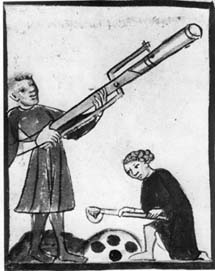
The answers would depend a lot on context, area and period (as usual). Still, early on gunpowder weapons in Europe were not that effective, and were infact quite prmitive - literally an iron tube on a stick.Which can look pretty cool nonetheless. You load it with gunpowder, insert the shot, insert a lit fuse at the small hole at the end, wait a few seconds and boom. Some early illustrations show these pot-like weapon, and it seems that early on they were loaded infact with arrows and not cannonballs or bullets. It took a while for gunpowder weapons to become better and commonplace on the battlefield. One of the early adoptees of the technology were polish hussites (not to be mixed with hussars, different things), and gunpowder weapons seem to have worked well with their famous wagenburg(againthanks wikipedia for the image) There is also the famous fall of Constantinople, where the Ottomans used cannons against the City pretty effectively. In any case by the XV-th century cannons were becoming common and you would see even some crazy ideas like this "tank" from Hans Talhoffers fecthbook from 1453. By the XVI-th century hand-held gunpowder weapons were also an important part of warfare ...
Despite this gradual success archers remained around for a while. The longbow, and especially crossbows saw some use in the XVI-th century, but with time were used more for hunting (in some places simple crossbows were used for hunting well into the XIX-th century) and even there they were soon pushed away.