Second Empire-style buildings and furniture can be found in cities and art galleries the world over, but I've never heard of, say, a "Third Republic" style chair or a Bourbon Restoration house. What are the origins of the Second Empire style, why did it have such a seemingly outsized impact, and what was its relationship with the government of Napoleon III?
First, a quick definition, just in case anyone's reading this who isn't in the know: the architectural style known as "Second Empire"/"Napoleon III" is characterized overall by inspiration taken from the Italian Renaissance - squared buildings, often with square towers, large porches, and tall windows - along with a mansard roof. The mansard roof was itself revived from the designs of the early modern architect François Mansart, and all together fits within the nineteenth century "revive ALL THE THINGS" design atmosphere.
The major cause of there being an architectural style known as Second Empire is Napoleon III and Georges Eugène Haussmann's redevelopment of Paris. Following in Napoleon I's attempts to modernize and improve Paris's crowded urban neighborhoods, Napoleon III extended the rue de Rivoli and built several new, broad boulevards on top of what used to be narrow, twisting, medieval streets and slums, lining them with more upscale housing and huge public buildings. While many revival styles were used throughout the city, you can still see swaths of homogeneous Second Empire architecture today - which is why the style has been associated with and named for the second Empire.
As decorative arts labels, Second Empire/Napoleon III are terms that get used, but not as frequently as the more descriptive "Renaissance revival", "Baroque revival", "Gothic revival", etc. There isn't, as far as I know, a real furniture-type decarts movement associated with the second Empire the way there is for the Directory and first Empire. Which makes sense! Because there was no project aimed at replacing hundreds of old public pieces of furniture with new ones to result in a fresh combination of stylistic markers. The closest thing is Rococo revival, which was used meaningfully by Napoleon and Eugenie to recall the grandeur of 18th century France and relate them to monarchs who might have been disliked and, y'know, rebelled against, but were considered to have received power legitimately.
So, why isn't there a Third Republic furniture style or Bourbon Restoration architecture? I would say that this is for the same reasons that Second Empire doesn't get used much with regard to decarts: there aren't movements that essentially derive from these regimes. During the Bourbon restoration, the heavy, neoclassical Empire style continued to be used, and the late nineteenth and early twentieth centuries saw a bunch of revival styles followed by Art Nouveau and Art Deco with no particular connection to the French government. Plus, on the whole, styles being named after regimes rather than artistic movements is only the norm until the Baroque in the late 17th century.
An important contributor is the fact that the Second French Empire is concurrent with the peak growth levels of Continental European Industrialization as well as North American Industrialization.
Cityscapes in the new industrial age could be subjected to dramatic changes: in addition from many French cities extensively remodeled in the "Second Empire" fashion, after the unification of Italy (which occurred with significant french help!) the City of Milan (Italy's industrial hub) adopted an expansion plan clearly inspired by Haussmann's plan for Paris.
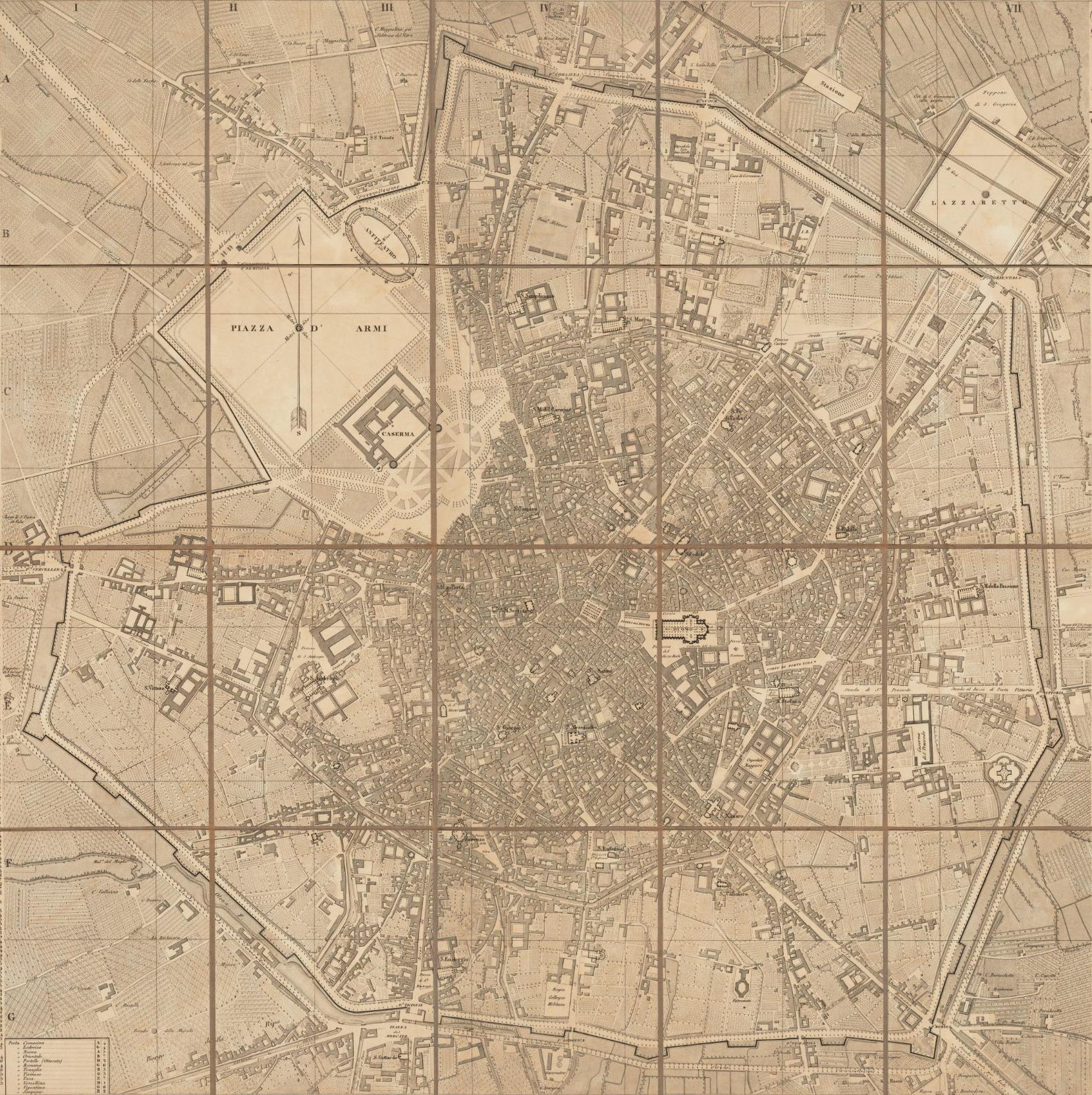
In fact, the Milanese plan was drafted by architect Cesare Beruto, the head a new city planning office founded as a clear reaction to the initiatives taking place in France. Beruto's plan, like Haussmann's, included carving wide boulevards in the city center while adopting a grid-like system to expand the city outwards, in addition to the reduction of the city's canal system in favor of expanded rail transport (compare the blue lines, representing waterways, in this 1880 map to this 1830 map) as well as the demolition of the old city walls.
You can compare the old city plan to the new one to get an idea of the kind of changes the city council implemented. Beyond planning a grid-like structure for future expansion, immediately noticeable is the addition of a boulevard in the center of the city connecting the Castle to Cordusio Square, the expansion of the central cathedral square, and the widening of existing arteries radiating from the center of the city (notable is "Corso di Porta Venezia," the boulevard connecting the city center to the northeast, which stayed the same size: this had been already turned into a monumental boulevard when the city was part of the Austrian Empire, being the terminus of the road connecting the city to Venice and Vienna. Compare this to "Corso di Porta Romana," the boulevard connecting the center to the southeast, which had been the city's main avenue during the Renaissance; you'll note how this avenue, which previously dissipated into many small streets, was connected to the cathedral square with an avenue running in a straight line).
The "French Empire" style significantly influenced the architecture of the new buildings constructed in the reshaped city. And Milan wasn't even the first city which the newly united Italy sought to update for the new industrial age: upon the proclamation of the Kingdom of Italy (which had initially excluded the Papal States and Rome) the new capital city of Florence, in spite of having been the capital of the Granduchy of Tuscany, was found to be entirely inadequate to house the new national administration. In 1865 architect Giuseppe Poggi's bid won a tender to restructure the city. His plan called for the demolition of the city walls to construct Haussmann-style beltways and the construction of modern city blocks surrounding the old city center.