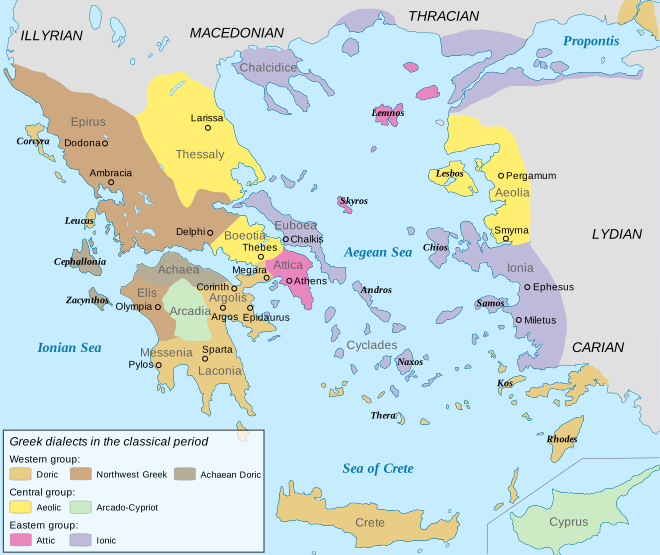
Would people from Athens be able to understand people from Argos? Or Sparta from Corinth?
The ancient Greeks spoke a range of different dialects. There were four main groups:
Each group had several subgroups, and some major dialects don't really fall within this fourfold division. Wikipedia has a lovely map showing the spread of each dialect.
The Athenians spoke the Attic dialect, a subtype of Ionic Greek. Thanks to the role of Athens as "school of Greece", this dialect eventually became the basis of koinê or "Common Greek", which was the standard Greek spoken and written dialect from the Hellenistic period onward. However, in the Classical period (5th-4th centuries BC), Attic was still just one variant of many.
The Argives, Spartans and Corinthians were all Dorians. They all spoke the same Doric dialect, which was also spoken on Crete, on Rhodes, and in the Corinthian settlements on Sicily. The clearest remnant of Doric Greek is the fact that we call Sparta "Sparta"; in Attic and koinê Greek, the town was known as Spartê, but Doric preserved the long [a] that turned into [ê] in Attic/Ionic Greek.
The differences between dialects were not so great that speakers of Ionic and Doric could not understand each other. There was constant interaction between these groups, through elite social networks and marriage, embassies, trade, migration, mercenary service and so on. Nothing suggests that any of this was ever seriously impeded by heavy accents or unintelligible local speech. Stereotypes did of course exist: the variant of Aeolic Greek spoken by the Boiotians was characterised by the Athenians as a hillbilly accent, and Doric was seen as rough and artless. Ionic Greek, by contrast, was seen as an expression of the Ionians' soft and chatty nature.