Whenever people point to the fact that from 2000 years ago there is a limited collection of recorded history, I always wonder why then does Pompeii have so much written around it? Surely if the average man could write a love poem to a prostitute, another could have written a daily diary? Was is only down to the scarcity of paper?
I can't claim to be an expert on this generally, but I am familiar with one period, namely the Early Islamic period, where this lack of written sources is a major problem and I can therefore go into some of the issues that I'm familiar with.
The first, as you note at the end, is the kinds of writing materials that were available. Paper didn't exist; it would not be introduced to Europe until about the 11th-12th century via Islamic Spain having been introduced into Islamdom, probably apocryphally but it makes for a good story, by Chinese paper makers captured at the Battle of Talas in the 8th century.
So in a pre-medieval context paper is not an option.
For long-format works the options then are basically vellum or papyrus. Whichever of those you use, in a mediterranean or northern European climate, over the course of 2000 years those are almost certainly going to be destroyed as a result of wear and tear from use, or, even if they are buried or stored somewhere unused, the basic climate is going to cause them to mold or weather and rot.
That's why deserts are so important for the discovery of early manuscripts. The Nag Hammadi library, the Dead Sea Scrolls, the Sanaa Manuscript of the Qur'an are among the most famous examples of papyri or animal skin texts preserved over a great many centuries by being stored in a naturally occurring version of ideal preservation conditions.
These are of course major, well-preserved finds of complete works or fragments of complete works, but the much greater volume of ancient material that we have are more or less random assortments of papyrus of little or no consequence. Huge proportions of this material are sitting in institutional papyrus collections, potentially unsorted and undated and that may or not be of any scholarly interest. As with today, the vast majority of printed material would have consisted of bank receipts, personal notes and correspondence, accounting lists, or as a result of damage over time small fragments of those mundane texts that are now un-identifiable. You can read one such example of the chaotic nature of these ancient papyrus collections from the Yale Papyrus Collection: http://beinecke.library.yale.edu/research/library-catalogs-databases/guide-yale-papyrus-collection
The example of Pompeii graffiti that you raised, however, can sometimes be a more interesting and useful category of material than that on papyrus or vellum because even though it rarely results in a discovery of a completed work it can be better preserved, better associated with a particular site, easier to date, and may be less likely to consist of useless accounting material.
Such sources fall under the broad category of "epigraphy", that is, writing or images inscribed on some other material, whether that's scratched inscriptions on a wall, cuneiform on a brick, an epitaph on a grave or a minted coin and so forth.
These materials form a huge and very insightful source of study for the ancient world. Many interpretations of early Islam, for instance, rely on studies of the coinage reforms of the early caliphs.
All of this is basically on the technical side, but on the supply side of literate peoples able to produce these materials, that of course varies as well. The vast majority of people in ancient times were illiterate. I'm not especially familiar with Pompeii or ancient Rome but it's worth remembering that we're talking about a wealthy urban center at a time when the vast majority of people were poor and rural. The residents of Pompeii were not, in an ancient context, average, they were the exceptions.
That being said, literacy rates do also vary over time. "Dark ages" are a real thing (though we have to be very careful with what we mean), where for various reasons the production of written materials declines. The 7th century when Islam arises is one such period. Islam also arose among a people, the Arabs, who were far less literate than some of their neighbors in late antiquity like the Egyptians. It's also worth stressing that this can be a cultural issue or feature rather than a technological lack. So for example there certainly were literate Arabs in the 7th century, even within Arabia; we have the inscriptions to prove it. But oral culture functions differently than print culture and works in different ways that can resist change, nor are all print cultures the same. The way that we treat texts in the modern era would have been utterly alien even to literate peoples in ancient times in terms of how we understand how texts are composed, handled, disposed of, what authority they possess, who is authorized to write them and what authority they convey and so on.
That's a bit of an aside to your question but it becomes an issue in relation why such people may or may not just have a written diary. Diary writing itself a cultural product that varies in usage. So for instance, Christian Protestant Puritans were enthusiastic diary keepers for religious purposes. As it happens such materials are of great interest to us today, but there's no reason why that must be so.
In any event, this is a bit rambling but those are some of the issues involved in the apparent lack of such sources:
First, I'll tackle the assumptions you made in the framing of your question, then I'll more directly answer your question.
First, the existence of graffiti does not mean that every Pompeiian could read. Much of that graffiti is very formulaic, requiring only very basic literacy to read. For example political adverts almost all use the same language and were often abbreviated ("Such group asks you to support Candidate for Office. He's deserving"). These could be understood by people with very low literacy. The more poetic stuff, like references to Virgil would need more learning to understand and write.
Like CptBuck says, writing diaries is a cultural trend that goes in and out of fashion. Just consider how popular livejournal was twelve years ago and how little you see that kind of thing now (not that there aren't a million blogs, but they used to be ubiquitous). Diaries are also quite ephemeral. They are subject to fire and mildew and rot, and crippling feelings of embarrassment, so they are often destroyed. More importantly, there aren't really any examples of diaries in ancient Rome. Marcus Aurelius's Meditations is sometimes called a diary, but it's more like a bunch of notes he took while reading philosophy and through discussions with teachers. Letter collections like Cicero's and Pliny the Younger's give some insight into daily life but they aren't reflective or confessional like a real diary. The closest we get is Augustine's Confession, which is a reflective memoir of his life leading up to his conversion to Christianity. Other memoirs did exist (like Caesar's commentaries, and a lost account of Cicero's consulship) but nothing with the reflectiveness of Augustine.
So where does all of this stuff go? It gets lost or more accurately, no one has the money, time, skill, or desire to care for it. The Romans had a truly astounding economy spanning from England to India and China and into large parts of Africa. This vast trade allowed them to specialize and increase their productivity at stuff they were really good at (like olives and grapes in Italy and grain in Sicily). That makes everyone wealthier, as long as trade continues. That means more people have time to read, more people have the money to buy books, more people can produce papyrus and bring that cost down, etc. So you have a relatively large market for books and they are cost effective to make. Once that economy collapsed some time in the third century then totally bottoms out in the fifth, all that stuff jumps in price and people need to make hard choices about what they can afford to produce. Without cheap grain from Egypt, very few people can afford to copy books down, and no one can afford to buy those books. Grandma's diary is left behind in favor of Virgil. In fact, you may have just scraped off what grandma wrote and copied Virgil on the same sheets of vellum. People had to decide what was worth keeping because they could not afford to keep it all even if they wanted to, so they made some hard choices. They decided to keep the universally revered writers like Virgil and Cicero but mostly they kept religious texts.
The thing to understand about Pompei is that it is an absolute exception. You most likely know this, but there's more to this. The dimension of the problem is bigger. Due to the unique circumstances of its demise, an extraodinary amount of 'everyday writing' in the form of grafitti (scratched inscriptions) and dipinti (painted inscriptions - don't ask, that's the way it's defined) has been preserved in situ. We can be quite certain that other cities of the empire had, in their time, a similar epigraphic landscape, with inscriptions painted and scratched on many available surfaces and put up in stone and other materials all over the town and the countryside. But since these everyday inscriptions were usually written directly in or onto the plaster or paint, they only survive very rarely and in exceptional circumstances. Sometimes we find flakes of the plaster from a wall with something scratched into it, but that's not common outside of Pompei.
/u/CptBuck has already pointed out the problem of the survivability of the material used to write on, I'm going to expand on this a bit for the Roman context, and on why there is so little of it there today.
There are several categories of material the Romans used to write on. Papyrus and vellum have already been mentioned. Others are:
Durable Materials
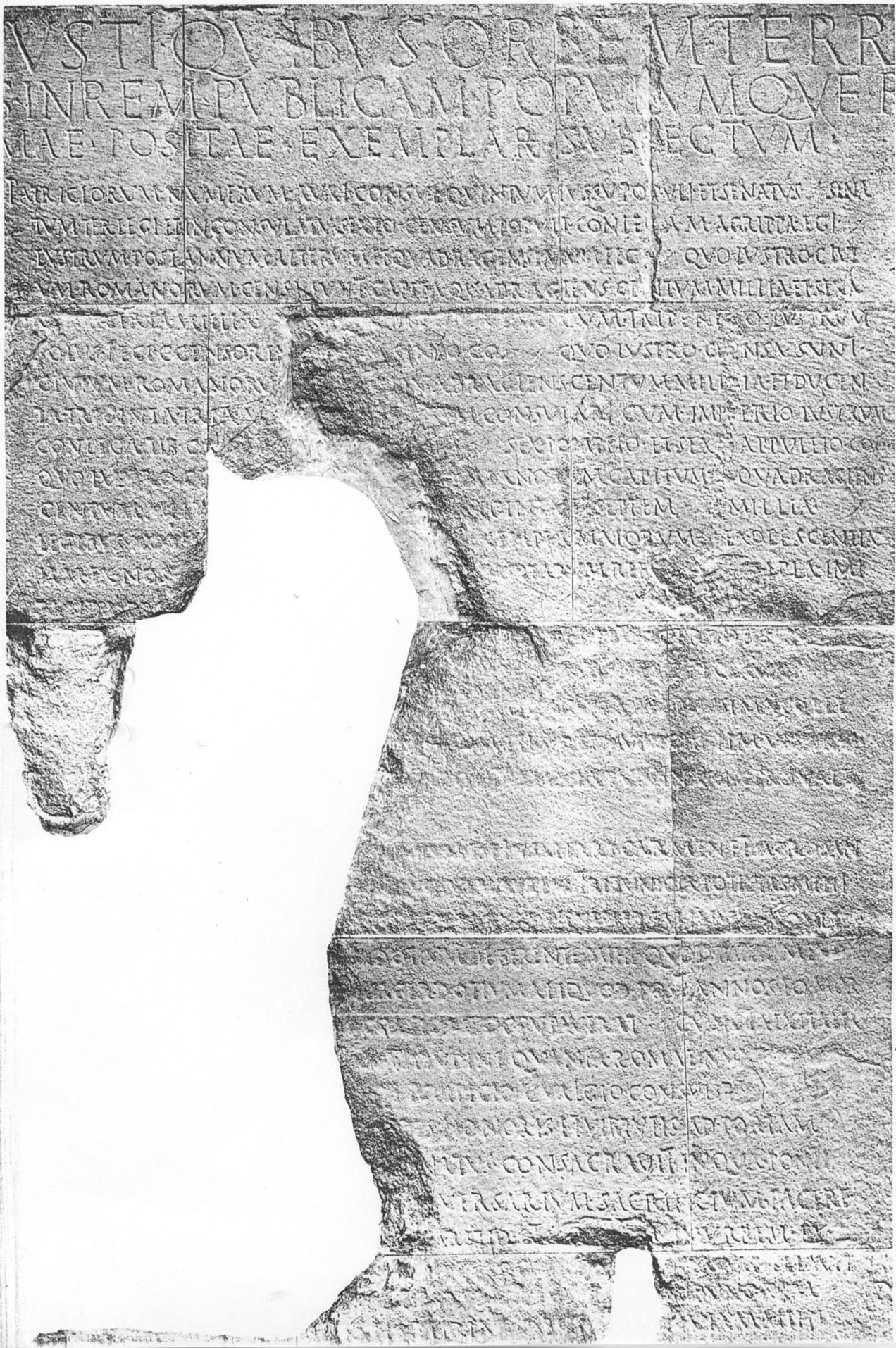
Stone. This is the one material that has preserved most of the writing from ancient times. Inscriptions made on stone were ubiquitous all over the empire, especially during the first three centuries, and used for every kind of texts, from milestones, tombstones, votive inscriptions, honorary inscriptions, calendars, victory monuments, building inscriptions and so on and so forth, and they would be found in any town and many villages and villas. Most of the texts are pretty bland and formulaic, and not of much literary value (though Roman funerary inscriptions are, as a rule, more verbose that contemporary ones and give us much more valuable information). Around ~4.000 contain longer texts of some literary aspiration, such as poems, sometimes pretty crude ones, but often also of the highest literary standard, quoting or imitating the style of famous poets. But also longer historical texts survive. The writings of Augustus, for example, a record of his deeds (the res gestae Divi Augusti), which were originally put up on bronze pillars next to his mausoleum, survives from copies made in other parts of the empire, for example from Ankara, and are among the longest inscriptions preserved. Stone, however, was of big value as a building material, and so most of the stone inscriptions have been lost to us due to being broken down (or burnt for lime) and being reused, many in ancient times already - though many more survive precisely because they have been reused for long-living buildings such as churches or city walls.
Precious metals. Metals like Gold or Silver were used for various inscriptions, most often inscriptions on jewellery (recording the name of the owner, or small epigrams), but also for votive tablets, small gifts left at a sanctuary containing a votive inscription by the dedicant, like this fine example from Frankfurt, Germany. Big letters made of gold were also sometimes inlaid for some extra-impressive monumental inscriptions. Due to the value of the materials used, the vast majority of examples that existed have been molten down for their value, and only isolated examples survive (though sometimes we're lucky, and find a whole bunch of them, f.e. some which barbarians had looted in Aquitania, but lost on their re-crossing of the Rhine).
Lead. Lead was used for many of the same purposes as precious metals, one of the more verbose categories of their use being in the curse tablets, into which the text was scratched for magical use. They often contained accounts of the injuries received, and what the author wished to happen to the person responsible. But lead was also used for lots of day-to-day writings, for example for bills or receipts. Since lead is so easy to reuse, these have also been molten down and reused, and so most of them do not survive.
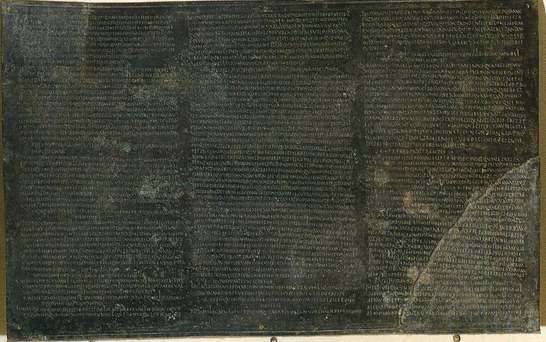
Bronze. Bronze was used quite often as a writing material, mostly for legal texts ('to incise in bronze' was a stereotypical formula used for the publishing of laws) or military diploma, certificates of citizenship given to veterans of the auxiliary units. I guess you get the gist, most of them have been molten down and reused, though new ones are still found from time to time. This category contains some of the longest written texts that survive directly from antiquity, since legal texts could often get quite long and technical (the more things change...). This is a version of the lex Irnitana, the municipal law codex of the city of Irni in Spain.
Gemstones. Gemstones were also often inscribed, but only with very basic information, mostly the owner's name or epigrams.
Pottery. Pottery was used for painting (marks or names of the maker, declarations of content for amphorae and other vessels used for transport) or scratching (often the name of the owner) small inscriptions into it, but pottery shards (so-called Ostraka) were also used as a convenient and widely available writing material.
Bricks. Bricks were often stamped with the mark of their maker, and these brick-stamps make up a very numerous, very short and very repetetive type of inscriptions. Of value to economic and military history mostly, but terribly boring if you ask me personally. Sometimes, more elaborate texts were scratched into unburnt bricks, but not much of that survives.
Glass. Glass was used as well, like on this cup, but unsurprisingly there's not much of that left.
Non-Durable Materials
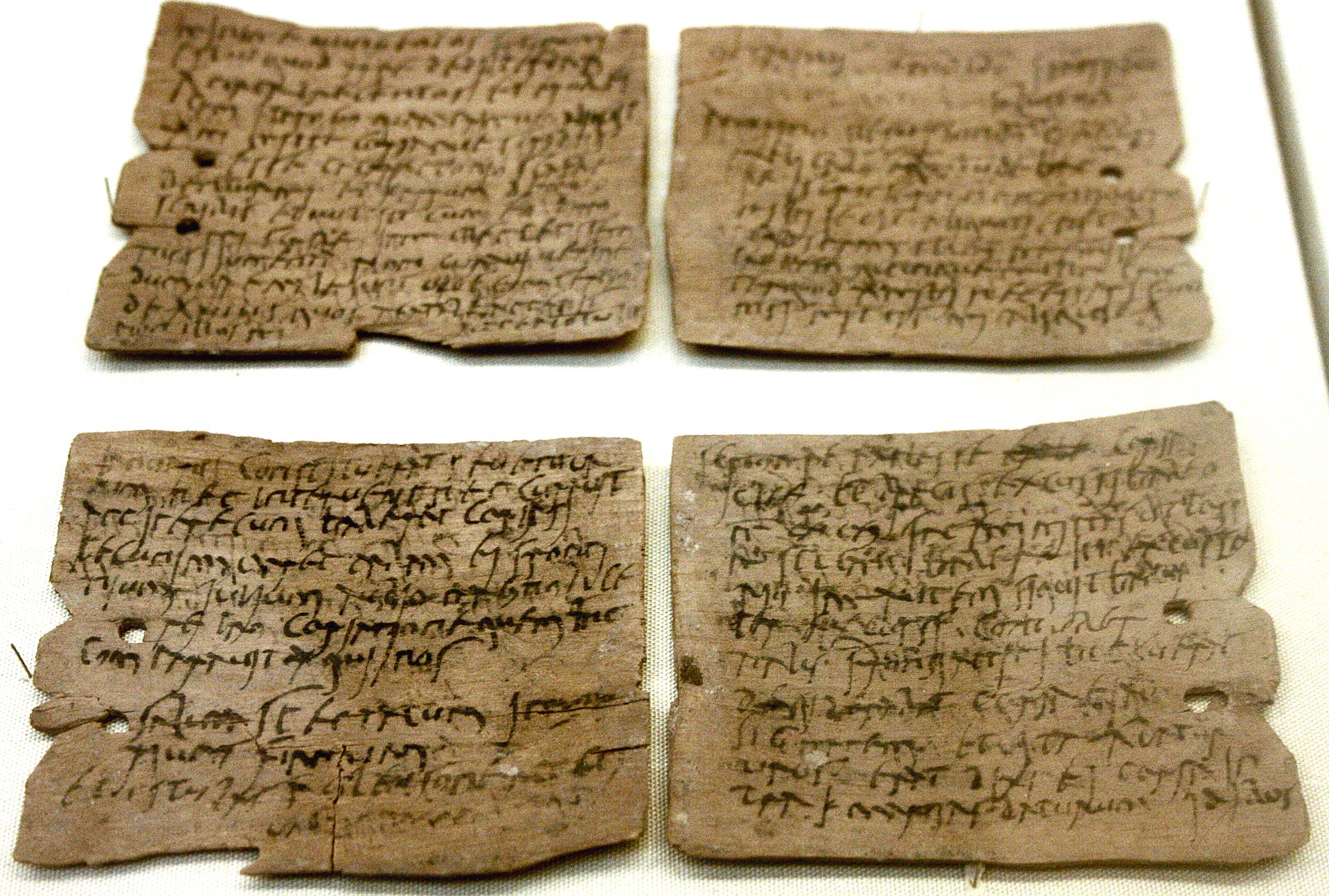
Wood. Small tablets made from wood were used as a writing surface for writing in ink. The most famous examples come from Vindolanda on the Hadrians wall, and preserve soldier's and civilians private letters (such as an invitation to a party), official communication, military paperwork and so on. Several more wooden writing tables have been preserved from all over the empire, but in a small number. But there also were monumental inscriptions made of wood, but even fewer of those survive. This category must have been very numerous, but again only very little of the material survives.
Trees. So-called dendroglyphs, small texts carved into the bark of living trees are a literarily attested, most often in the context of love poetry - same as today, ancient people used to carve the name of their loved ones, or their love interest, or love poems, into the bark of a living tree. Unsurprisingly, none of that has survived, but we know that it existed.
Wax. Tablets, covered in a small layer of wax into which text could be enscribe with a stilus. They were used for learning to write, for writing letters, documents and literature as well. Only few of them survive, a large group for example for Herculaneum.
tabulae dealbatae. 'Whitewashed tables', made of wood, painted over in white and used for official proclamations and messages by the magistrates. Easy to reuse, difficult to preserve.
Plaster and Stucco. I already mentioned it above, but grafitti and dipinti made on plaster only survive in a very small number in specific circumstances.
There are some other materials that I haven't mentioned, those include amber, ivory, leather or bone, but they are not very numerous.
All in all, we have ~ 400.000 different Latin inscriptions that have come upon us directly from antiquity.
You can have a look at almost all that we know of today here. Warning, clicking this link might crash your browser or take quite a time.
But even all of that material is not even 10% of what existed in antiquity. It might not even be 5%, and the real number is probably closer to 1%, but it's hard to say. For all that we have, so much more has been lost. So what I really wanted to say, in a very roundabout way, is A) Pompei is an extreme outlier, and B) the actual survival rate of the type of material that survives from Pompei is not much higher than that of Ancient literary text in general.
I've been studying the ancient near east for some time and I would like to add to the already well written responses here.
The main reason for the lack of literacy sources has been touched upon already, although I have not seen anyone actually reference the main reason why. Writing material was more of a luxury resource and with climate, wear and tear, etc... it took very specific conditions for it to survive for 2,000+ years unless it was transcribed. The majority of the large completed works we have today were deemed by people throughout the centuries as being important enough to have someone transcribe the works to make copies of for either more distributed readings or to retain the current copy that needed to be transcribed to retain because the current copy was getting to the point of illegibility.
The climate as has been mentioned plays a very large role as well. Southern (Upper) egypt is where we get the vast majority of surviving papyrus because the climate allows it to survive without breaking down. The delta region (lower/northern egypt) on the other hand papyrus decays and breaks down really easily due to the moistness. Another fun fact about Papyrus is that a lot of time we're missing the first and last "page" due to the ends of the papyrus decaying while the rest of it can survive in the ideal climate types.
Letters, diaries, etc... we do have some of, but it is due to it surviving in the perfect climate or being reused as another person has mentioned in another comment for this thread. For instance we have 2 letters from a scribe from the reign of Thutmose III/Hatsheput that were preserved because the papyrus was reused to cover a hole in a mummy.
Outside of ideal climate and transcribing works, there are two/three other major ways for works to be preserved. A natural disaster such as what happened in Pompeii is one of them and that has the added benefit of preserving the artwork and things like Graffiti that would normally erode away. Next would be ironically when a town is looted, pillaged, and/or razed. Pretty much anything written on clay gets effectively fired up and it turns the soft clay into an almost everlasting clay object that preserves the writing / markings on it. The and/or third option is more or a less a mixture of the two. Something happens to the area and it's not rebuilt upon or it gets lost from time and/or built around / over without completely destroying the area itself.
Now for the ending of this, couple of points to make.
An average man writing a love poem to a prostitute isn't necessarily the case with the love poem to the prostitute at Pompeii. Using Pompey the Great as an example, something that was seen as a great trait for him was that he gave up a prostitute that he still loved to a friend who also loved her. The guy that wrote the poem could very well have been more than your "average Joe". And by that I just mean the guy could have been a public official or from the higher end of society which would put him out of the class of average man.
Literacy in the ancient world is likely understated, especially from around 2,000 years ago. As for your average person who couldn't read or write, there were professions would would be able to do it for them. Using Ancient Egypt as an example, we do know that illiterate people did write letters to each other. It involved paying someone like a scribe to write the letter as you dictated it and then when it was delivered it would need to be read out to the other person who could not read it. Paying priests to write down a note or letter to give to a healing god also was fairly common to attempt to get the god to heal the person you were praying for, often a loved one. Point being - both literate and illiterate people in the ancient world did leave a written record.