Jumping into this real quick.
I think it's important to distinguish a few things about the way politics worked in Rome. True democracy (in the style of ancient Athens) never really existed, Rome was a republic for a reason. With that in mind, I'll throw a few facts out here and you can decide for yourself if it qualifies.
Even during the early stages of the Empire, there were still senatorial elections. For instance, if one wanted to be quaestor (the first level in climbing the Roman power structure), one still had to stand for election within the senate (and if you weren't a senator, you could ask the Emperor to allow you to stand for election). This is a little outside of your direct question, but just to give you the idea that democracy continued even inside the city as well.
Anyways, onto the question properly. By 79 A.D., I believe Pompeii would have held the status of a Latin Colony, which meant that, even during the Republic, the members of Pompeii would have very little say in the actual politics of Rome. However, colonies had the ability to control their own local politics, electing their own aedile (think of it as a city manager), quaestors, and diplomats etc. This makes intuitive sense if you think about it. the empire was massive, and the senate/emperor could not micro manage everything.
Beyond the colonies, the provinces would still be governed by Senators (and then much later, by a combination of senators and military generals) into the republic.
I guess the short version here is that, despite the massive changes that the Empire went under when an emperor took power. Very little would change on the local level outside of Rome. Colonies and Municipalities would still control their local politics with a large degree of autonomy. Provinces and conquered territories would be administered by a mixture of local elite and senators (except for Egypt, where it was a personal representative of the emperor) Depending on where you were in the Empire, you might see a larger amount of Imperial spies Bureaucrats in the court, but local politics would have remain largely how they were prior to the fall of the Republic.
As for sources, I unfortuantely can't cite a specific source, i'm drawing on the huge number of Roman books i've read over the last few years.
If you're more interested in Pompeii proper, this website has a pretty decent description.
http://en.antiquitatem.com/pompeii-electoral-graffiti-aedile-iivir
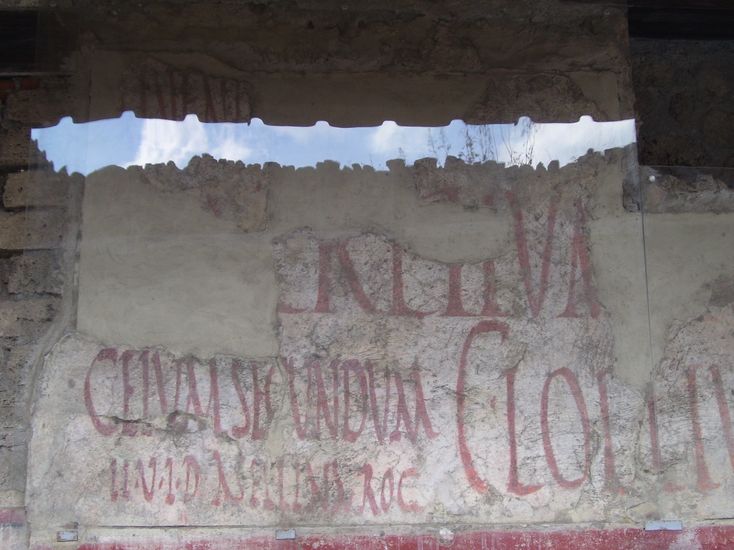
Hi there u/grapp -- while it's slightly orthagonal to your question, you may be interested in this answer from a few days ago, from u/astrogator, on the graffiti in Pompeii and what it tells us about the city.
That depends on how narrow or wide you want to define democracy. As /u/Cormag778 has mentioned, Rome cannot really be considered a democracy, even during the Republic. However, there are different levels and opportunities for popular involvement, and elections. Roman magistrates such as the aedile were elected, for example, as in the Republic. I'm going to approach the topic in a very broad way, trying to outline common elements, but will also focus mainly on the western part of the Roman Empire, and the first two to three centuries. That's the area I'm most familiar with, and things do change quite a bit in Late Antiquity - others here are far more qualified than me to speak on that, though.
Leaving a certain amount of autonomy for the local governments was a defining characteristic of the way the Roman Empire governed and controlled all of the Mediterranean and much of Northwestern Europe. In essence this means that control below the level of the province was in the hands of local municipalities, cities and their respective territory - such as Pompei. As H. Mouritsen has said, "the ideal city of the Roman Empire was in many ways a mirror image of Rome under the Republic"^1; and they were organized and governed just like that. There were several possible constitutional forms that these cities could take. There were peregrine cities, essentially native cities that so far retained their original constitution under the Roman sytem; municipia, with either minor Latin, major Latin or full Roman citizenship; these could also retain their local structures, but were often modelled according to Roman law, and finally the colonies, or coloniae with either full Roman or Latin citizenship. Pompei, originally just an ally of Rome, had become a Roman colony as colonia Veneria Cornelia Pompeianorum in 80 BC with citizenship status. As a rule of thumb, communities in the Greek east more often retained more independent consitutions than their counterparts in the west, where they were often founded ex nihilo by the Romans. Roman citizens thus had a kind of dual citizenship, in their hometown community they belonged to directly, and the wider Roman empire.
While the differences between a municipium and a colonia gradually dissappeared, it's still hard to generalize over such a large time and space, and the details could vary from place to place, there are still a few common threads that characterize government at the local level. And one of the most important ones was the separation between the Elite, which at Rome was represented by the Senate, and the rest of the people, the populus or plebs - exemplified by the famous official abbreviation S.P.Q.R., senatus populusque romanus, the Senate and the people of Rome. It gets overlooked quite often, but this exact formulation encapsulates this very important distinction at the heart of Roman politics. In the colonies and municipiums, the two groups were formed by the ordo decurionum, the order of the decurions, on the one side, and again the populus or plebs on the other side. The decurions were the Elite, and as much as they were an administrative body, the undisputed government of the city, that met in a curia (usually in a basilica on the local forum) and deliberated about local politics, they were also a social class or order, as the Senate, with property requirements and other limits barring the access to this prestigious class. You can see this division also at work in Pompei, for example in this honorific inscription^2, which had been awarded 'by decree of the decurions and consent of the people' (decurionem decreto et populi conse(n)su). The members of the ordo were usually appointed for life, either selected from among the ex-magistrates or co-opted from among qualified citizens of the city (usually freeborn, with enough wealth and of the required age). How exactly that worked, especially in each singular case, is unclear, but traditionally, as in Rome, membership of the ordo decurionum followed the holding of a magistracy.
These were elected offices, and so you have a democratic element, but it was heavily constrained, since to get elected to a magistracy, you also had to fulfil property requirements, be of good moral standing, free of public debt and had to have a honourable profession (or none at all). Furthermore, election to public office was usually coupled with a so-called summa honoraria, a payment that was due upon assumption of office, and could range from rather modest (yet for the common citizen practically unobtainable) sum of 2.000-4.000 Sesterces in Italy or Spain to 38.000 Sesterces in Carthage, as specified by surviving town laws; usually to be spent on games, other public spectacle or public building projects. And you would be expected to pay a lot more out of your own pockets over the course of your magistracy. When you became Aedile, for example, you were expected to pay for gladiatorial games - we can see this at work in another painted inscription from Pompei:
A(uli) Suetti Certi / aedilis familia gladiatoria pugnab(it) Pompeis / pr(idie) Kalendas Iunias venatio et vela erunt^3
"The group of gladiators of Aulus Suettus Certus, aedile, will fight at Pompei on the day before the Kalends of June (May 31st). There will be an animal hunt and awnings."
In any case, this already presented your first hurdle to a true democracy, since this denied the passive franchise to a significant majority of the population. There were several levels of magistracies open for election. The highest was those of the duoviri, or 'two-men', the two mayors or the highest representatives of local iurisdiction, under the direction of the provincial gouvernor (which is why they were officialy called IIviri i(ure) d(icundo), the two-men for the speaking of law). Sometimes there were four, and the office was that of the quattuorviri, quattuorvir in the singular. Other titles are found less frequently, such as sufetes in North Africa, using the old Punic style. The duumvirate or its equivalents brought considerable status and prestige with it, and thus was highly sought after. In Pompei, for example, Ceius Secundus ran for the office of duumvir, and apparently had a woman named Asella among his supporters:
Ceium Secundum / IIv(irum) i(ure) d(icundo) Asellina rog(at)^4
"Asellina asks (that you vote for) Ceius Secundus as duumivir iure dicundo".
Other local offices open to elections were the aediles, the Aediles, mainly responsible for public works and public buildings, keeping the streets in order and supervising the local market and the weights used there; and the quaestores, the Quaestors, responsible with collecting, managing and spending the public funds under the supervision of the Duumvirs. There may have been a strict cursus honorum, a path of office that had to be followed, from Quaestor to Aedile to Duumvir (and finally the Duumviri Quinquennales, who filled a role and position similar to the Censors at Rome, supervising the drawing up of citizenship rolls - the census - every five years, hence quinquennalis), but that's not sure.
The elections worked similarly to the way it worked at Rome, with a popular election by the comitia, the popular assembly. The population was separated into curiae, Curias, who gave their vote as one block. Whoever had the majority of these block votes won the office. This was the most important task of the popular assembly, though they also were often required to give assent to decisions of the decurions, for example on public spending, the handing out of municipal honours or gifts (statues and plaques) to deserving citizens, or denunciations. This is represented, as in the above inscription I mentioned, by formulas such as decreto decurionum et consensu populi, but the division of responsibilities was quite clear, and just as in Rome the citizen assembly didn't have the right of initiative.
We should also be careful not to take the programma, the election campaign dipinti that you mention in your question which survive so often from Pompei, as a direct for a vibrant local democracy, nor immense popular interest in the local elections. Mouritsen states that the named supporters, such as Asellina, were probably most often directly connected to the person seeking office, such as being their clients, and the posters "may be interpreted as largely symbolic reminders to the electorate of the annual elite contest for which their participation was required."^5 I would not be quite so pessimistic, but the fact remains that for most citizens, the opportunities for democratic participation were very limited. For women, such as Asellina, supporting a candidate she couldn't vote for, may have been the only way of direct political participation.
So to conclude, there was, in the towns of the Roman Empire throughout its first three centuries, a form of republic with democratic elements closely modelled on Rome itself, which, consequently, was fraught with much the same social and monetary restrictions barring entry to public offices and the governing body of the city itself, though social mobility was greater in the smaller towns. The practical influence of the individual non-elite citizen (ignoring soft power) was limited to voting for the magistrates and the laws issued by the decurions.
Mouritsen 2014, 228.
CIL X 1026.
CIL IV 1189.
CIL IV 7873.
Mouritsen 2014, 233.
Main sources used:
H. Mouritsen, Local Elites in Italy and the Western Provinces, in: C. Bruun - J. Edmondson (eds.), The Oxford Handbook of Roman Epigraphy (Oxford 2014) 227-249.
S.T. Roselaar, Local Administration, in P.J. Du Plessis et al. (eds.), The Oxford Handbook of Roman Law and Society (Oxford 2016): 124-136.