Sports fans today strongly identify with their favorite teams. When the Red Sox win a game, fans are more likely to say say, "We won!" rather than, "those guys on the team won and we watched." Team rivalries also result in fans of one team having disdain the fans of another team, sometimes leading to fights or brawls.
Were there similarities between today's sports fans and Ancient Romans who attended events at the Coliseum? Did people have a favorite gladiator or favorite lion that they passionately identified themselves with? Was there anything akin to wearing your favorite player's jersey?
Also today it's not uncommon for fans to riot when their teams lose or even sometimes when the win. Is there any evidence of riots incited by the outcome of a Coliseum event?
The Romans were very passionate about their sports, which manifested into several different forms of partisanship.
Some gladiators did achieve individual fame, but as you could imagine, it's tough to achieve a lasting following in a sport that involves fighting to the death. Rather, when you imagine famous fighters who would have been well known around the Empire like Flamma, Priscus & Verus, and Tetraites, I think it'd be more fitting to think of them as "legends" rather than active sports heroes. You almost certainly never saw them fight, but retellings of their epic duels would get passed around for ages.
In terms of arena fans, the most important way to categorize your fandom would be the fighting style you liked. There were many different fighting styles, but the most well-known classes were the parmularii, who fought with small shields in the Thracian style, and the scutarii, who were identified by their large rectangular shield. Each of these styles produced a very different type of fight, and people were passionate about their side. Caligula liked the Thracians, for instance, and Domitian was so partial to the scutarii that he considered criticism of them to be a personal insult.^1
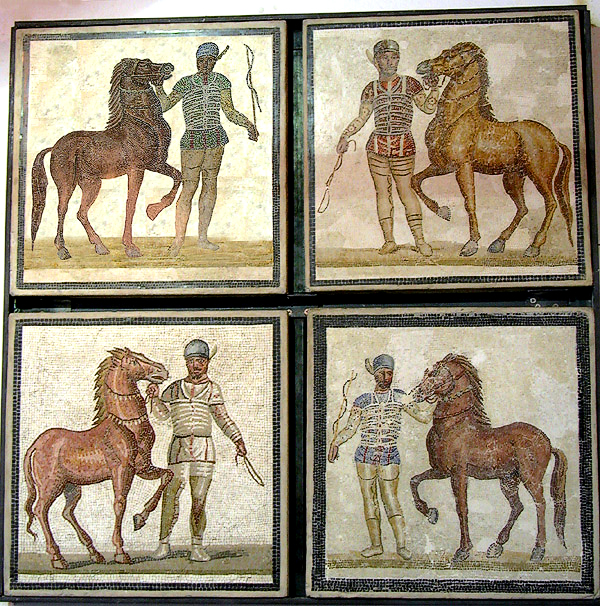
Another major source of partisanship was in chariot racing. There were four major Roman racing companies, the Blues, Greens, Reds and Whites, and those colors would have been worn by racers and supporters in a very similar way to how jerseys are today. The factions functioned somewhere between a political party and a gang, and cultivated loyalty by creating "clubhouses" throughout the major cities of the Empire.^2 Later, in the East, conflict between the Blues and the Greens escalated into a full scale riot in which as many as 30,000 people were said to have died.
Hope that provided some good context.
Edit: One other detail I thought of that I think is critical to conceptualizing what it would have meant to be a Roman sports fan.
Today, we elevate athletes to the highest social level. They get paid millions of dollars and mingle among high society. In Ancient Rome, the exact opposite was the case. The gladiators you saw fighting were the absolute lowest ring of society. They were strange foreigners captured in disgrace, enslaved, taken halfway across the world in chains, and forced to duke it out with a hungry lion for the amusement of a cheering crowd. In almost all cases, your lot as a gladiator was short and brutal.
The Romans always romanticized combat and military glory, and they loved the games because they brought those things close to home for entertainment. But you didn't aspire to be a gladiator the same way you would aspire to be Michael Jordan.