I would like to know the motives behind the Marquis of Pombal's 1761 decision to abolish slavery in Portugal. Was it due to altruistic reasons or was there some monetary incentive behind it? The Brits abolished slavery thanks to Wilberforce's efforts and the declining value of the slave trade, so was it the same case as with the Portuguese?
I want to tackle on another question to this. Brazil received the vast majority of slaves that came to the Americas (40% of the total slave trade). Brazil remained a colony until its independence in 1822, and only legally abolished slavery in 1888 (although by that time most were already free).
What happened in the period between 1761 and 1822? How did this impact the relationship between Brazil and Portugal?
Correction:
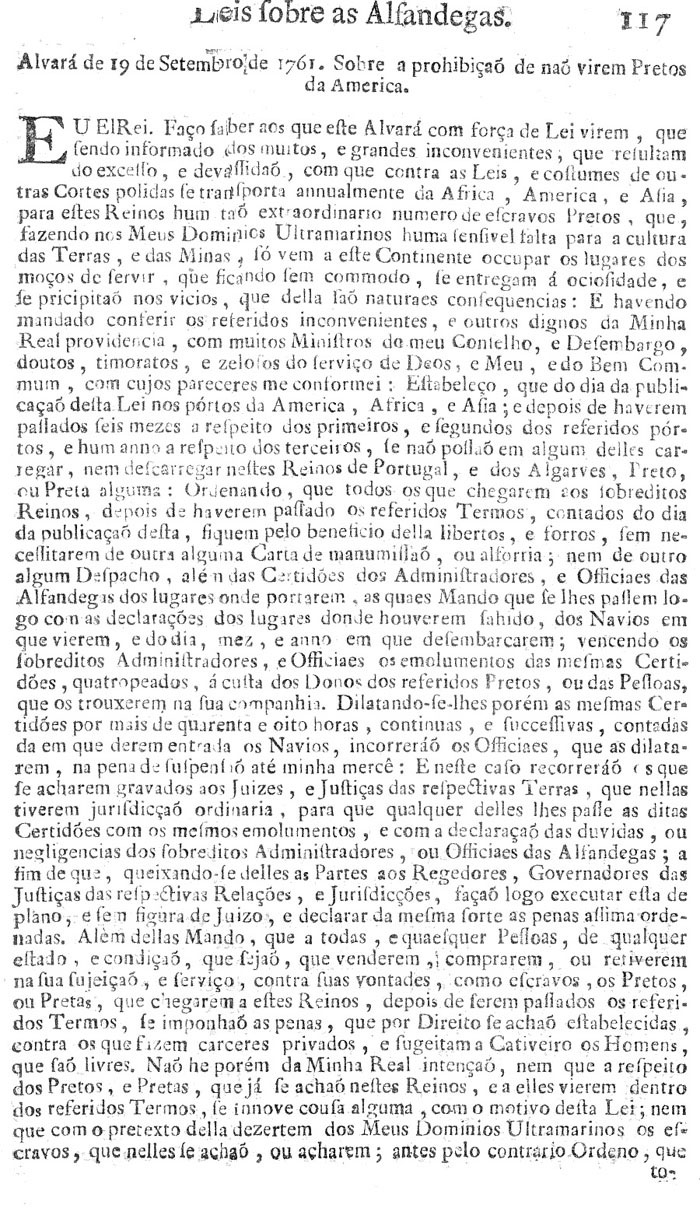
The charter of 19 September 1761 did not abolish slavery in Portugal, it prohibited the transportation of slaves from the empire (Africa, Asia, America) into the kingdom (Portugal). Should slaves be transported into the kingdom, they would be granted freedom.
It essentially dictated the end of slave trade into the continental centre of the empire.
http://www.governodosoutros.ics.ul.pt/imagens_livros/20_sistema_regimentos/vol_ii/0117.jpg (the charter)
As for motives, the charter mentions that:
There were many significant inconveniences resulting from the excess and debauchery with with such an extraordinary number of black slaves were being transported annually from Africa, America and Asia to the kingdom, going against the laws and customs of other courts.
Such slaves were greatly needed in the overseas domains to work in lands and mines, and should they come to the continent, they would take the place of young serving men, who would become jobless and indulge in idleness.
Although we would like to say that Portugal abolished slavery because of high moral standards and an high sense of human rights of the Africans that was not the prime reason.
In 19 of September of 1761 Marquis of Pombal makes a law stipulating that its now prohibited to load and transport any black slaves to Portugal. Nothing is said about the Portuguese Empire south of the Equator.
The Marquis was a man deeply influenced by the Enlightenment movement, he was also an absolutist that wanted to extend the power of the king. Connected to those facts is the expulsion in 1759 (mind the date) of the Society of Jesus from Brazil.
In 1755 the Marquis creates (from the initial idea of the Governor of Grão-Pará e Maranhão, his half brother) the Company of Grão Pará e Maranhão, it was a monopolist state owned company (the Marquis and his wife were members of it) that dealt mainly with slaves. Its main objective was to develop the agriculture and commerce of that region (Sugar, and sugar was made by slaves). The Society of Jesus was by then main producer of sugar and main competitor.
The fact is that Portugal, the metropolis, in 1761 does not need any slaves, but Brazil does. So it is a way to redirect the flow of slavery away from Lisbon and direct it to where is more needed. Between 1758 and 1778 - the duration of the monopoly of the Company in slavery - an estimated 25000 slaves were introduced in the region to work in sugar plantations.^1
It´s also true that some humanitarian notions were taken in mind when the law was made. Especially the works of the Jesuit priests António Vieira and Manuel da Nóbrega claim for the end of the slavery. The Marquis had an humanitarian spirit and he tried to end the discrimination between old and new Christians in Portugal (law in 1773) and he also deeply transformed the Inquisition and the way they operated in Portugal (1774) but you cannot say that it was the main reason to create the first law for the abolishment of slavery.
The law that abolished slavery and freed any existing slaves (from the Crown and Church) only takes full effect in 1878 when Brazil is no longer a Portuguese Colony making then small impact in the Portuguese economy and society.
So, in a way you can say that the Marquis was a men of his time. You can attribute some humanitarian reasons to the laws but they are mainly commercial reasons. The focus on Brazil made the loss of the Indian possessions and market a not so bad loss for the Portuguese crown.
Sources:
Caldeira, Caldeira. Escravos e Traficantes no Império Português. Lisboa. 2013 MARCOS, Rui de Figueiredo. As Companhias Pombalinas: Contributo para a História das Sociedades por Acções em Portugal. Coimbra: 1997 Marques, António Oliveira. História de Portugal Vol II, Lisboa 1998.
^1 Carreira 1968, 1988; Dias 1970; Silva 2008; Florentino & Ribeiro 2004; Pinto & West 2012.