Not sure if I can ask this question here, but I'll try anyway.
I love history, and I'm about to graduate from high school, but I'm not sure whether I'll be able to make a career out of it. I'd like to hear your experience: what do you guys do for a living? Did you specialize in anything? How hard was it to find a job? Hope you guys can help me, and sorry if this kind of question is not allowed!
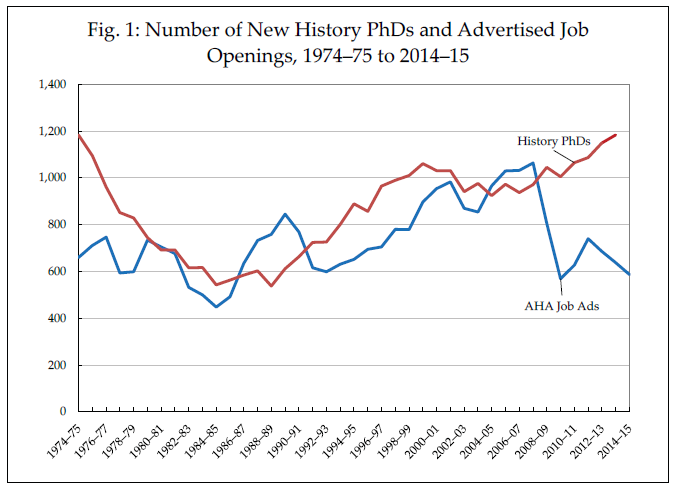
We got a similar question in /r/AskAcademia, and this is what I wrote there. I think you're worrying about this a bit too early on — at least, I don't think anyone here can tell you what the job market in history is like. Right now it is pretty terrible but will it be like that in a decade, when you'd be on the market? I have no idea, I doubt anyone really does.
I will only add to the above by saying that there are many things one can do with a history degree other than become a professional historian. It's sort of like studying music. Are you going to be a rock star? Well, it's a possibility, it might all work out — the talent, the luck, the connections. But it would be imprudent to bet on that. Does that mean you shouldn't study music? No way — there are lots of interesting careers in music, and if that's what gets you going, then find a way to make it work. But you might consider diversifying your approach (e.g., music + engineering or music + computer science allows you to do lots of different things) so that you have multiple career options available to you at the end of the cycle. With history it is (currently) very similar: the number of "good (tenure track) history professorships" is not very large and the likelihood of that being your career outcome is potentially very low. If that's all you plan for, then you will find yourself in a stressful situation. If you plan for a spectrum of outcomes, you'll have less stress.
Again, I would not, at this stage, be under the delusion that you will know what you want to do in your future career. I sure didn't when I was your age, not only because one's interests and priorities shift over the course of your early twenties, but also because you haven't really gotten to see more than the smallest fraction of possible things to learn about. There's a huge, exciting, fascinating intellectual world out there — explore it.
Right now I am taking/have taken many classics and history courses during my undergrad. I have spoken to several professors about this kind of issue. My professor, who teaches Greek/Roman Comedy as well as Paganism to Christianity (got his doctorate in something like ancient literature/comedy [writing his thesis on Medieval Dark Humor]), said that the job market is EXTREMELY difficult and depressing. All he can get are the odd teaching jobs that are very stressful, undependable and don't pay well. He is constantly having to write and produce pieces of work so he might get published, which can then maybe help his job hunt. Basically unless you're absolutely amazing, have the right connections, go into your desired area of historical expertise at the right time and are ok with forgoing making money until you're basically 40, I wouldn't recommend it. Even if you're lucky and have parents paying the ridiculously high undergrad college fees, you still have to go to get a doctorate to be taken seriously, which adds another 5-7 years of studying during which you're not making much money. Then once you come out of your PhD program, you have to be ready to move at a moments notice if an ok opportunity comes up, many people who've recently graduated have to take any job they can. That sounds extremely stressful and competitive. Are you sure that you would still love working as a historian with all those troubles? You might want to go to college doing something else you like, but which will give you more opportunities and treat history as a hobby. Anyway I wish you the best of luck in figuring all of this out! You're young so don't put too much pressure on yourself and situations change all the time. I personally have the feeling that now there are too many people going into computer sciences and engineering so that job pool is going to get extremely competitive, and have heard that even the sciency jobs aren't paying well.
I finished my master's degree in history last spring. I thought about continuing my studies, but I was offered a job teaching high school history. I loved teaching in grad school, and the pay is much better than my pitiful grad assistant stipend. Plus, I get summers off to work on my own research, and being a high school teacher is much more conducive to me having a family than academia was.
I was able to get my emergency certification and pass the two Praxis tests required in my state during my first semester of teaching.
Plus, we need good history teachers in high school, so students won't be lost when they get to college.
My specialty is wealthy people of color in the antebellum South, but I teach world history, early US history, government, and economics. It's a wild ride, but it's so worthwhile. Honestly, I think public schools would do well to recruit more teachers from academic graduate programs. It's not lucrative, but neither is academia.
I wish you all the best!
I have a bachelors degree in history, with a couple of minors, and got employed fairly easily. If you want to be a teacher, many states, but not all, will allow you to get certified on a temporary basis as long as you have a bachelors and can pass a few standardized tests. That's actually what I'm doing right now. There's also jobs with the national parks service and museums, giving presentations at historic sites, tours, etc., which I used to do.
Otherwise, a degree in history is sort of a degree in advanced reading comprehension. As much as it's about history, it's also about gathering and synthesizing sources into a fluid and coherent piece. If you have some basic job experience and can represent yourself well, you can spin it into many things based on that; many people actually consider a BA in history the best prelaw for that reason.
However, I couldn't tell you anything about a masters or doctorate in history, and that's just my experience. I happened to live in one of the most historic cities in the southern US, so NPS/museum jobs were much more abundant that if you were living in, say, small town Wyoming.
Thank you guys for your answers - you're all so kind! I'm going to read every discussion and answer what I can. Appreciate ya!
Start by asking yourself: "What do I want to do with history?" Do you want to teach? Elementary, Middle, High School, College? Do you want to just do research and write? Maybe thinking of going down the J-School route is your thing. Do you like history museums or curating libraries and special collections? The point is, there are multiple pathways to making a career out of history. It's a tough (broad) field no matter how you tackle it but if you are truly passionate about history, you will find your way. I did (Which I'm rather proud at--'See mom & dad, I didn't have to go to law school after all!').
I'm actually a grad student in history at a pretty fancy university. I'll be honest, things are grim, even here. If you don't get into a very good school as an undergrad, then do very well there, your chances of making a decent living as a historian are very low. In some fields they'll often have 300 applicants per job, and good applicants too. If you want to do it go for it, but it might not work even if you're the best at everything you do.