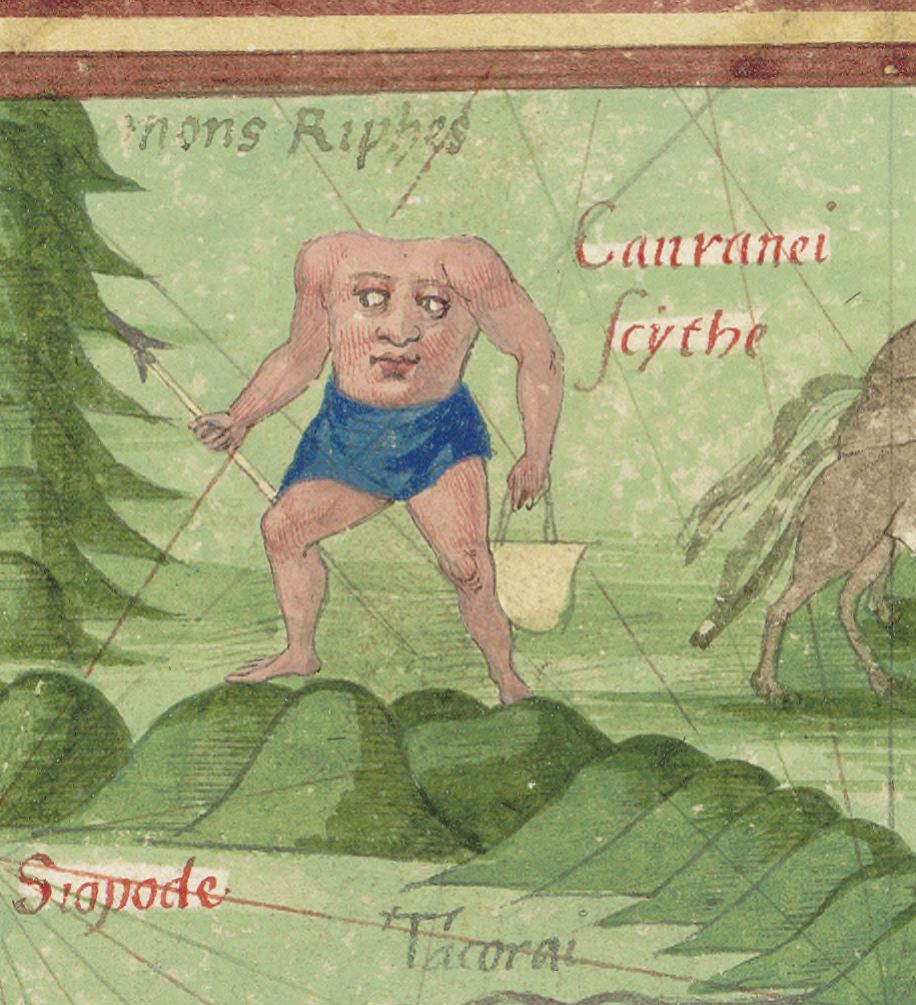
Sure, why not? I mean, to put it another way, even by the late 17th century, when the Royal Society of London was doing all sorts of proto-science work and claiming to be skeptical and empirical, they still weren't sure about werewolves, many believed that you could still use magical religious chemistry to discover the secret of immortality, and they were only partially convinced that massive crocodiles could be born out of tiny eggs. A few deades ea
Which is to say: the "natural world" of the far past in not the world we live in now. What's the boundary between bullshit and truth? They weren't sure, and they didn't have great ways of knowing. What they had were things other people said they had seen, or things the ancients said existed, and depending on who you talked to, people could believe lots of different things. They had very limited means of communicating the existence of natural animals and their appearances, and they filtered everything they saw in the world through preconceptions, even when they were trying to be empirical.
So a horse with a horn — why not? There are lots of things with horns. The world is a big place. There are animals with ambidextrous noses, I hear, and massive beasts that wear armor. There are birds without feet, maybe, and an ocean full of monsters. People have said it is true, in far-away lands. Don't even ask about the people who live over the sea!
To put it another way, this is the only specimen of a hippo that almost anyone in Europe could see for two hundred years without going to Africa. Real? Fake? Not easy to know, in a day before easy travel, easy reproduction of evidence, etc.
All of this is separate from what was being marketed as unicorn horn. There were plenty of fraudsters and hoaxers making money by selling nostrums and alchemical medicines to rich nobles. There were definitely learned people who suspected these as being just moneymakers with no intellectual integrity. There were a few people who tried to figure out what was what. The guy who basically figured out that what was being sold as unicorn horn was narwhal horn was Ole Worm, a Dutch naturalist who assembled an impressive cabinet of curiosities, sort of an early natural history museum (you can see the spiral horn at the back center, in the shelf). It's a weird bunch of odds and ends — this is what "biology" looked like before it got more systematic (you can see the benefit that someone like Linnaeus brings to this world, with a practical system for sorting out the near infinite variety in nature).