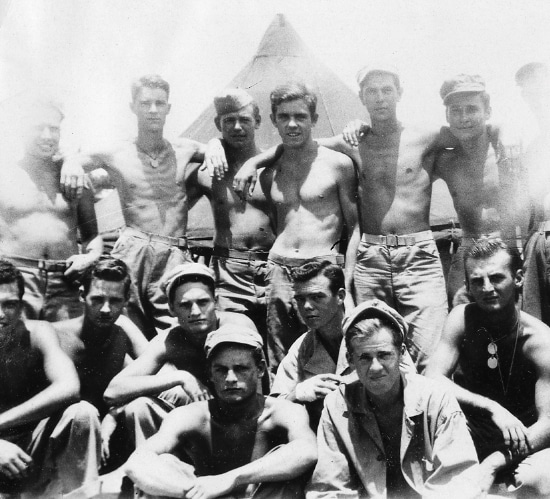
I saw a picture of Eugene Sledge and his platoon at Okinawa where most of the guys are shirtless here
Sledge was in a mortar platoon, and therefore those men would all be classified as infrantrymen and front-line combatants. While, the men there don't look weak or out of shape, they are definitely smaller than the Soldiers and Marines I personally know, especially the infantrymen.
I know one factor could be that the men in the photo had been in combat for a while, and burning a lot more calories than they were consuming. And Americans in general were just a lot smaller back then.
But what other factors were there? Did infantry have to carry less? Were weapons and ammunition lighter?
During World War II, the average body measurements of the over six million male inductees into the U.S. Army was found to be 5 feet, 8 inches tall and 144 pounds in weight, on average an inch taller and eight pounds heavier than his Great War counterparts. He had a 33-1/4" chest measurement and a 31" waist measurement. The clothing sizes most most frequently issued were a 7 to 7-1/2 hat, number 9 gloves, a size 15 shirt with a 33" sleeve, a 36 regular jacket, a pair of trousers with a 32" waist and a 32" leg length, size 11 socks, and size 9-D shoes. He could expect to add an inch to his chest and gain six to nine pounds during training. Army "A" rations were quite filling, often 1,000 to 1,500 calories more than many civilians were receiving. The average woman volunteer was found to be 5 feet, 4 inches tall and weigh 128 pounds. The average height and weight for a man in the United States today is 5 feet, 9.3 inches and 195.5 pounds; for a woman, 63.8 inches in height and 166.2 pounds.
During World War II, men needed to be between 5 feet and 6 feet 6 inches tall and weigh more than 105 pounds to be accepted into the Army. The Marine Corps was far stricter; the 1940 Marine Corps manual specifies heights of between 5 feet 6 and 6 feet 2 inches tall.
The World War II-era figures are smack in the middle of the "normal or healthy weight" BMI category as specified by the NIH, 18.5-24.9. BMI measures body mass in relation to height, but (controversially) does not take into account the percentage of fat on a person's body in relation to muscle and vice versa. According to BMI alone, 65 to 75 percent of U.S. adults today are overweight or obese.
| Era | Sex | Height | Weight | Body Mass Index |
|---|---|---|---|---|
| World War II | Men | 68 inches | 144 pounds | 21.9 |
| World War II | Women | 64 inches | 128 pounds | 22.0 |
| Today | Men | 69.3 inches | 195.5 pounds | 28.8 |
| Today | Women | 63.8 inches | 166.2 pounds | 28.5 |
Most inductees were children of the Great Depression. For example, on October 15, 1943, 31.2 percent of soldiers assigned to the 10th Mountain Division at Camp Hale, Colorado, were between 20 and 22, with 21.8 percent being between 18 and 19, and 17 percent being between 23 and 25 years old. Most of these men would have been born between 1918 and 1925, making them between 8 and 15 during the height of the Great Depression in 1933. Outright malnutrition (which could lead to rejection until the problem was corrected) or low weight upon induction was a problem. In Missouri, 300,000 schoolchildren were examined in 1934; 14 percent of them were considered malnourished. In Pittsburgh, Pennsylvania, the percentage of children who were 14 percent or more below average weight increased from 7 percent in 1927 to 12.6 percent in 1934. The malnutrition rate in coal mining areas of states such as Kentucky, Ohio, and West Virginia often exceeded eighty percent.
Sources:
G.I.: The U.S. Infantryman in World War II, by Robert S. Rush
History of the Tenth Light Division (Alpine), by Captain Thomas P. Govan (Army Ground Forces Study No. 28, Historical Section Army Ground Forces, 1946)
Tailor to Millions, by Harold P. Godwin (Quartermaster Review, May-June 1945)
"Children with Half-Starved Bodies" and the Assessment of Malnutrition in the United States, 1890-1950, by A.R. Ruis, Ph.D