Michael Kazan has a rather provocative op-ed in the NYTimes today that turns on its head many of the things I assumed to be true about WWI. Most notably, he argues that it was a bad thing the US entered the war since it forestalled the possibility of a negotiated settlement on more equal terms, leading to the Versailles Treaty, the stab-in-the-back theory, and so forth. Does anyone give credence to this argument? In my understanding Germany was essentially a military dictatorship at this point, and peace feelers were not getting any traction on either side. I'd love to hear someone else's opinion!
Here's the article for reference: https://www.nytimes.com/2017/04/06/opinion/should-america-have-entered-world-war-i
Well, counterfactuals are impossible to be sure about.
His American-centric view ignores the very real possibility that France and/or Germany collapses in a Communist/Socialist revolution. Another year or two of war in Europe might well resulted in more collapses and revolutions, with remaining powers too exhausted to do anything. Imagine 1920 rolling around with a Communist Russia, Germany, France, and god only knows what in the Balkans, Eastern Europe, and the collapsing Ottoman Empire, with a socialism/communism rising in Britain and Italy as well. That could have touched off more civil wars and counterrevolutions in a continent already facing food shortages.
The US entering the war may have prolonged the war, but the state of affairs in Europe made an unequal settlement inevitable.
Before the US entered the war, there were several peace initiatives that didn't go anywhere. The US under Woodrow Wilson especially attempted to get the major powers together for a "peace without victory" but none of these talks ever got anywhere.
The closest that Europe may have come to a negotiated settlement before the US entered the war was likely the Sixtus affair. It started in 1916 when Sixtus, a French Aristocrat whose sister was married to new Austro-Hungarian emperor Charles, started talks between France and Austria-Hungary about how to have a separate peace between Austria-Hungary and the entente. Basically, the treaty would have given France Alsace-Lorraine back from Germany, restored Serbia and Belgium, and otherwise left Europe unchanged.
The problem with the treaty was that it offered back land from a country the entente would still be fighting (Germany), as well as when the Italians got word of it they refused to end the war without getting something, mainly land, from the Austrian-Hungarians.
This resulted in this specific example of a peace falling apart, and it lasted through when the US joined the war in April of 1917, so any other attempt at a negotiated peace was after the US entered the war.
At that point, a war with a harsh treatment against either side was inevitable as the French and British were resolute to at least hold until the US arrived if not make their own gains and victory, and the Germans had to starve out the British or make a break in the Western lines to prevent them from losing.
It's worth noting that even after the Armistice the blockade on Germany and central Europe persisted until the Treaty of Versailles was signed, with one of the major reasons for Germany signing the treaty being the hope of getting food to its own starving population.^1 With the US at the negotiating table, the chances of Germany being able to get a more fair peace treaty was possible, but the British maintaining the blockade meant that Germany did not have the internal strength to even stay longer at the negotiating table.
Edit: Sources
As somebody who has studied the period around WWI mostly from a German perspective, I agree with the main point of u/Xargav, that is that the US entering the war might have quickened it's end, but that it's involvement was not the tipping point. I could argue that the Russian Revolution was a more critical tipping point, but instead I'll try to address the rather vague question: "Was Versailles always going to be harsh?" My answer is affirmative, but I'll approach it from a rather oblique angle that should all come together nicely by the end. Along the way, I'll try to point out the relatively small magnitude of Wilson's joining the war (the involvement of the states financially, on the other hand, is a whole separate beast). At the end, I'll muse a bit on the backstab myth and how it is (not) related to Versailles. Finally, I'll take a little jab at an implication made in the op-ed that I believe to be a misleading over-simplification, namely that the backstab and Versailles necessitated Hitler's rise. Otherwise, if the backstab and Versailles don't make Hitler, who cares whether Wilson created them or not?
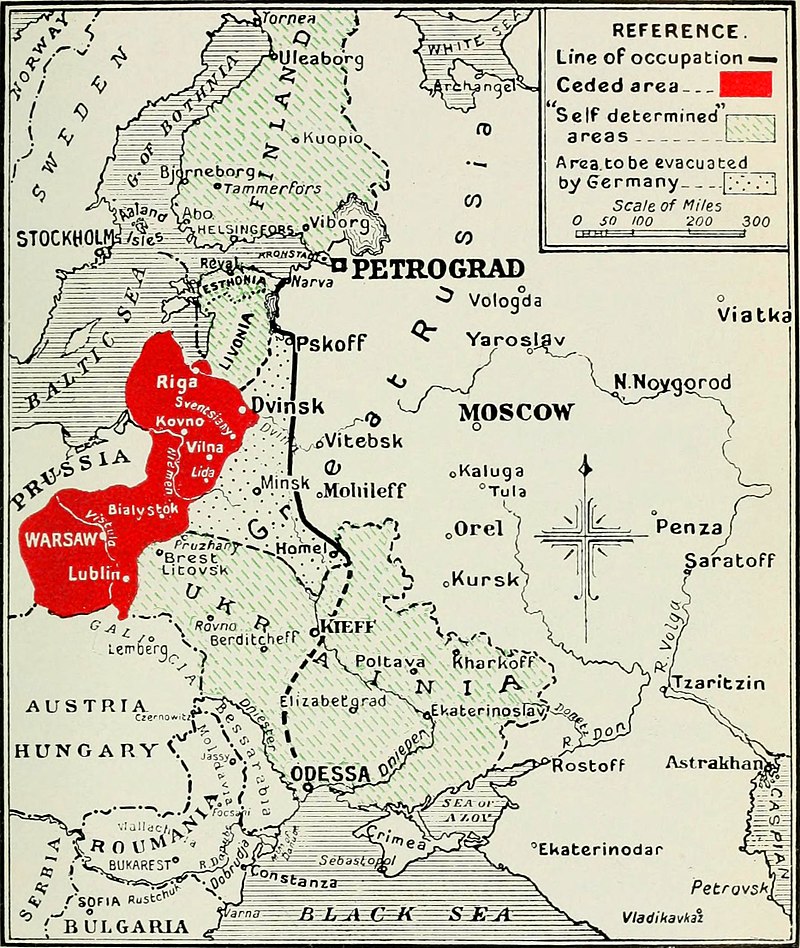
Just before the US entered the war in April of 1917, the Russian Revolution occurred, in March. Key to Lenin's claim to fame was the assertion that the ongoing and disastrous war with Germany would be brought to an end at any cost. To get a sense of of what "at any cost" means, take a look at this map of territorial concessions made in the treaty of Brest-Litovsk. I would make the argument that a treaty signed in a world where the States retained their neutrality would look largely the same, for two reasons. First, that Lenin was politically obligated to accept essentially any peace treaty put on the table, and that therefore peace in the east was inevitable once the Russian Revolution had succeeded in overthrowing the Russian Empire. Second, that the German military leaders and political élite were politically obligated to be as demanding as possible, as by 1917 (and certainly by the time the treaty was signed in 1918), dismally-deteriorating domestic socioeconomics had eroded the German populace's will for total war, an erosion that could only be appeased by a decisively-triumphant peace. Finally, I will argue that the harsh terms of Brest-Litovsk, the domestic political situations of France and Great Britain, and the inevitably-total defeat of Germany were the main contributors to the harsh terms of Versailles -- not the military presence of the States. I'll then make a statement about the stab-in-the-back myth, which I think is both erroneously and dangerously reduced to popular, reactionary fanfiction in the referenced op-ed, as well as in popular memory.
I'll give a picture here of the home front in 1917 Germany, because it gives important context to the question of why the German military was so demanding in exacting concessions, even when the sheer magnitude of those concessions were to its own disadvantage.
Pre-war Germany was heavily dependent on the labor of migratory laborers, who would enter Prussia every year (by the hundreds of thousands) during harvest season from Russian-possessed Poland. As an aside, this was one issue where Wilhelm II came into direct conflict with the Prussian, landowning élite. By antagonizing Russia as he did in the years leading to the Great War, he was acting against the interests of their labor market, because no migrant laborers -> bad harvest -> no money. As 1914 turned 1915, where once were migrant laborers were now conscripted soldiers and citizens of a combatant nation. To Wilhelm and his Generals, this was not an issue because they genuinely (myopically and arrogantly, nevertheless) believed that the war would be done and dusted, come Christmas. This promise of "The boys'll be home by Christmas" was one that the German public fully believed in, for a plethora of reasons that I won't go into here. To continue with our agricultural narrative, as 1914 passed into 1915 and 1916, the results were a devastating agricultural crises, and the emergence of a black market for food that inflated food costs even further. Mind you that, aside from isolated instances, there was no famine in Germany during WWI -- largely thanks to rationing programs created by Municipalities and States, at the encouragement of the Reich. However, as the public sector paid much more (and often with Reich-awarded credits) for each loaf of bread than the average citizen, the markets began to steadily inflate until the masses were entirely dependent on dwindling rations. The emergent, politically-inclined, and self-consciously entitled middle class of teachers and service-sector workers found themselves either unemployed, conscripted, or repurposed into industrial labor by Hindenburg's program of 1916, a transition that had a tremendously negative impact on their sense of pride, and on morale in general. Factories that made linen were repurposed to make uniforms, school teachers were moved to work in steel factories, and small shop owners became nodes of a black market nexus that both drove inflation and conspiracy. Remember, this was before we had a good layman's explanation of inflation -- to these people, Hans down the road was now inexplicably selling his bread for triple the price and was only accepting payments in War bonds, which people informally and disastrously used as a substitute for currency. Children were no longer going to school, but forming gangs and getting involved in petty crime, as crime rose and schools, bereft of repurposed instructors, closed down. Sucked into the realities of total war, the morale of a citizenry whose sense of status quo was rapidly eroding was palpably poor and ripe for revolution. When historic proportions of laborers (and finally, soldiers) held strikes in 1917 and 1918, it wasn't against low wages or empty stomachs, it was against the uniform erosion of recognizable society.
These changes were not haphazard, but carefully orchestrated. It is important to note that by 1917, the German state had been gradually transformed from what was essentially a constitutional monarchy with a free-market economy into a military dictatorship with a completely war-centric economy. This wasn't because Hindenburg and Ludendorff were hungry for power and riches (they already had plenty of both), but rather because it had gradually become necessary, in order for the German state to continue what had become a war of attrition in the west -- which, remember nobody thought would drag past 1915. The isolated German state simply could not compete long-term with Great Britain and France (both economically supported by the States) in terms of resource production and manpower. The Hindenburg program throttled the German population and uprooted society, just to make ends meet in the short-term. Nobody at the top of the military hierarchy wanted to face the reality that the war was unsustainable -- such that instead of a realistic self-assessment of industrial capacity, what was needed was more direct authority, more focused labor, and, importantly, more money to pay for it all. Within the directly-elected Reichstag, there was an awareness as early as 1915 that the situation was not economically sustainable, as evidenced by several more pacifistic members of parliament voting against the authorization of war credits, and breaking to form an independent party. Even in 1916-17, the German state was literally living on borrowed time, borrowed money, and borrowed labor. The difference was that while France and Britain had assets to borrow against, and worthy creditors in the United States, Germany was borrowing against its own assets and credit, which were eroding week by week.
My main concern with Kazan's piece is that there is no real evidence to support the idea that the IS entry to the war made peace negotiations any more complicated. The main reason the Treaty of Versailles was so damaging was that it was used as a punitive measure, punishing the Axis and most specifically Germany. This took several forms, but the most devastating was reparations.
German reparations were so punitive and damaging that the entire German economy was destroyed post-war. The UK and France, especially, were devastated by the war and wanted revenge, and so required Germany to pay huge reparations regardless of Germany's ability to actually do so.
The thing is, US involvement had little to do with this dynamic. The US was not hit so hard by the war, and so had no need to extract revenge. In fact, US interests revolved mostly around Wilson's 14 points, largely a statement condemning colonialism, and the efforts to establish the ill-fated League of Nations. The US contributions to the Treaty were almost entirely about restructuring the existing geopolitical landscape.
But even if the US did not get involved, it is unlikely that the reparations would be lighter, but fairly likely the reparations would be worse. Part of the reason the allies imposed such harsh penalties in Germany was because France and the UK accursed a very large war debt mostly to the US. By the end of the war, the debt was getting so intimidating that the US created the lend-lease program, which allowed the US to send aid to the Allies but didn't rack up a monetary debt. When the US entered the war, the UK and France were extremely tapped for resources--it was called the Great War for a reason. An entire generation of Europeans was lost in that war. The US shouldering some of that responsibility in terms of materiel, finances, and manpower meant that the UK and France were less taxes than they could have been. Had the US not got involved, it's entirely possible the costs would have been even greater and the reparations would have been even greater.
So in short, I doubt Kazan's piece has any actual support. The US softened the cost for the victorious powers and tried to distract the peace discussions from revenge and status quo. The US might not have been entirely successful (ok, not even remotely successful), but to say that the US made things worse, as argued by Kazan, has little historical support.