So everyone knows that the daddy of Communism is Marx and the most well known schools of Marxist thought is Leninism and Maoism. Then you start getting into increasingly more diversified ones. There's Trotskyism, Hoxhaism, Guevarism, Ho Chi Minh Thought, Khrushchevism, Juche, Luxemburgism, on and on.
Communist thought is as rich and diversified as any other school of political thought like Monarchism, Democracy, or Anarchism. So, what are these different schools and how and why did they form?
[1/2]
As I've put in my other answers regarding communism, full disclosure, I am answering this question both as a historian and a communist, and if the mods feel that there is a conflict of interest in my post, I completely understand if they feel inclined to take it down. That said, I'll try and present things as objectively as possible.
Right, so let's start with the most basic unifying word for all these ideologies: communism itself. Communism as an ideology is divided into two main trends: the Marxist trend, and the anarchist trend. This was what split the original First International, the IWA, in the late 19th century, was factionalism between the Marxist and anarchist factions, and they are largely distinct from each other. Marxists believe that socialism (and subsequently communism) must come from a dictatorship of the proletariat, i.e. a society in which the proletariat are the dominant class, to the same extent that the bourgeoisie control society under capitalism, and all the legal and extralegal means that may imply. It should be noted that Marxism is explicitly authoritarian, going all the way back to Marx and Engels themselves. Anarchism, meanwhile, believes that a communist revolution ought to abolish the state immediately and transition into full-blown communism with no dictatorship of the proletariat or socialism in-between, holding that all power is inherently bad (whereas Marxists see power as a tool to be used for good or for bad).
As your question is about Marxism, I'll solely address Marxism now. Marxism was largely unified pre-WWI, a largely theoretical ideology which had next to no experience being implemented on a mass scale in a revolutionary scenario. And then the Russian revolution, and international reactions to it, happened. Marxism's first major split was around the late 1910s and early 1920s: from this split we get Leninism and Left-Communism. Leninism is largely self-explanatory, based on the writings of Lenin and Trotsky (who were both leaders of the Russian revolution, but by no means similar - but we'll get to that). Left-Communism is made up of a variety of internal tendencies of its own, all loosely held together by the common belief that the Russian revolution was overall positive; that the formation of Soviets was the correct approach to make in terms of organizing the proletariat; but that the authoritarianism of Lenin's government was wrong. Lenin detested Left-Communists, to the extent that he wrote an entire work essentially calling them whiny children. Notable internal tendencies in Left-Communism include Luxemburgism, based on the writings of Polish-German revolutionary Rosa Luxemburg, and Council Communism, as well as the writings of Italian revolutionaries Antonio Gramsci and Amadeo Bordiga.
So, to recap, thus far Marxism has divided into Leninism and Left-Communism, and we've briefly explored the internal divisions of Left-Communism. Now, onto the divisions of Leninism.
Leninism split with Lenin's death in 1924 into Marxism-Leninism and Trotskyism (some Trotskyists call themselves "Bolshevik-Leninists" as opposed to "Marxist-Leninists"). Marxism-Leninism was Stalin's tendency, and indeed would go on to become the guiding ideology of the entirety of the Eastern Bloc (and China, Vietnam, Laos, and Cuba still claim Marxism-Leninism as their guiding ideology to this day), and consisted essentially 95% of Lenin's writings as well Stalin's own comparatively minor additions: these being, Socialism In One Country, and the Marxist approach to the question of national liberation, and the right of oppressed peoples and nations to self-determination. Stalin did not ever claim to be building something new off of Lenin's ideals, but simply following Lenin's ideals. If you'd like an introduction to Marxism-Leninism, Stalin's Foundations of Leninism essentially outlines Marxism-Leninism very well. Trotskyism, meanwhile, was based more off the ideals of Trotsky, who had formerly been a Menshevik before joining the Bolsheviks, whereas Lenin had always been a Bolshevik. Whereas Marxism-Leninism called for a socialist state to develop itself and build proletarian consciousness via economic development of the means of production (i.e. Five-Year Plans, collectivization of agriculture, etc), Trotskyism focused more on spreading the revolution immediately after victory in one country. A common Trotskyist critique of the Soviet Union under Stalin was that a "bureaucratic class" came to dominate the Soviet government rather than the workers; a Marxist-Leninist (and any derivative) rebuttal would be that bureaucracy is not an economic class, as it is not a relation to production, and that bureaucrats were still technically workers, just of a different sub-category than industrial proletarians.
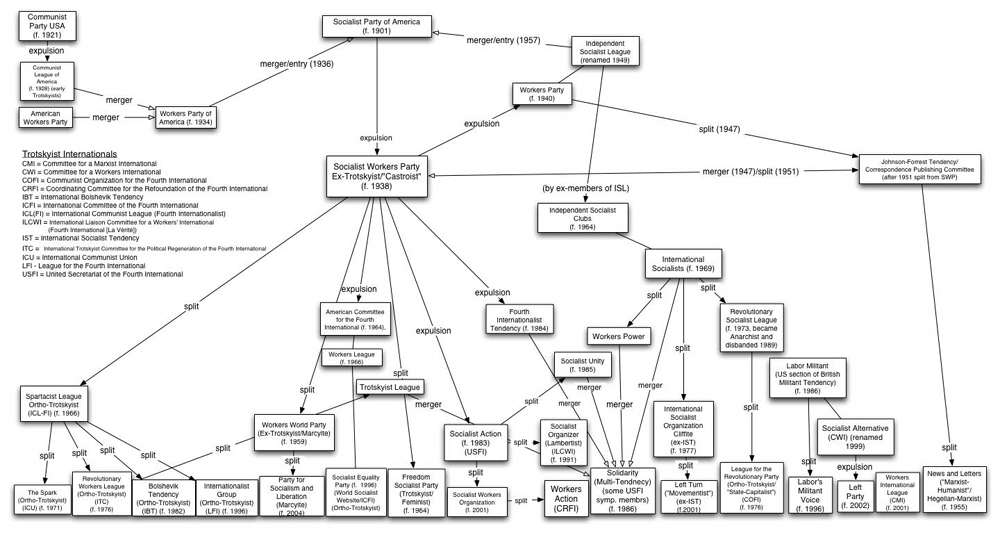
To briefly tackle internal divisions of Trotskyism, well...there are many. An often-repeated cliche of Trotskyists is that they always split off from one another due to internal factional disputes, much as they did from the Comintern. Keeping track of Trotskyist organizations and their relations (and animosity) toward each other boggles the mind. I'll leave a simple chart to explain my point. Trotskyists believe the Soviet Union was only socialist while Lenin was in charge, and have a variety of terms to describe it under Stalin and onward: the most common are "state-capitalist", "bureaucratic-collectivist", and "degenerated worker's state". The proponents of each also disagree with the others.
So again, to recap: Marxism splits into Leninism and Left-Communism. Leninism splits into Marxism-Leninism and Trotskyism. We've explored the breakdowns of Left-Communism and Trotskyism, so let's keep going down the line here.
As mentioned, Marxism-Leninism went on to become the largest and most well-known communist ideology out there for its role as the officially listed governing ideology of the entirety of the Eastern Bloc. After WWII and into the beginning of the Cold War, to be a socialist state was to claim allegiance to Marxism-Leninism. This would change, however, after Stalin's death and the rise of Khrushchev in the 1950s. During his secret speech in 1956, Khrushchev denounced Stalin; in response, Mao soon took to calling Khrushchev a phony communist. By the late 1960s, the ideological gap between the Soviet Union and China was so great that they officially severed ties, thus also splitting Marxism-Leninism, to which they both claimed to be the true successors. Soviet government ideology is typically referred to (by critics at least) as Revisionist Marxism-Leninism, alternatively Khrushchevism or Brezhnevism (as your OP states), while Chinese government ideology came to be known as Marxism-Leninism-Mao Zedong Thought, or simply Mao Zedong Thought (or MZT for short). Enver Hoxha, leader of socialist Albania, was perhaps the most prominent third party to all this: initially aligning with Mao in the split, he soon split with Mao as well, adding a third variety of Marxism-Leninism to the mix, known as Anti-Revisionist Marxism-Leninism, or simply Anti-Revisionism.