Question inspired by this amazing video I just watched, detailing and narrating a 3d rendering of Rome:
https://youtu.be/e_phjB19ZEg (cred: /u/Neutral_fellow for posting in this thread)
I'm curious how Rome's engineers managed the flow of water which seems like it would have to change over time, both as demand and supply of the system changed. How was water routed through the city? What would happen if one bathhouse or neighborhood fountain demanded more water? Was there any water pressure to speak of, other than whatever was present in the Aqua Claudia itself?
Short answer is they didn't have much of a dynamic water system as we think of it today. Very few homes had anything akin to indoor plumbing or even water in the house.
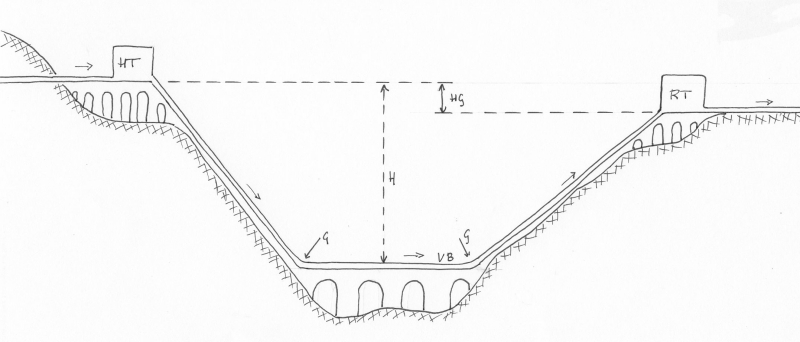
Water was distributed throughout the city at different fountains where the residents would come collect water in jugs, buckets, etc. The 'tap' was always on and water was always running to these fountains. The water pressure was simply gravity doing its work. Aqueducts would bring water into the city from the mountains and the flow of water downhill created all the pressure. They did use some techniques to move water uphill, such as a siphon which was basically a wider passage for water moving downhill and a smaller passage moving back uphill creating pressure (see a drawing here). The only way to create more water pressure was to have the same amount of water moving through a narrower passage, like when you put your thumb over the end of a hose.
If a bathhouse or neighborhood fountain needed more water, engineers would create either a larger passage for water to flow through or create multiple channels for water to reach its destination. While this doesn't mean more water pressure, it does mean more water was able to service the fountain/bathhouse.
In terms of how they expanded supply as the system grew, they simply built more aqueducts. The Aqua Claudia came in on the Esquiline and distributed to various points of the city from there, but eventually Rome grew to have 5 aqueducts servicing the city.
For more detailed information, checkout some sources on the Topography of Ancient Rome. I particularly like The Topography and Monuments of Ancient Rome by Samuel Planter. I got it from a college course, but I'm pretty sure you can purchase it for less than $5 for the kindle.
One thing to remember about the Roman water system is that it required an enormous amount of resources to operate. Someone might imagine setting up a aqueduct and then it basically takes care of itself: water runs from its source to its destination like a man-made river. Actually a very well-run administrative apparatus was required to keep it going. This included money, manpower, materials and expertise as well as institutional and legislative frameworks.
Luckily, we have some first-hand accounts of how it worked from Frontinus, who was Water Commissioner under Nerva. The officials overseeing the system tended to be high-ranking and powerful, because it was one of the most important pieces of infrastructure for the city. Frontinus wrote a book detailing the assets and workings of the system, and also gives a bit of its history.
At various times the government hired contractors to maintain the system, and under Marcus Agrippa they had their own dedicated workforce of slaves. Frontinus gives a detailed account of the organisation of the workers who maintained the system.
Also, at the end of the upcoming quote you can see that the system was flexible enough that they could re-route water, at least to some extent, when necessary. If a particular neighbourhood needed more water, or had its own normal supply compromised, they could take action to rectify it.
116… There are two of those gangs, one belonging to the State, the other to Caesar. The one belonging to the State is the older, which, as we have said, was left by Agrippa to Augustus, and was by him made over to the State. It numbers about 240 men. The number in Caesar's gang is 460; it was organized by Claudius at the time he brought his aqueduct into the City.
Both gangs are divided into several classes of workmen: overseers, reservoir-keepers, inspectors, pavers, plasterers, and other workmen; of these, some must be outside the city for purposes which do not seem to require any great amount of work, but yet demand prompt attention; the men inside the city at their stations at the reservoirs and fountains will devote their energies to the several works, especially in case of sudden emergencies, in order that a plentiful reserve supply of water may be turned from several wards of the city to one afflicted by an emergency.
And, of course, these are just the slave gangs dedicated to the water supply. They also employed professionals, like architect-engineers.
The system was continually breaking down just from its simple nature. People illegally tapped it for private sources of water, stonework crumbled with time, and a particular problem was hard water deposits, like you can see in this photo. These needed to be cleaned out periodically, which was no easy task.
Overall the roman water supply was a major bureaucracy and took significant expertise to operate.
If you’d like to take a look at Frontinus, who I think is really quite fascinating, you can read him here.
Related question, are there any accounts of Roman cities experiencing water shortages due to putting too much demand on their aqueduct? (which, I suppose, would only be possible through bad planning for new developments)
And perhaps something I should take to a physics subreddit, but how did they judge how much water would be needed for new additions?