I fear there are no extant depictions of Jesus Christ that can be securely dated to the first or second century AD. This is likely caused by the relative obscurity of the Christian religion in those early times as well as by the skepticism that early Christians harbored towards the pictorial arts or religious art as a whole. Religious pictures were closely linked in the early Christian mind with paganism and the worship of idols.
However I know of two depictions of Christ that can at least roughly be dated to the second or third centuries AD making them oldest extant ones. Unfortunately they aren’t all that helpful in discerning how people back then imagined the appearance of Jesus. The first one is the famous Alexamenos graffiti from the Palatine hill in Rome. It shows a man with a donkey’s head being crucified and a second person in front of him. An accompanying inscription in Greek explains that the picture shows a man called Alexamenos worshiping his god, presumably Christ. The context is obviously polemical and anti Christian so it doesn’t show you how Christians themselves imagined Christ’s appearance. This is different with the second example from that time, a small intaglio from the city of Gaza that today is kept at the British Museum in London. It shows Jesus as a bearded figure on the cross. The repeated use of different appellations for Jesus in the Greek inscription suggest a magical use for this small object which was officially frowned upon by the Christian clergy. The object is far to small to allow any kind of detailed depiction of Christ’s physiognomy.
It is only from the 3rd century AD onwards that we can find examples for a Christian art that also seems to have been sanctioned by the clergy. For example a wall painting from the famous house church of Dura Europos at the Roman Empire’s eastern frontier shows Jesus the miracle worker who is healing a paralyzed man. A sarcophagus found at the church of Santa Maria Antiqua in Rome shows among other things the baptism of Jesus by John the Baptist. All those artworks depict Jesus in very nondescript or idealized ways. And this doesn’t really change all that much after Constantine the Great legalized the Christian religion at the beginning of the 4th century AD when a more and more elaborate Christian art began to develop. A mosaic from the church of Santa Pudenziana in Rome that was produced at the end of the 4th century depicts Jesus already as the fatherly bearded figure that looks familiar from later medieval or modern depictions. However other artworks like the marvelous sarcophagus of Junius Bassus which was produced at Rome in the middle of the 4th century still often depicted Jesus quite differently, here again as an idealized young man with flowing hair. A page from the 6th century Syriac Rabbula Gospel shows Christ with short curled hair and short cropped beard. The question how Jesus exactly looked like apparently was of no real concern to ancient Christians.
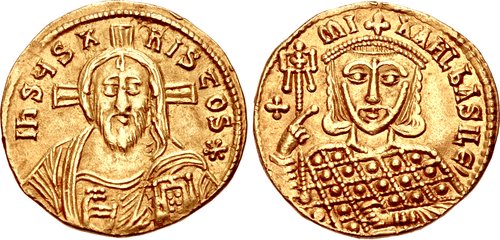
A change in this attitude can be detected in late 7th century Byzantium. This was a time when the worship of christian icons was seemingly beginning to take up steam. Back then the Byzantine Empire was beset on all sides by dangerous enemies and its leadership was desperately hoping for salvation from the Christian god or at least trying to foster unity by showing their intense devotion to the Christian religion. Coins that were minted in that time seem provide evidence for a growing concern about the right way to depict Jesus. Emperor Justinian II who ruled from 685 to 695 AD was the first ruler to put a portrait of Christ on his gold coins. With the long strait hair and beard it closely resembles the version of Christ that we’ve already seen in Santa Pudenziana. However this portrait doesn’t seem to have brought him much luck. Justinian’s autocratic way of ruling had alienated the byzantine elites and in 695 they deposed him, cut off his nose and sent him into exile. The decision to show Christ on the imperial coinage seems to have been a controversial one because Justinian’s successors immediately reversed it. This however isn’t the end of Justinian’s story. For ten years he remained in exile until he was able to summon enough support to regain his throne in 705 AD. After that he again put Christ’s portrait on his coins although in a slightly different way. This time the portrait looked like this, closely resembling the way Jesus was shown in works like the Rabbula Gospel. It seems that Justinian may at least partially have blamed his temporary downfall on the use of the wrong depiction of Christ and now he was trying his luck with a slightly different one. It might have been smarter to also change his autocratic ruling style because in 711 he a was deposed again and this time killed for good. Christ again vanished from the imperial coinage.
Shortly afterward began the time of byzantine iconoclasm when heated disputes began to be waged about the question whether it was at all permissible to worship holy images. After almost one and a half centuries the iconodule side won and the veneration of holy icons became an integral part of Orthodox Christianity. After iconoclasm it became intensely important to depict Christ and the Saints in exactly the right way. For Jesus this meant that the type of Christ Pantocrator which had also been used on Justinian’s original coinage became more or less the standard. It even again appeared on imperial coinage like this one from the 9th century emperor Michael III.
Outside of the Orthodox world the antique attitude towards depictions of Christ more or less survived unchanged. Medieval as well as modern works of art can still show him in very different ways. The high level of prestige that Orthodox icons achieved even in the west may however have contributed to the fact that today this is the most common version of Christ by far.
Are you talking about depictions in art or textual depictions? Just clarifying that in 1-2 A.D., Jesus was still a child. He wasn't crucified until he was 33 years old, so between 30-33 A.D. give or take a few years. Most text (such as the gospels) and artistic interpretations of him wouldn't come until after his death.