Hello! I'm interested in the European colonization of the Americas during the time roughly 1500-1600. I can't seem to finde a comprehensive and accurate map of the territories owned by Spain, Portugal, France and Britain. Does anyone have reliable sources? I'm especially interested in North America (France, Britain). The maps could be historical or modern. But I think maps are the best way to understand this question. Thanks in advance for your help!
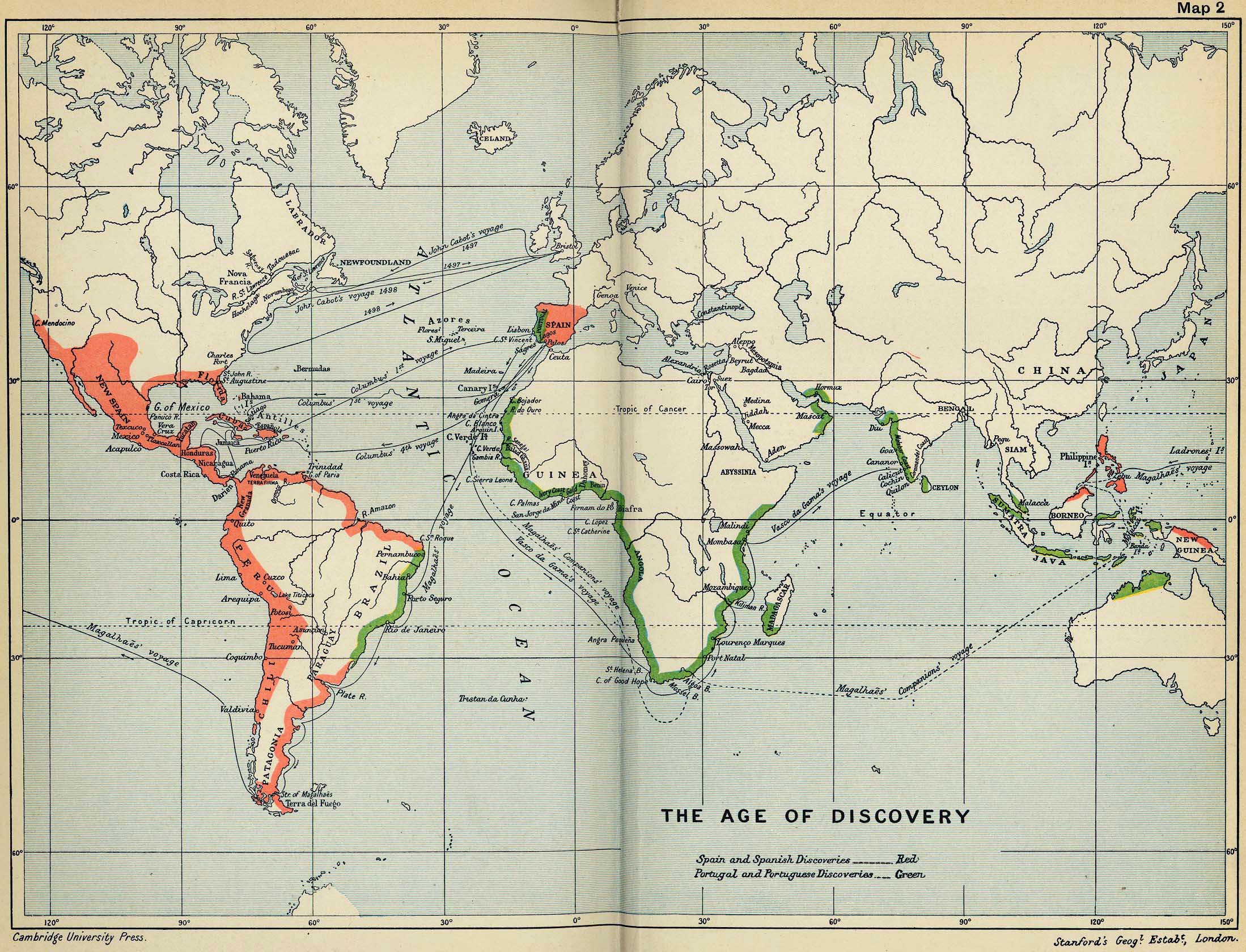
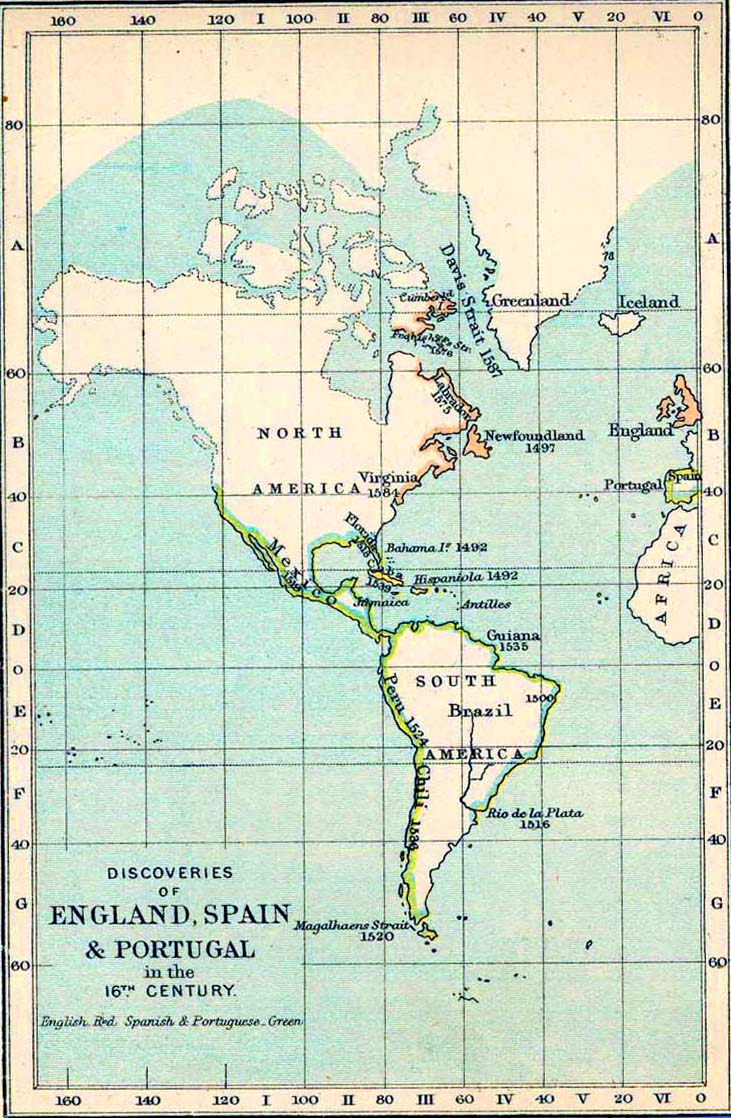
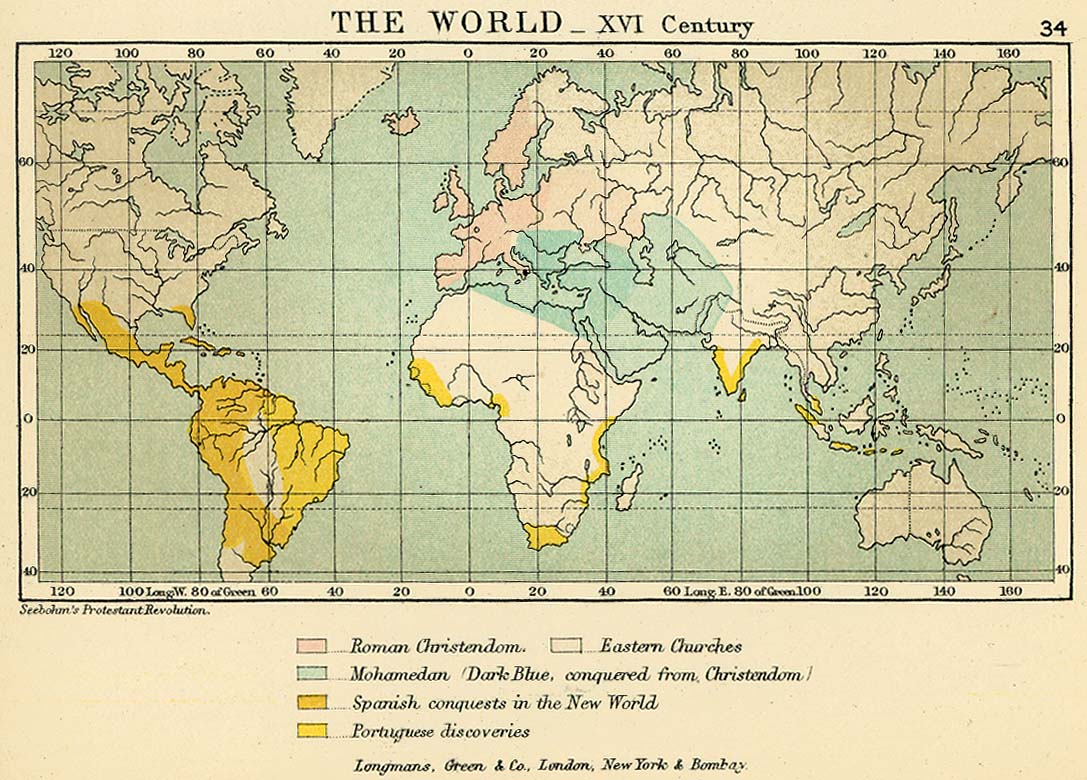
Here are some maps OP:
http://www.britishempire.co.uk/images4/spainportugalmaplarge.jpg
http://www.emersonkent.com/images/americas_16th_discoveries.jpg
http://www.emersonkent.com/images/world_map_16_cent.jpg
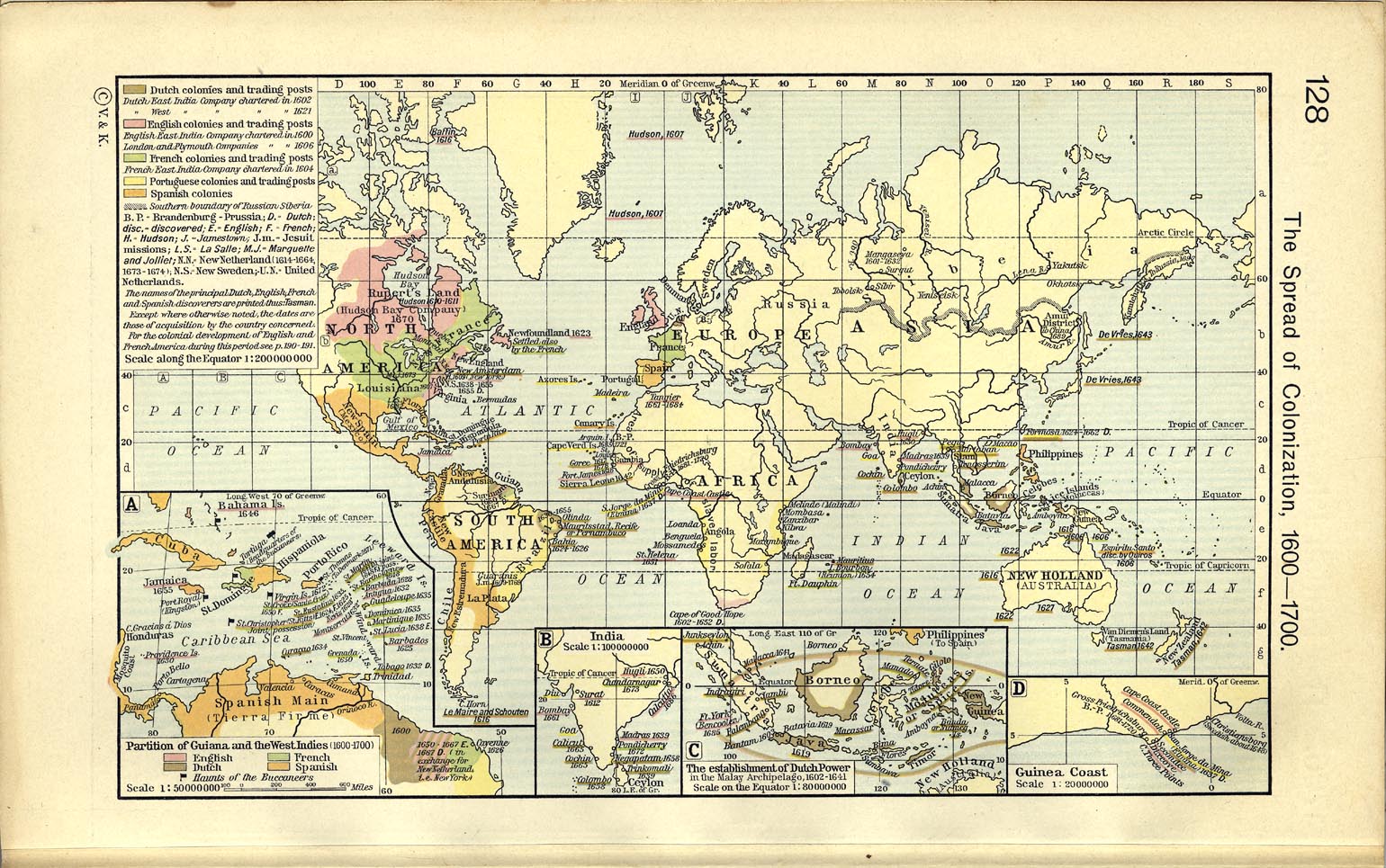
You should note the language here though. “Discovery” and “conquest” are used. Contrast that with this map of the “Spread of Colonization” 100 years after your inquiry.
I’ll limit this mostly to North America and the efforts of the French, Spanish, and English on the continent in the 16th century. Mostly because I’m already gonna run the risk of abridging some important nuance and if I talk about South America that becomes a certainty.
You put English and French in parentheses, but if we’re talking about European presence in North America in the 16th century let’s start with the Spanish. By 1500, the Spanish on Hispaniola had begun to turn a profit on sugar and tobacco, but beyond that there seemed to be little of promise. Columbus still hadn’t found his passage to the east and the vast tracts of gold he’d assumed the natives were sitting on proved to be…elusive. Between 1509 and 1511 the Spanish flag had been planted throughout most of the Caribbean and the northern coast of South America. These trading posts would serve as a good jumping off point for Spanish explorers to probe the continent of North America proper.
In 1513 Ponce de Leon, looking for a place to settle down and play bingo after retirement, began to explore the coast of Florida. In 1521, he attempted to establish a permanent settlement in southwest Florida, but manage to antagonize the Calusa Indians in the region to the point that they attacked, wounding Ponce de Leon and forcing the settlement to be abandoned. Other ill-fated attempts would follow him. In 1526 Lucas de Ayllon led a party into what is today Georgia, where most of the settlers met with death by starvation and disease. Ponfilo de Narvaez made his way through northern Florida and eventually Texas where many of his party were captured and enslaved.
These explorers were in part prodded on by the tantalizing success of Hernando Cortes. Cortes’s conquest of the Aztecs, his encounters with the agriculture, architecture, and of course gold and precious metals in Motecuhzoma's (Montezuma's) "kingdom" were among the factors that opened European eyes to the promise of the New World beyond their quest for new trade routes. In 1539 Hernando de Soto invaded Florida. De Soto brutally subdued the Indians in the region in an effort to force them to cooperate and lead him to riches, which in turn led to ambushes against De Soto and his men.
This brutality was mirrored by Spanish exploration of the North American southwest under the command of Coronando. Coronando’s tactics eventually led to a Pueblo rebellion in 1540 to which he responded by burning down a dozen or so villages. In at least one of these instances he burned the inhabitants alive. Each of these parties eventually abandoned the North American continent. None found their water passage and none found splendor on the scale of what Cortes did in Mexico, but all managed to shape Indian attitudes toward Europeans for a long time.
The problem with not mentioning South America is that it makes the Spanish New World invasion look like a dismal failure. That isn’t the case. Back in Europe Spanish silver exports from the Peruvian mines were giving Spain financial and political power that was making other European crowned heads uneasy. In response to Spanish success, Francis I, King of France licensed several expeditions. French voyages made it up the St. Lawrence river to where Montreal would eventually sit. Giovanni de Verrazzano found the Hudson River and eventually made his way to Nova Scotia.
More to the point of your question though, Francis I also authorized privateering against Spanish vessels carrying gold and silver. Early French attempts at settlement were essentially bases from which to support this privateering. French ships frequently raided Spanish galleons and Caribbean settlements and supporting this practice would be made much easier with North American centers of operation. The settlements would also serve the purpose of supporting French exploration of the continent and finding that waterway to the Pacific (gotta dig European tenacity in this regard).
Much like the Spanish in Florida, the French failed to establish these settlements. There were attempts in 1541 in Canada, 1562 in South Carolina, and 1564 on the St. Johns River in Florida. This last one was problematic for the Spanish, who by 1565 had returned to Florida to found St. Augustine. A Spanish force found the French settlement and destroyed it. In its place the Spanish placed a string of missions in accordance with their mandate to bring Christ to the natives.
From about the 1560s on to the 17th century the French would find economic success in fishing and trading. Whaling and fishing camps allowed French fishermen to exploit cod, haddock, and other north Atlantic fishes, and relations with Indians (a stark contrast to the early Spanish) allowed the French to gain an upper hand in the fur trade.
English attempts at settlement of the New World didn’t even begin until 1584 after explorers with patents issued by Queen Elizabeth (Humphrey Gilbert set out earlier, but he drowned in 1583 off the coast of Newfoundland) set out to survey and settle the North American continent. The 1584 expedition was small, headed up by Philip Amadas and Arthur Barlowe who came across Roanoke Island. Roanoke fails a few times, most famous of course being when a relief vessel sent from England finds the colony empty in 1590. Prior to Jamestown in 1607, English motivations are mostly the same as French motivations; the Spanish are getting super fat and rich.
The whole point in this is that the century after Columbus sailed the ocean blue is a time when European powers are trying to gauge the viability and value of establishing a presence in North America. The English and French do this with a mind to the enormity of a wealth the Spanish head start has given them. Who settles where is in some ways a necessity, economically and militarily. By 1600 the question of ownership is far from answered and attempts at North American settlement are still failing more often than succeeding.
100 years across three major European powers and a huge continent is pretty broad and I did my best to get to the gist of your question. I don't know how more regular posters here manage to cover wide ranging questions so succinctly. If you have any follow-ons I'd be happy to go into detail about anything I've said here.