Apologies if the question is worded awkwardly.
I was thinking today, there are a few peculiarities to driving on a major highway like I-95 which aren't present when driving on smaller roads. Like, using entrance and exit ramps, driving at prolonged high speeds, and continuing relatively straight for long periods of time. I would assume that American drivers, before the construction of these highways, were not accustomed to driving in this way.
For example, not having to make an actual turn for hours on end would probably be strange to someone when the highways were first built, and I'm guessing that there were drivers who could have fallen asleep or something because of a lack of stimulus.
Are there any documentations of Americans having to relearn their driving habits, or adjust how driving was taught in response to a newly built highway system?
It depended on where that person came from! Like any big technological system the highway network started in bits and pieces. If you lived in and around LA or NYC highways were pretty common, if you were coming from a smaller town in New England or the MidWest, they were a novelty.
By the time Eisenhower signed the Interstate Highway Act in 1956 the term "highway" was a known term. Robert Moses, the great builder of New York City, won a $25,000 prize in 1954 for an essay contest hosted by the main pressure group to build the highway system and he titled it "How to Plan and Pay for Better Highways." (P. 249 in Jackson's Crabgrass Frontier) The use of the word "better" there is a hint that the term highway already existed.
Most Americans though would be more familiar with the designation "expressway" or "parkway" though. Starting in 1916 with the passage of the Federal Road Act states and the federal government paid 50/50 to upgrade 200,000 miles of roads that linked all cities with a population of more than 50,000. (P.167 in Jackson's Crabgrass Frontier)
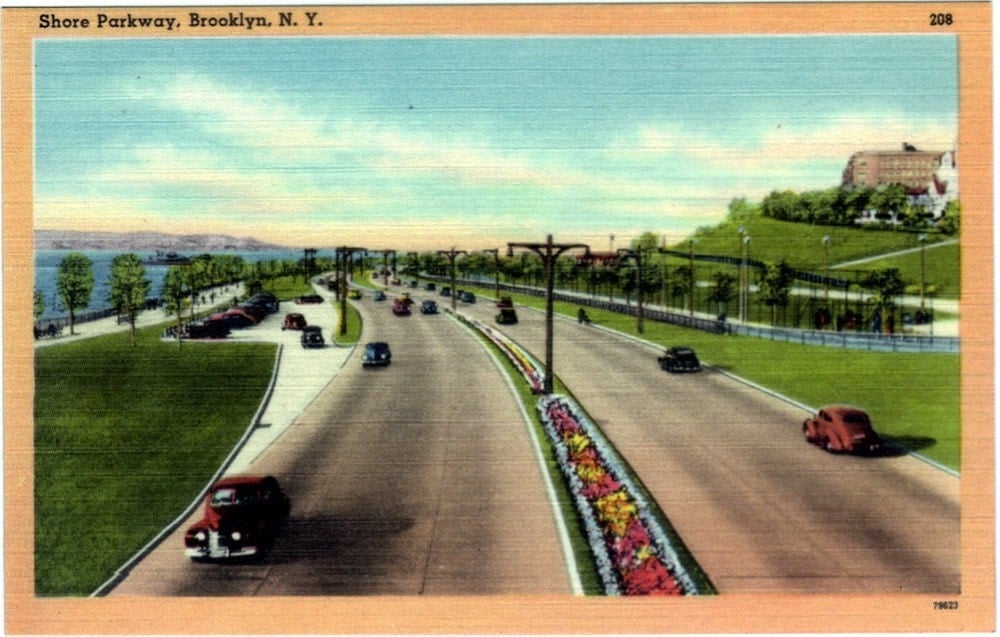
The Long Island Motor Parkway is generally considered the first highway in the United States and it was completed in 1911. Ten years later the Bronx River Parkway was completed as well. Before the great depression there were about a dozen parkways and expressways built around New York City (Jackson P. 160)
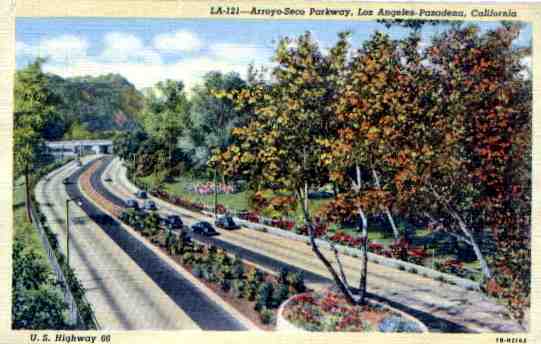
In California a bunch of retail store owners lobbied the state to build one of the largest networks of highways that would lead directly to downtown Los Angeles which was completed a few weeks before Christmas in 1940.
Outside of LA or NYC though, there were only a few really well maintained and paved roads that had limited entrance/exit rules. I began by describing highways as a "novelty" for those outside of LA and NYC and there's no better way to demonstrate that than by showing all of the postcards that were made for parkways and expressways.
The TL;DR of it all is that many people visiting NYC or LA for the first time would have a bit of a learning curve, and by the time the national highway system came to a small town there would have probably been a few people who had never ridden on anything like it. Still though, it was always a bit difficult to figure out where and how to get around in new streets. Standardized road signs were still being rolled out by the time the highway act was signed.
[Edit: accidentally posted this as a reply to a comment instead of a top-level comment.]
[Edit 2: It still seems clear to me that many drivers got on a limited-access highway for the first time when the Interstate Highway System came to their town but others have compelling disagreements. Read the whole thread for context.]
You might be interested in a very similar question from six months back.
How did car buying in the 50's work? Did we see the same pushy sales tactics used today? Were people as gullible and willing to sign up for whatever the salesman said they "needed"?
I've heard people used to be able to check individual options and essentially custom order their own car, instead of having to pick one off the lot and go from dealer to dealer like they do today.