Wealthy plantation owners would have been ware that the 13th ammendment would apply to them if the union won the war.
Was there a bank run type dash to sell slaves and protect against losses? Were there farmers buying up cheap slaves in hopes of a large payout if the confederacy won?
A few things to help you answer this question.
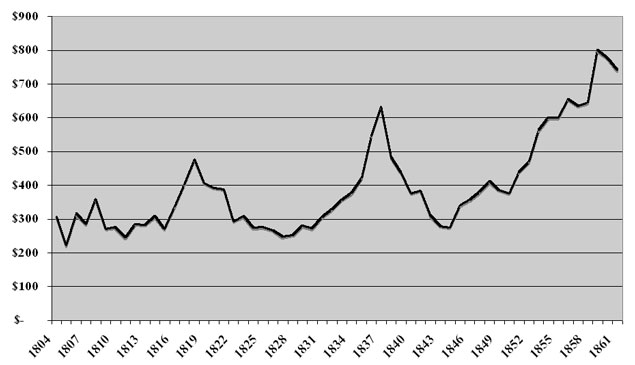
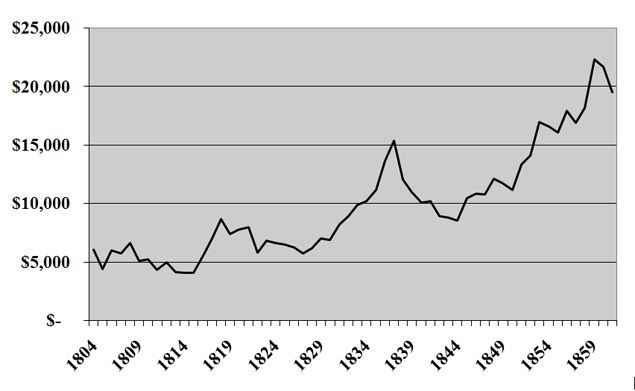
First, this paper by Samuel Williamson & Louis Cain cites data from the 5,000-page "Historical Statistics of the United States: earliest times to the present" on changes in the historical price of slaves.
I've been unable to find the original data (which would be fascinating), but a chart appears to show slave prices through 1863. If I'm not reading the chart incorrectly, the average price of a slave in nominal dollars peaked at $800 in 1861, and then fell slightly more than $50 until 1863, when the data ends. (In 2011 dollars, $800 is more than $20,000.)
Caveats:
Less sweepingly, there are some anecdotes from contemporary newspaper accounts about slave prices during the war — and more specifically, about falling prices.
In January 1863, a major Maryland slaveholder's estate was sold, and the New York Times reported:
The appraisers of the slave property of the late CHARLES CARROLL, of this State, one of the largest slaveowners in Maryland, have made their returns to the Orphans' Court, assessing the value of 130 slaves at an average of only $5 each. This, they say, was the highest rate they could name, after consulting with numerous slaveowners and dealers. One slavedealer told the Appraisers he would not give $500 for the whole lot. This is considered a striking illustration of the depreciation of slave property by the rebellion, and will have a powerful influence in this State.
Before the war, a single male slave in his prime could routinely fetch more than $1,000. This was in Maryland, which was not subject to the Emancipation Proclamation, but slave prices reflected sentiments that slavery was not likely to survive long — no one wanted to sink much money into "property" that might be forcibly liberated in a few years.
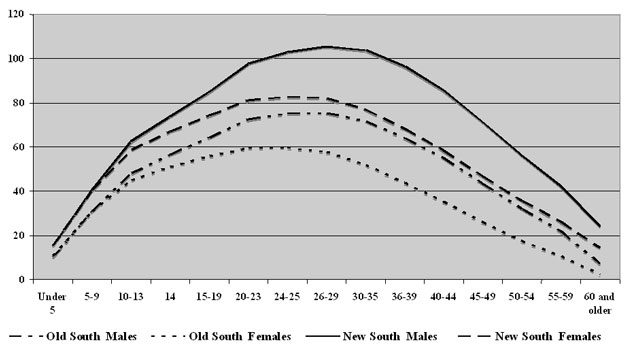
At the same time in the Confederacy, slaves were still being sold for prices similar to their pre-war levels. One receipt for a March 1863 sale shows a 26-year-old woman being sold for $1,600. That's a nominal price in Confederate dollars; by early 1863 it took three Confederate dollars to buy one gold dollar, so the real price is probably closer to $530. That's not too far off the 1850 prices; this table suggests a 26-year-old woman in the New South would have fetched around 75 percent of a male of the same age — implying that as a man, she'd have been worth around $800, or the average slave price.
A few months later, the New York Times analyzed slave prices in different parts of the country, and found they varied wildly:
The Times continues:
In the farther States of the Southern Confederacy we frequently see reports of negro sales, and we occasionally see boasts from rebel newspapers as to the high prices the slaves bring, notwithstanding the war and the collapse of Southern industry. We notice in the Savannah Republican of the 5th, a report of a negro sale in that city, at which, we are told, high prices prevailed, and at which two girls of 18 years of age were sold for about $2,500 apiece, two matured boys for about the same price, a man of 45 for $1,850, and at woman of 23, with her child of 5, for $3,950.
The Times them summarizes and adds an extremely important caveat:
Twenty-five hundred dollars, then, may be taken as the standard price of first-class slaves in the Confederacy; but when it is remembered that this is in Confederate money, which is worth less than one-twelfth its face in gold, it will be seen that the real price, by this standard, is only about $200. In Kentucky, on the other hand, though there is but little buying or selling of slave stock going on, we understand that negroes are still held at from seven to twelve hundred dollars apiece.
So to answer your question: Yes, slave prices did vary wildly, and the changing political and military situations did play an important role in determining how much a slave would fetch. In some areas (Maryland) prices plummeted; in others (Kentucky) they stayed steady, but sales became much rarer. The rebellious areas of the country saw continued slave activity; prices had fallen considerably from their peak but remained above rock-bottom when you adjust for the value of Confederate currency.
(It's also worth remembering that in the event of a Union victory, both slaves AND Confederate dollars were likely to become worthless.)
I hope that helped answer your question.
Edit: Formatting, fixing an unfortunate mistake
Follow up question: Was there a trackable market for slavery as a commodity? I know that the stock index wasn't really in widespread use until 1893, but was there a trackable market price for, lack of a better term, the slave commodity. Were there futures contracts based upon the trade? (As abhorrent a concept such as slavery can be, the economy is intriguing.)
I don't have an answer, but I have follow-up questions that are tied with this. How informed were the plantation owners, the regular people of the war? Could the slave prices fluctuate if communication between traders was much slower than now?
I'm sure that not everybody knew what was happening on the front and if they were actually winning or losing because of not wanting to release war secrets and possibly propaganda.
I'm European so I'm fairly uneducated about US history, sorry if my assumption is wrong.
Two follow-up questions: If these responses occurred, how did they differ between Confederate states and Union slave states? And what was the reaction to the Emancipation Proclamation in the Union slave states and Confederate-controlled territory?
Edit: in an economic sense, not a public opinion sense.
Corollary question. Were there ever any slave "bubbles"? As in were slaves ever seen as an asset that would hold much value?