Asking for a friend 😉
Edit: I know I can go drinking or whoring. I'm looking for experiences unique to Rome in the late Empire. Specific types of gambling, drugs, sex shows/acts, fights and wrestling, and other vices that I'm probably not creative enough to think of that the Romans definitely thought of. This question goes beyond just wine and sex. I was also interested to know what affect (if any) Christianity had on Roman vice and sexual promiscuity.
Edit: now I have gold to spend on debauchery! Thank you kind Redditor!
To a very real extent, the private lives of Romans is rather closed off to us. This is particularly true of the poor, but even of the rich, as biographical sources tend to overwhelmingly focus on the political careers of their subjects. To take one example, Julius Caesar has an early life that is to an extent unusually well documented--he lived in tumultuous times, and we have records of his meeting with Sulla, giving a speech for his fathers death, and being appointed (and unappointed) to an important priestly position, and making an alliance with King Nicomedes of Bithynia, all before he was twenty. It is a pretty remarkable set of teenage years and so we hear about them, and he later did some pretty remarkable things in his twenties such as court cases and pirate hunting that we also hear about. What we don't hear about is what he did on his days off, aside from shtupping the occasional political rival's wife, which I would honestly consider on-the-clock political work.
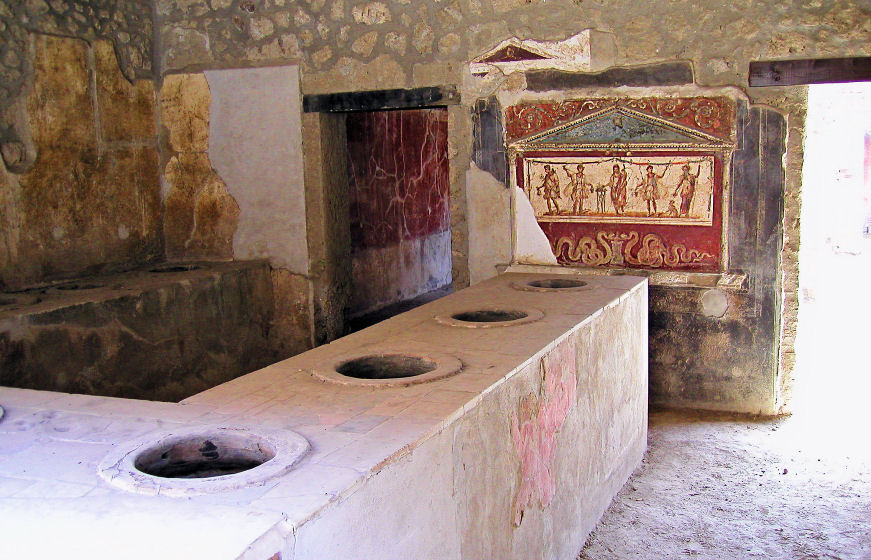
So when we talk about private, non-political life, we really need to toss aside many of our best sources and we rely heavily on mining other sources for details, particularly didactic moral sources, a handful of comedic sources, a few genres of poetry, etc. There is also archaeology, which similarly has some pretty fascinating insights (such as a sign outside a tavern that advertised prices for wine that, adjusted for daily wages, are roughly equivalent to what we pay per drink today, so you can put "public drinking/bars" on your list) but has some difficulty with telling us about individuals. It is great that we can see a Roman streetside countertop but who actually used it is a bit opaque. The standard answer is that those served a poor clientele, because the rich went to dinner parties, and while I suspect that has an element of truth, I also have no problem imagining young elite Roman rascals going into taverns, similar to white hipsters in the twenties hanging around Harlem. One intriguing bit of evidence to my mind is the graffiti of Pompeii a lot of which refers to taverns, drinking in public and general carousing. Literacy was probably more widespread in Rome than we might suspect, but I rather doubt it penetrated much more than 50%, and so the guy who scribbled about how he wanted to screw the barmaid was at least "middle class". Other ones also mention brothels and the like, and there is one passage from the famously upright and dour Cato the Elder in which he recommends going to a brothel rather than taking out one's lust on other men's wives, but also says not to go too frequently (I can't find a good way to show the passage, so here is a somewhat unwieldy Google Books link).
So drinking in bars and visiting brothels are open, but there is a significant complication with the latter, in that, to use an old distinction, there are prostitutes and there are courtesans, modeled after the Greek hetaera and somewhat analogous to yiji in China and the more formalized geisha of Japan. Essentially women who performed for men in a romantic but not necessarily sexual way, and were valued for their artistic abilities or skills in conversation. There is a lot of complexity here, but broadly speaking going to a prostitute might not just be a matter of sex. A powerful literary portrayal of this comes from Propertius' poetry set to Cynthia, who is somewhat gradually revealed to be this sort of courtesan. She is also implicitly referred to as unfree--I am somewhat revisionist on slavery in Rome as I tend to think people are far to ready to see slaves in things, but I suspect sex work in Rome was no more free of compulsion than it is today.
There are also dinner parties, which I suspect you are less interested in but certainly formed an important part of nightlife for the elite. And there is also general carousing and hellraising. Nero was said to wander the streets at night starting fights while he was emperor, and while this seems unlikely it implies that making trouble was something that young, aristocratic men did. Juvenal, who takes the literary persona of the poor, struggling intellectual, also notes that you need to be careful men with large retinues carrying torches and bronze lanterns at night. I am far from an expert, but I understand that in early modern Europe, particularly Florence, this sort of young, hellraising aristocrat was common, so I suspect something similar at Rome.
Hard to say much about gambling, but it did happen. Dice are a relatively common find.
To my mind the best readily available work on Roman daily life is Mary Beard's Fires of Vesuvius on Pompey, but she does take the traditional approach to "rich eat in, poor eat out" that I feel is worth complicated. Don't know a great source for that because the conclusion is my own (not that it is unique to me, I suspect), but Kristina Milnor's chapter in Ancient Literacies does a good job of talking about the grafitti of Pompeii. A lot of the rest is primary source, but I can point you in the right direction if you are curious on any given topic.
EDIT: I just saw your first edit. Not to disappoint, but the Romans were not actually masters of the subtle arts of debauchery. They certainly threw parties in which people got very drunk, but this happens today. They had bars, but we have bars. They had sex work, but sex work still exists today. The idea of Romans being particularly decadent is due to the conventions of Roman moralistic literature, as well as the interests of the monks who transmitted it, who cold use an image of a depraved pagan Rome as proof of the righteousness of Christianity. Probably the closest thing to what you are looking for is a description of the future empress Theodora, who began life as an actress, by the historian Procopius in Secret Histories 9:
Often, even in the theater, in the sight of all the people, she removed her costume and stood nude in their midst, except for a girdle about the groin: not that she was abashed at revealing that, too, to the audience, but because there was a law against appearing altogether naked on the stage, without at least this much of a fig-leaf. Covered thus with a ribbon, she would sink down to the stage floor and recline on her back. Slaves to whom the duty was entrusted would then scatter grains of barley from above into the calyx of this passion flower, whence geese, trained for the purpose, would next pick the grains one by one with their bills and eat.
A reference to the mythological story of Leda and the swan. Given another post that is currently popular, I think it s worth emphasizing again that while I do not think enslaved status can necessarily be assumed in sex work, it was certainly common, and even those who were not legally slaves were not free of compulsion.
EDIT2: I just woke up to a bunch of follow up questions, which I will try to get to when I am free later today.
Conversely, as a follow-up, what options would be available to a Roman Woman of the same period with a similar mindset?
Salve!
Hic est subredditus nomine AskHistorians. Habemus regulas multas. Responsa bona et longa requirimus.
Caveat shitpostor! Habemus autem "Malleus Bannificarum" et hunc malleum amamus.
Errata: Pro auro, aliene dulcis, gratias tibi ago.