To put it simply, there wasn't a power vacuum. The notion that the Western Roman Empire (WRE), declined and crumbled into ruin or vanished into a puff of smoke doesn't hold much weight. While there are dozens, if not hundreds, of theories and answers for why the WRE collapsed, one fact that many will agree with is that several strong and promising kingdoms waxed while the WRE waned. My personal thoughts, (and this is also one of the more popular theories today although many will disagree) are that Rome had certainly declined from its peak under the Antonines, but was still strong well into the fourth century. It would require external forces, namely the migrations and invasions of Germanic peoples, to expose weaknesses in the late Roman system and eventually push the WRE into collapse. While many crises during the 3rd century weakened the empire, a few highly capable Emperors: Diocletian, Constantine I, and arguably Theodosius I, were able to restore order despite setbacks during the 4th century.
To give a few examples of the state of the Empire at the death of Constantine in 337 AD: treaties (foedera) as used a regular way of raising frontier troops (federati) and supplement the depleted army; the currency is stabilized after being wracked by inflation; tax collection is improved with bureaucratic reforms; a new, considerably more defensible capital in Constantinople is established. At this point the empire is in good shape, unified under one Emperor and not confronted with large scale foreign or domestic conflicts. While nowhere near the heights of the 2nd century, the empire is stable and strong. Few would have guessed that in 73 years the eternal city, Rome, would be sacked and the Empire would be on the verge of collapse.
Over those 73 years, many different Germanic peoples would move into the empire, some with hostile intentions: Alans, Sueves, and Vandals; others with more nuanced motivations: the Visigoths and a little later, the Ostrogoths. These peoples battered the WRE with conflict on a massive scale. While the WRE was still strong, this mass migration started a series of events, combines with other factors internal to the empire, that eventually caused its collapse. When the WRE ceased to exist, these peoples founded kingdoms on former Roman land under strong rulers at the heads of strong armies. The battle of Adrianople is testament to the strength of just one of these groups, the Visigoths, who were able to wipe out a large professional army led by an emperor despite being outnumbered. If the Eastern Roman Empire was going to come for it's lands, it wouldn't be without a fight.
While some spend their entire careers studying these peoples and their histories it is not my area of expertise and I will only touch on them briefly. The Visigoths and Ostrogoths came into the Empire peacefully, seeking protection and land to settle. For a variety of circumstances too complex to cover here, the Visigoths were at some points at war with the Empire, and sometimes fighting on its behalf. For the purposes of this answer, what is important is the end result, the Visigoths settled in southern Gaul by the Emperor Honorius in return for military service. They created a vibrant kingdom, with its own written law code, and largely adopted the culture of those they ruled, including converting to Christianity. They also stayed loyal to Rome during this period, and even defeated the Sueves in Spain at the request of the Roman Emperor around 455-456 AD.
In roughly 473 AD the Ostrogoths moved into Imperial territory. They attempted to gain the recognition of the Eastern Roman Empire for protection and lands to settle. In 489 AD the Ostrogothic King, Theodoric, is sent into Italy at the request of the Eastern Roman Emperor Zeno. Theodoric defeats Odoacer who had deposed the last Western Roman Emperor in 476 AD. By 497 AD, Theodoric had conquered all of Italy and is formally recognized by the Emperor Anastasius.
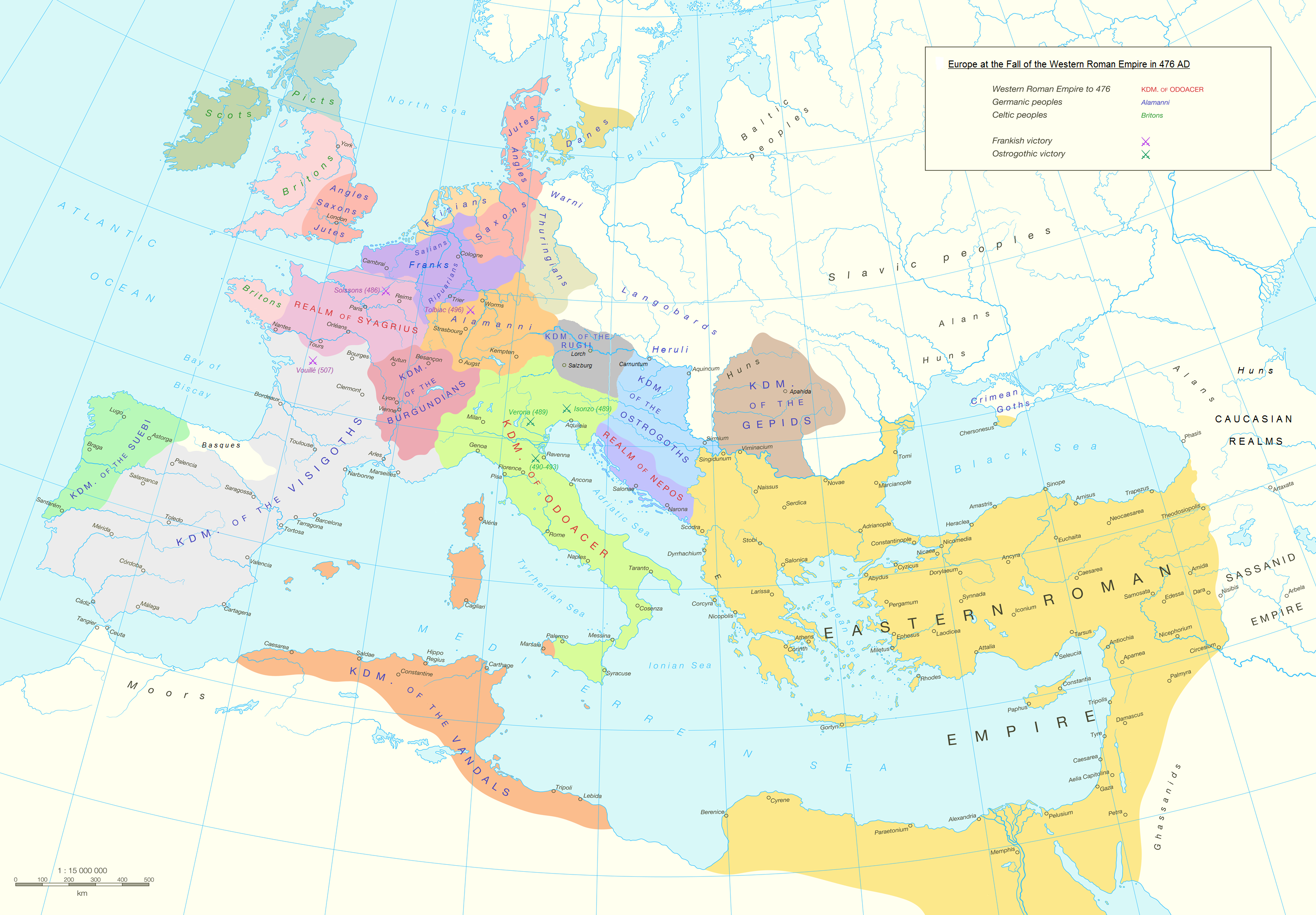
Maps of this time period are a bit silly to take too seriously but here's rough outline of the players involved when Romulus Augustulus is deposed as the last Western Roman Emperor in 476 AD:
https://upload.wikimedia.org/wikipedia/commons/0/0b/Europe_and_the_Near_East_at_476_AD.png
Now we can see a clearer picture of western Europe, there is no power vacuum, but instead a collection of several strong (and several less strong), independent kingdoms. These kingdoms have provided stability and protection to territory previously under constant attack and uncertainty. We can see that simply walking in and reclaiming the lost territory would be no easy task. Not only would a western offensive be difficult, the Eastern Roman Empire (ERE) was faced with one of Rome's strongest adversaries, the Sassanian Empire, in the east. Rising from the ruins of the Parthians, the Sassanian Empire was large, well organized and aggressive. The Sassanians were a constant eastern threat, occupying modern day Iraq, Iran, and parts of Turkey, Armenia and Syria. With such a large and powerful adversary on their borders, it was not possible for the ERE to devote their full attention west.
All of this being said, there were several attempts to reclaim lost Western territory. The most famous coming under the reign of Justinian I (527-565 AD). By 534 AD, Justinian's great general Belisarius had reclaimed Africa from the Vandals. Justinian exploited a succession crisis in a kingdom where the ruling aristocracy (the Vandals) were extremely unpopular with their former Roman subjects. These factors, along with Belisarius' brilliance, caused the territory to fall in a matter of months.
Italy would be a completely different story. Encouraged by his quick victory in Africa, Justinian ordered an immediate invasion of Italy in 535. While Belisarius won many battles and nearly completed the conquest by 540, a new Sassanian conflict caused Belisarius to be recalled and redeployed. This pattern of brief deployments, followed by recalls due to Sassanian aggression, rebellions, and plagues continued until the Eunuch general Narses was finally able to end the campaign and conquer Italy in 552.
The plague led to a complete demographic collapse in the east, nearly as severe as the Bubonic Plague (Black Death) that would devastate Europe 800 years later. Collapsing tax revenue, combined with the increased military requirements of eastern and western campaigns emptied the treasury.
A brief excerpt from Prokopios to paint the dire straits created by the plague,
During these time there was a pestilence, by which the whole human race came near to being annihilated.
The disease in Byzantium ran a course of four months, and its greatest virulence lasted about three. And at first the deaths were a little more than the normal, then the mortality rose still higher, and afterwards [the number of] dead reached five thousand each day, and again it even came to ten thousand and still more than that.
Three months, or ninety days, of the highest death rate comes to 450,000 if we take the 5,000 dead per day estimate. 900,000 dead if we take the 10,000 per day estimate. This is just in one city, so to think of the devastation is unimaginable.
After all of this, Justinian's newly conquered lands of Africa, Italy and parts of Spain would not contribute much wealth to the empire. Rebellions and Berber invasions in Africa, complete devastation from brutal conflict in Italy, it was much to overcome and the ERE did not hold onto these lands long enough to consolidate and rebuild. Despite these setbacks, the Empire endured for almost another thousand years beyond Justinian. The Romans, as they called themselves until the end, never gave up their will to reconquer what had been lost which I cover in this answer: https://www.reddit.com/r/AskHistorians/comments/67d2bk/at_what_point_did_the_byzantines_consider/
Sources
Amory, People and Identity in Ostrogothic Italy.
Thompson, The Goths in Spain.
Barnes, T. D., Constantine and Eusebius
Edward N. Luttwak, The Grand Strategy of the Byzantine Empire
Prokopios, The Wars
Thomas F.X. Noble, Late Antiquity: Crisis and Transformation
edit for clarity
In what sense? The Byzantine Empire was an important, albeit awkward, clumsy, and (mostly) declining power in the mediterranean for many centuries following the evaporation of the western half of the empire.
In 554, the Eastern Emperor Justinian was able to re-absorb Italy as well as parts of Spain and North Africa into his Empire. However, the Empire's chronic manpower problems, structural issues rendering it a less efficient power projector than in the past, and changing social, economic, and power dynamics in western Europe meant that soon after Justinian's death there was a long confrontation between the Lombardo/Italic aristocracy in Italy and the Greek-Speaking Byzantines, dividing Italy. Byzantine outposts dotted the Mediterranean: the "Romagna" or coastal strongholds held by Byzantium around the delta of the River Po ruled by the Exarch in Ravenna; the Duchy of Rome, in theory ruled by the Roman Senate under the protection the Exarch; and he deep south of Italy, whose inhabitants were predominantly Greek-speaking.
The Byzantine Empire continued to be an important player in the Central/Eastern Mediterranean until the late 8th century, when the Lombard King Desiderious kicked the Byzantines out of Italy.