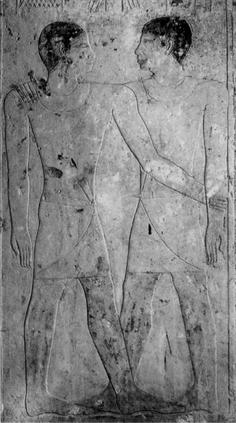
Here is the mural. Sorry about the quality, this was taken a few years ago inside one of the lesser tombs surrounding Giza. The paint seems to have eroded somehow (despite being inside) but it seems like they are both men, judging from the lack of breasts. According to the slightly sketchy 'tour guide' who showed it to us, the two fellows are 'good friends' and certainly not gay, despite the fact that they are clearly holding hands.
Edit: Here is another one from the same tomb that seems to show two men about to have sex, or a cop searching a guy who has 'assumed the position'
So, the first picture is from the tomb of Khnumhotep and Niankhkhnum, servants to the Pharaoh during the Egyptian Fifth Dynasty. There has actually been considerable scholarly debate as to whether this relief and others, like it suggest that the two men were in a homosexual relationship, or were close friends, or were brothers.
We don't know much about attitudes toward homosexuality in ancient Egypt, so it's really going to be speculative here, but there are several things that could push a historian either way. On the one hand, both of these men were buried together, yes, but they were also buried with extensive depictions of their wives and many children, suggesting that they were at least somewhat interested in heterosexual intercourse. On the other hand, the depiction of the two men nose-to-nose is suggestive of extreme closeness; there is some evidence that "Eskimo kissing" (rubbing of noses) was a form of intimate expression between lovers in Ancient Egypt, though, again, sources are rather scant.
Another theory is that the men are depicted as connected physically because they literally were -- in other words, they were conjoined twins.
As for the second picture, this does not look like someone about to perform a sex act. Both men depicted are clothed. There is an unfortunate discoloration near the rear man's knee that looks rather phallic, but the front man's bent-at-the-waist posture is quite common in depictions of workers, especially field workers, in Egyptian murals, and it is further quite common to have an upright person (an overseer) standing behind the bent-over worker, implying domination or at least supervision. There is not necessarily anything sexual (or law enforcement related) going on here.
Sources:
Parkinson, Richard: Homosexual Desire and Middle Kingdom Literature in The Journal of Egyptian Archaeology
Oakes, Lorna: Pyramids Temples and Tombs of Ancient Egypt: An Illustrated Atlas of the Land of the Pharaohs (2003)