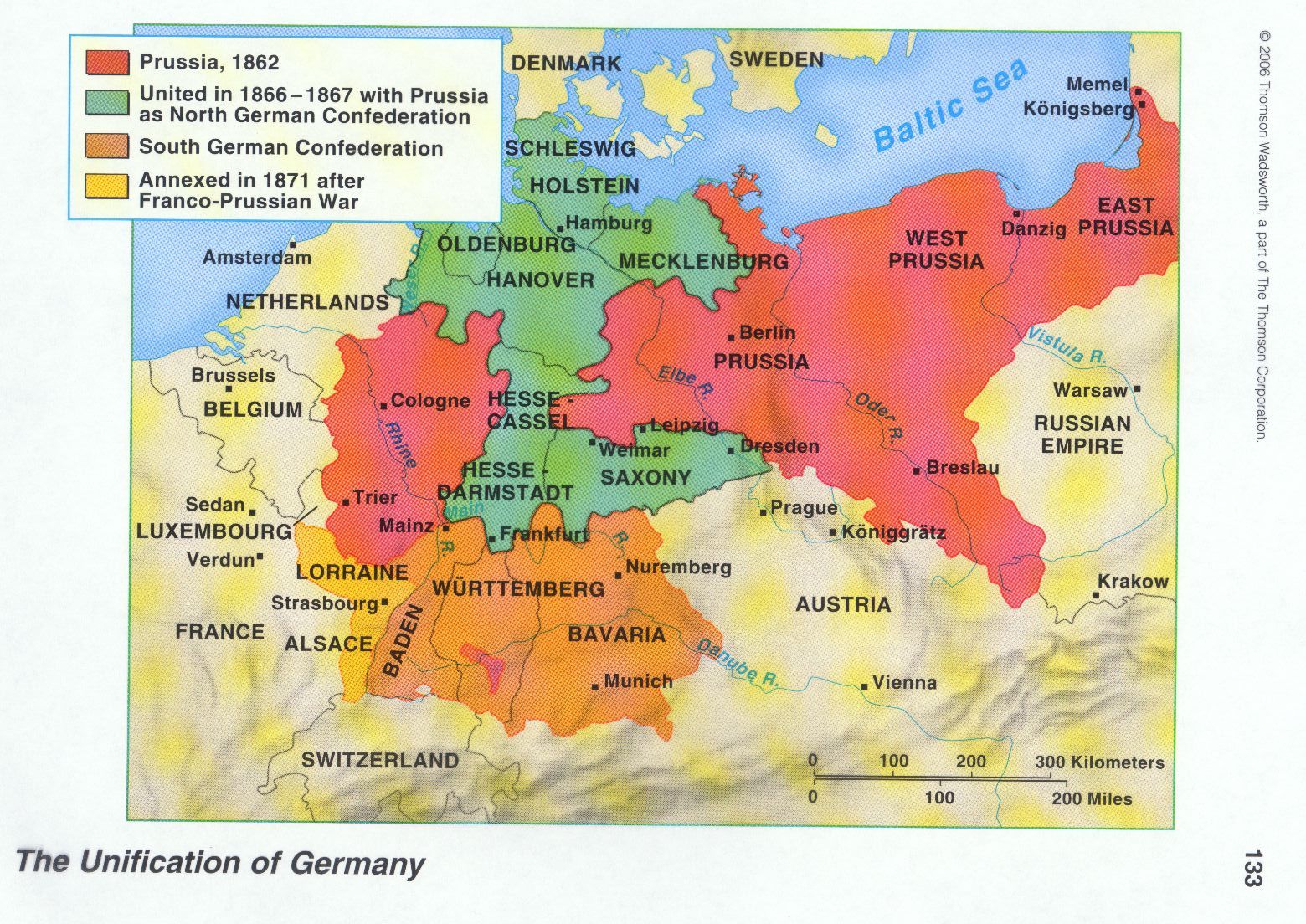
German unification is a complex story but there are a number of misconceptions in this question that need to be cleared up. Firstly, Austria did not really "get" southern Germany, which is generally taken as the Baden, Württemberg, and Bavaria, all of whom ended up in the German Kaiserreich in 1871- see this map. The main German territories that would remain in Austria were in Cisleithania, seen in this map in red. This area was not wholly German, with most German-speakers were clustered in Austria, Tyrol, and the Sudetenland, as seen in this map of the Empire's languages. Secondly, while Prussia did annex Hanover, Hesse, Nassau, and Frankfurt am Main in the Wars of German Unification, the Kaiserreich was a voluntary union. Granted, the monarchs and rulers of non-Prussian Germany had no alternative to reject the federal union, but they still possessed considerable leeway in shaping the structure of the emerging German state. Bismarck was too canny a politician to stomp on all local privileges and a number of these German states recognized that a federal union was beneficial to their own interests.
Going into the meat of the question, German unification never proceeded on a straight line in the years after the Congress of Vienna. There were a number of different proposal percolating between 1815 and the 1860s for a unified German state. Broadly speaking, the debate over unification in the first half of the nineteenth century ranged between two poles called Kleindeutschland (lesser Germany) and Großdeutschland (greater Germany) solutions. In general, the Kleindeutsch position stressed that Germany should unify as a political entity consisting of the core German states. These central European states were allegedly ethnically and linguistically homogeneous (on the ground, the various German states were far more diverse, but nationalist activists often overlooked this). The partisans of Großdeutschland argued for a larger expansion of Germany into regions where there were large German minorities like Bohemia. The political conditions in Europe in the mid-nineteenth century tended to favor the Kleindeutsch solution. Incorporating Austria into a future German state would have meant adulterating this new German polity because in addition to Austrian Germans, the Austrian Empire contained many Slavs and other non-Germans. One of the big sticking points of the Paulskirche debates about German unification in 1848 was whether the Austria empire could be incorporated into a new German union given the size of its non-German population in places like Bohemia. The only real practical solution to this impasse would have been a real or de facto dissolution of the Austrian empire, which the Habsburg emperor would not permit and would invite outside intervention by France and Russia. Therefore Großdeutsch and pan-German activists in the nineteenth century often saw the old imperial house as a barrier to their aspirations to unite the whole German cultural sphere.
But a Kleindeutsch solution was not a straightforward alternative either. The small German states emerged from the Napoleonic Wars as both enlarged polities with modern administrations and armies. While kingdoms like Bavaria, Saxony, or Württemberg were not strong enough to lead their own unification drives, they were large enough to be an impediment to a Prussian-led unification. One of the defining characteristics of Prussia's post-1848 German diplomacy was to try and find a way to corral southern and north central Germany under Prussian leadership. One pre-1848 institution, the Zollverein (customs union) was successful in cementing Prussian control over the Central European economy, although states like Bavaria were quite resistant to these economic integration. Other Prussian initiatives were less successful. One of Bismarck's hopes was to unify Germany under confessional lines. As a staunch Lutheran, Bismarck was leery of incorporating too many Catholics into a Prussian-dominated polity. One of Bismarck's schemes during the Crimean War was a proposal that Austria and Prussia divide up Central Europe along the Main River leaving Prussia with the mostly Protestant northern half of the German Confederation. While this proposal went nowhere, it does speak to Bismarck's initial reluctance to include sizable numbers of Catholic Germans under Prussian control. Such confessional divisions were a non-starter. For one thing, the Habsburgs were not eager to play this game and saw Prussian domination of the Confederation as inimical to Austrian interests. Additionally, the southern German states did not relish being pawned off either and tended to play both sides while favoring Austria.
The Wars of German Unification helped solve these political impasses for a German state by both cementing Prussian hegemony and forcing the southern German states to heel. But even here it was not a foregone conclusion that the southern German monarchs would accept Prussian overlordship. Bavaria in particular proved to be quite troublesome during the negotiations for the German union in 1871 and Bismarck had to use a combination of threats and inducements to bring the Wittelsbachs to declare Wilhelm I emperor. The resulting German constitution did cede a good deal of local autonomy in the federal union even though Prussia was by far the largest and most important member of the German states.
Outright annexation was never really an option in this political context. The dissolution of the middling central German states in the 1860s was as far as Bismarck could go, and even there he had to cede a degree of local control. A hyperaggressive Prussian annexation drive would not only stiffen the resistance on non-Prussian Germany to unification, but it would be counterproductive. As an archconservative, Bismarck was not in the habit of disestablishing monarchs or setting dangerous precedents. This would not only bad politics for central Europe, but would also put him at odds with his very traditionally-minded master Wilhelm I. Moreover, preserving the German monarchies would not only ease unification, Bismarck placed great hopes that such traditional institutions would act as a firebreak for unsettling modern political developments like mass politics and liberal democracy. One of the hopes of Bismarck was that the survival of these traditional institutions would channel modernity into more controllable forms.
One of Bismarck's famous phrases was that one cannot make a wave, one can only ride it. This aphorism was particularly apt for German unification. None of the major actors created the conditions for unification and were often at the mercy of developments. Bismarck's adroit manipulation of chaos gave the appearance he was in control of things which in turn made it look like the Kaiserreich was a historical inevitability, when in reality things were far more fluid.