Hi everyone
A local newspaper made an article on two crossbow loaders that were found in a neighboring city.
Aside from the fact I have a question about it, I think I should put it here as well because according to what's said in the article it's quite a good find and might interest some of you. (to clarify, it's not these small forked objects, it's a huge thing)
Here is the link to the article (no paywall), it is in French.
I will write down there a full translation of the digital article in case you're curious, just skip it otherwise, my question isn't answered by the article.
Beginning of article
Two crossbow loaders from 1353 found in Sion
image label: The object now exhibited in history museum allowed to load knight's crossbows
Middle Ages: recent studies allowed to shed light on pieces that were found in the Valère arsenal, crossbow loaders built in Winter 1353.
We thought these were catapults. Two pieces of wood were "sleeping" (kinda weak translation but whatever you get it) in the cantonal depots for quite a while. When the arsenal was inventoried, a hundred years ago, we had labelled them as simple catapults. Until the day where an archeologist and German historian, Fabian Brenker, turns his interest to it. According to him, it is not a catapult but a crossbow loader. "I knew of the existence of this object from the literature, but never, to my knowledge, had we found one in real life."
Without waiting, he makes contact with the cantonal museums and goes to Sion. Thanks to his analyses, he manages to determinate the precise date of creation of the object. Winter 1353. The loader although imposing and difficulty transportable, was essential to the knight. Before every shot, this man had to reload his weapon.
From shadow to light
the preservation of these objects is a miracle. "They could have been used to make a fire, says Fabian Baker. The fact they still do exist demonstrates of their value." Their identity found again, the most beautiful of the 2 pieces is today out of the shadow. She has made her entrance in the museum of history where it proudly sits at the entrance.
End of article
(The digital article is smaller than the paper one I have, but the only real difference is that it mentions that it was too heavy to carry around so was probably used for defense of static positions such as towns, the rest of the paper article is really not that interesting)
My questions :
Why did we need this ?
I mean from what I've always seen/read/heard on crossbows, I know they're a pain to reload but I thought that you could always do that with both your hands or with a crank for some. Isn't that ineffective to have to line up/move to the location of the loader and wait for your turn to reload this ? Or did there exist crossbows so powerful you couldn't actually reload them by hand ? Was it because it was too early to have cranks invented ? Because it's cheaper than cranks ? Because it's making it less hard on your body to sustain longs periods of using this weapon ? Because there's less risk of harm to yourself when you reload it this way ?
Googling around, I couldn't even find another picture or mention of static crossbow loaders, whether in French or English, looks like a really niche thing so I guess it was far from extremely useful ?
I appreciate you reading this far and hope you'll have useful answers :)
(And it looks like knights where I used to live didn't care much about the whole "no range kills" thing, just noticing by the way)
Thanks for bringing this to our attention, it's really interesting. In an unfortunate twist of fate, I'm currently visiting my parent's for a week, and I don't have access to all of my research materials. As a result, I can't do the proper research this question deserves right now. I'll try and offer an answer based on what I think off-hand right now, but if you ask again in a week (or I remember to come back to this thread) I can probably give you a much more detailed answer.
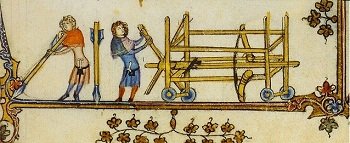
From looking at the pictures, and the article you helpfully translated, I think that's a crossbow-spanning bench, not devices for loading crossbows. The terminology is kind of vague, so it's easy to confuse them, but the short version is this: benches like these were used to string crossbows, not reload them. Putting the string on a really powerful crossbow was extremely difficult, they are designed to be hard to bend after all, and well beyond the ability of human power alone. Benches like these were common in crossbow-makers workshops, where they would be used to put strings on new crossbows, or remove them from crossbows needing repairs. The pictures above show how the crossbow would be placed on the device, and usually there would be a large cranking device mounted on the side of the device that would be used to pull the string back. There are a few ways this could be done, but usually it was by using a longer string, which was attached to the arms and used to pull them back to the point where the shorter, actual string, could be placed on the weapon. I'm not aware of any examples surviving, although I had assumed there would be one or two, but they appear relatively frequently in medieval and early modern pictures depicting crossbow making (there aren't that many of them, sadly). Unfortunately, I can't remember the exact names of these images right now, so my searches are coming up blank. I have copies of them in my house, but that's sadly some distance away from me right now!
The other likely possibility is that this is the base to a rampart crossbow. It's hard for me to gauge it's size exactly, but if it's enormous, than this is very possible. A rampart crossbow is basically a slightly smaller ballista. There's a technical difference as well, ballista are powered by torsion, while a rampart crossbow is just a really big crossbow, so it's powered by tension in the bow. If this is a base for a rampart crossbow, the crossbow would have been a constant part of the weapon, only removed if it broke or needed repairs. This would essentially be a piece of siege weaponry, designed to be operated from a fortified position, and not a device that soldiers used to reload their personal crossbows. There's a picture of this kind of weapon in MS 264 in the Bodleian Library