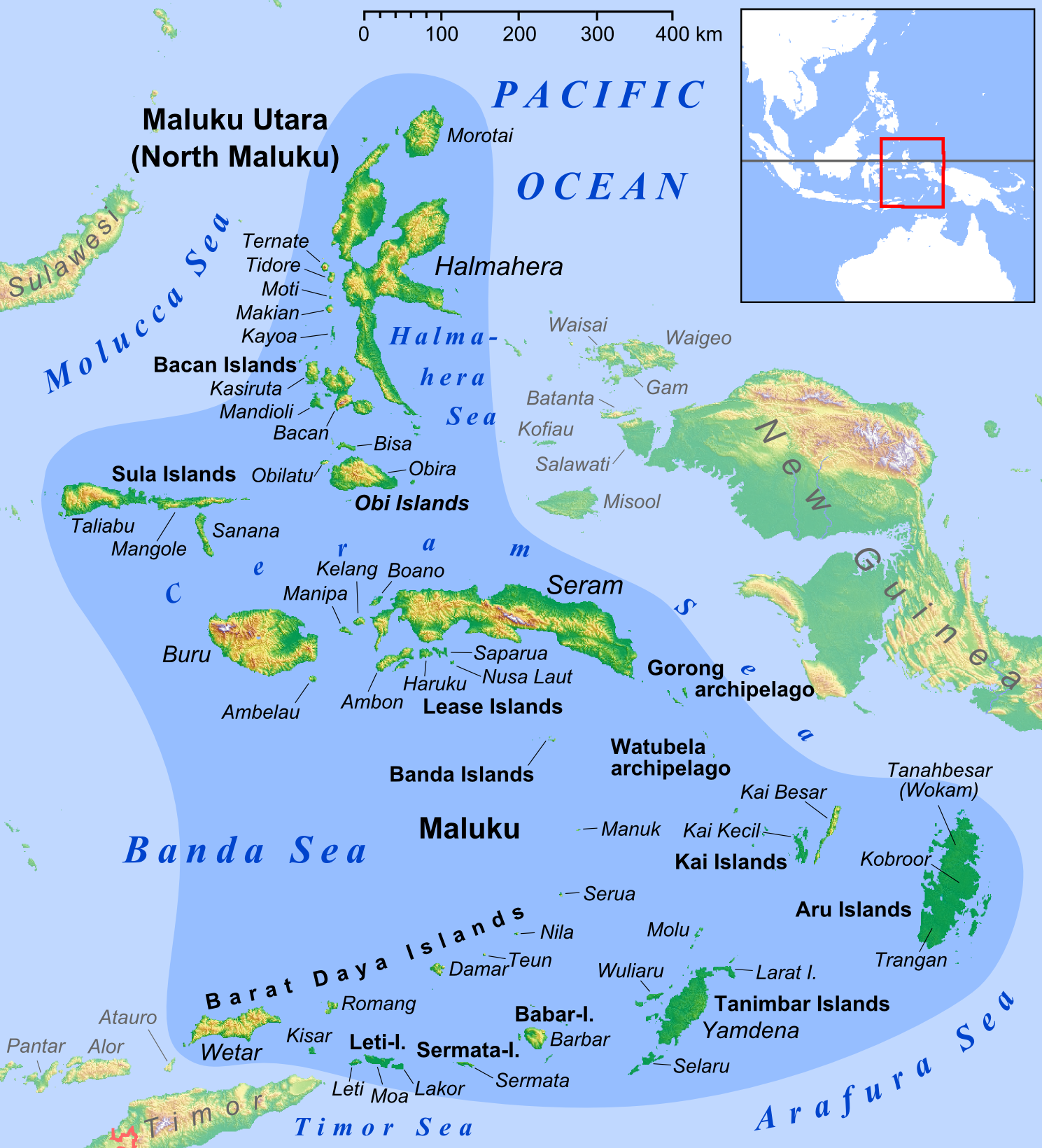
As I was reading some pages of Native Peoples of the World: An Encylopedia of Groups, Cultures and Contemporary Issues by Steven L. Danver, I came to this passage.
The Maluku Islands (also known as the Moluccas or the Moluccan Islands) are famous as the Spice Islands. Originally, the population was Melanesian; however, many people were killed during the Spice Wars of 1600s. During the Dutch colonization of Indonesia, a significant number of Austronesian immigrated to the Maluku Islands.
Exactly how did the Dutch colonial authority replace the original Melanesian population with outsiders and are there any original Melanese population today in Maluku Islands?
That encyclopedia is pretty wrong there, but then many encyclopedias are.
So the primary question here is that of terminology. "Austronesian" is a well-defined term referring to those peoples who speak the premodern world's most widespread language family, ranging from the kings of Madagascar to subantarctic hunter-gatherers. Melanesia is a rather vague geographical term, much of which is inhabited by Austronesians. So the two aren't exclusive terms in any way.
What this encyclopedia seems to be doing is rather misleadingly referring to Papuan language speakers as "Melanesian." Now, "Papuan" is another awfully vague term that basically means "Melanesian languages that aren't Austronesian."
So with the confusing terminology out of the way, let's answer your question. Is it true
Your question about whether there are any "Melanesian" peoples today in Maluku has a very simple answer: a resounding yes. The basic fact of Maluku linguistics is that the islands are divided between Austronesian and non-Austronesian languages, which have borrowed so extensively from each other to the point that some linguists have trouble differentiating between the two. One small island is even split in half between an Austronesian and a non-Austronesian language.
Even today, both types of languages are going strong. The non-Austronesian Halmahera languages are particularly widely spoken today by as many as 200,000 people,^1 although the eclipse of the old kingdoms and the influx of outsiders have shaken up the situation a bit. Even Abdul Ghani Kasuba, the current governor of North Maluku, is from a town that traditionally speaks the Halmahera languages of Galela and Tobelu. In fact, official statistics show that the three largest local ethnicities in northern Maluku are either Papuan (Ternatens, Tidorese) or half-Papuan and half-Austronesian (Makianese). There are plenty of non-Austronesians left in the Spice Islands.
The basic fact of Maluku linguistics is that the islands are partitioned between Austronesian and non-Austronesian languages, and have been so since at least the 16th century. So who was here first?
This question looks like it should be simple to answer, but it's not. Let's start with the Austronesians, who we're more sure about. Most linguists believe that the Austronesian languages originated in Taiwan or southern China.^2 This means that all Austronesian speakers outside Taiwan are immigrants or adopted elements of immigrant culture. This would seem to suggest that the original inhabitants were indeed "Melanesians" and that the Austronesians were the newcomers. Indeed, Maluku has been populated for tens of thousands of years, but archaeological evidence suggests that the Austronesians first arrived in northern Maluku only around 1300 BC.^3
On the other hand, remember that the Halmahera languages, the main non-Austronesian languages spoken in Maluku today, are almost certainly related to a number of languages spoken in western New Guinea. It's fully possible that the Austronesians came first around 1500 BCE and was then succeeded by Papuan migrants from the New Guinea coast.
Overall, archaeologist Peter Bellwood favors the view that the Austronesians did indeed come later. There was a sudden intensification of human activity around 6000 BC, possibly including the introduction of New Guinean agriculture, and his argument is that this stymied Austronesian settlement and ensured that Maluku would retain large Papuan populations.^4 Nevertheless it's hard to definitively say that the Austronesians were the newcomers.
Now, the final part of your question. If the "Melanesians" did not go extinct, and if they might not have been the original inhabitants anyway, why does this encyclopedia talk about the Dutch replacing the native population with Austronesians? The answer lies in the political strategies of the Dutch East India Company (VOC) in Maluku.
The primary goal of the VOC in Southeast Asia was to create and enforce a monopoly on certain luxury goods so that they could manipulate prices to their heart's content. Tragically, the "fine spices," all of which are endemic to Maluku, proved to be virtually the only product for which this dream was achievable - albeit at a bloody cost.^5
Why did this Dutch project involve so much blood? The conflict lay in the fact that the Dutch generally could not compete with Asian merchants unless they had a monopoly on a certain good. But the spices that the Dutch thus sought to monopolize were also the economic bloodline of the peoples of Maluku. The economy was centered on a system of reciprocal exchange in which the ruler collected spices from the people in return for distributing the trade goods earned by selling these spices.^6 In areas where local kings were strong, the Dutch tried to circumvent this system by paying the kings money in return for losing their rights to the spices. The kings actually liked this because they now had unlimited access to trade goods in the realm, whereas the old system meant local nobility could sell spices and engage in trade on their own terms. But to normal people, it meant that they were now at the total mercy of the kings and the Company for basic goods like cloth or rice.
But this doesn't really resemble what the encyclopedia talks about. Rather, the encyclopedia's wording about population replacement is almost certainly a reference to Dutch policies in areas without strong monarchies. The most famous example of this is the near-total genocide of the Bandanese. The Banda Islands in southern Maluku happened to be the only source of nutmeg and mace in the entire world. Unfortunately, the Bandanese rejected the notion of kingship, they were ruled by a council of wealthy merchant chiefs (orang kaya, literally "rich men") who each commanded his own band of followers. From 1602 to 1621, the Dutch constantly attempted to enforce their monopoly on the hundreds of orang kaya and consistently failed. Finally, the Dutch governor proclaimed:
One cannot hope for anything certain from that nation unless they be once and for all brought under control by warfare.
In 1621 the VOC conquered Banda with a massive military force. Forty-five orang kaya were captured and beheaded. Out of the 15,000 Bandanese, eight hundred were sold as slaves in the Dutch colonial capital of Batavia and a few hundred more were spared so they could teach the Dutch how to care for the spice plants. Some 1,000 escaped. The rest - more than 10,000 men, women, and children - were all killed or left to die in the inhospitable wastes of the archipelago.
The Bandanese population in the Banda Islands itself, already reduced to a few hundred slaves in 1621, continued to collapse under brutal Dutch plantation slavery. By 1681 less than two hundred Bandanese were left; by the early 18th century the population was extinct. Instead, the nutmeg and mace were produced in plantations run by Dutch entrepreneurs and worked by 4,000 badly mistreated slaves. Every year around 200 slaves had to be imported from all around the world (including from Africa!) just to maintain this population of four thousand, since ruthless Dutch policies meant that people didn't have children and the age distribution of the population went way off balance. In traditional Maluku societies children represented around 38% of the population, while less than 9% of Banda's slaves were children.^7
Thankfully, the Bandanese genocide was not complete. While the Bandanese have been extirpated from their original homeland, there are two villages in Kai Besar Island (map showing Maluku) where Bandanese continues to be spoken. Nonetheless, the Bandanese genocide remains one of the most bloody events of the Early Modern era.^8
But the Bandanese were Austronesian speakers, albeit a very mixed population. Non-Austronesian speakers lived mostly in northern Maluku, particularly under the control of the powerful sultanates of Ternate and Tidore. As I mentioned above, in moderately centralized realms the Dutch governed through proxy sultans. In the case of northern Maluku, rulers had long collected spices through a corvee system. Now the Dutch made them destroy spice plants through this exact same system so that only Dutch-owned plantations would have these spices.^9 Was this a burden? Yes. Did this result in any major population transfer from Papuan to Austronesian? No, not at all; if anything, the native proportion of the population may have increased due to the decline in trade. Rather, the currently sizable number of non-native Austronesian speakers in Maluku has more to do with distinctly modern developments as Indonesia consolidates into a single nation-state.